
A Fine Anthology, a Peek Inside the Mind of Mycroft, and a Drood Who Isn't Edwin. Also a Preview of Coming Attractions from Yours Turley
In recent months, I've been researching and writing my next story for Sherlock Holmes and the Crowned Heads of Europe, to be entitled "The Case of the Dying Emperor." For anyone who might be interested, here is Dr. Watson's introduction:
"With the horrors of the Great War still fresh in our memories, it seems strange to recall that Great Britain’s relations with Imperial Germany were not always marked by mutual antipathy. Indeed, for much of my lifetime, our traditional European enemies were France and Russia; with the new German Empire, we shared both a common racial heritage and close dynastic ties. The events I shall narrate fatefully transformed that relationship, beginning a quarter-century of rivalry and tension that eventually would lead to war. Naturally, there were many other causes of the breach, but those I shall leave to the historians. In a symbolic sense, the change occurred with the untimely passing of one German Emperor, Frederick III, and his succession by another whose name became anathema in our new century. This was, of course, 'The Kaiser,' William II, who led his empire to destruction and engulfed all Europe in its ruin.
"The case was also a beginning for my friend Sherlock Holmes, initiating an anti-German espionage campaign that would occupy him, intermittently, until the very night the war began. Unmasking the plot behind William’s unforeseen accession was the first of Holmes’ diplomatic missions in which I was permitted to take part. For almost forty years, my notes on this case have languished in my tin dispatch box. . . ."
While studying the contents of that dispatch box, I have been eagerly awaiting the next two volumes of MX Publishing's ongoing anthology of traditional pastiches. Part VI, which debuts on May 22, includes "A Scandal in Serbia," one of my other stories from Crowned Heads. Part VII, due out in the fall, will contain "A Ghost from Christmas Past," my account of Dr. Watson's little-known--and sadly brief--first marriage. (No, dear Mary Morstan, you were not the first.)
Meanwhile, I've made a feeble stab at keeping current with other people's work. Here are my reviews of two Holmes-related publications, plus an older book that has some relevance to fans of Conan Doyle, even though it's set earlier and involves two other famous writers.
 Holmes Away From Home, Adventures From the Great Hiatus Volume I: 1891-1892 Volume II: 1893-1894
My rating: 5 of 5 stars
Having read and enjoyed Beyond Watson, the first anthology from Belanger Books, I took up this collection, which unveils the mysteries of “The Great Hiatus,” with great anticipation. Happily, the two volumes, edited by David Marcum, are even better than their predecessor. There are very few weak entries, and many of the stories are outstanding. My personal favorites were: Craig Janacek’s “The Harrowing Intermission” and Mark Mower’s “The French Affair,” in both of which Watson employs his medical expertise to solve the case; S. Subramanian’s “The Incident at Maniyachi Junction” and Daniel D. Victor’s “For Want of a Sword,” based on two compelling historical events; Marcum’s “The Adventure of the Old Brownstone,” which passes to another famous sleuth; and Richard Paolinelli’s “The Woman Returns” (no Holmes fan should need to ask which woman), a nicely plotted tale that remains true to the characters depicted in the Canon. Other stories by Deanna Baran, S.F. Bennett, Sonia Fetherston, Jayantika Ganguly, John Linwood Grant, and Shane Simmons are almost equally well done. Marcum offers enlightening introductions to both volumes, and—just for context—the new stories are bracketed by Conan Doyle’s originals that began and ended “The Great Hiatus.” Given its quality, one might justly consider Holmes Away from Home the last word on these “lost years” of Sherlock Holmes’ career. While more tales will surely follow, this anthology serves as a model to which they can aspire.
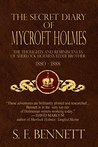 The Secret Diary of Mycroft Holmes: The Thoughts and Reminiscences of Sherlock Holmes's Elder Brother, 1880-1888 by S.F. Bennett
My rating: 5 of 5 stars
Devon-based Sherlockian S.F. Bennett, the author of several excellent short stories for MX Publishing and Belanger Books, has taken on the task of editing the long-lost diaries of Mycroft Holmes. Her initial volume (let us hope the first of many) begins in 1880. At 33, Mycroft has already founded the Diogenes Club and is well on his way to becoming both curmudgeon and gourmand. However, he is not yet the éminence gris at Whitehall that he will soon become. At this stage, therefore, Mycroft’s diary entries focus not on great events but on retaining his position, avoiding the marital ambitions of his cleaning lady, and surviving the variable offerings of his club’s chef. Naturally, it is his feckless, financially dependent brother (still “playing the game for the game’s sake” in the Montague Street years) who comes to dominate the diary. Ms. Bennett skillfully traces the often prickly—but invariably amusing—relationship between the siblings, as Sherlock glibly defends his amateur status (“What value can a man assign to knowledge?”), Mycroft glumly hosts the redoubtable Toby (“I am not my brother’s dog’s keeper”), and senior bests cadet in “our usual game of observation and deduction.” Occasionally, they must unite to fend off other members of the Holmes clan, for Mycroft and Sherlock are (remarkably!) the least eccentric of the lot. By the time the volume ends in 1888, it is evident that both their characters have grown. Mycroft may empathize with Mrs. Hudson over her tenant’s many faults, but he also rebukes Lestrade’s ingratitude at receiving Sherlock’s aid. Our emotionally aloof detective makes a touching gesture to spare the feelings of his first true friend, whose merits Mycroft has already recognized. Along the way, they combine their talents to solve at least two cases, including the Melas affair that marks Mycroft’s first appearance in the Canon. Now that her groundwork has been laid so well, we can trust Ms. Bennett to treat the manifold crises of the 1890’s, and Mycroft’s political and diplomatic work at Whitehall, with the same humor and knowledge of her characters that she exhibits in this book.
 Drood by Dan Simmons
My rating: 4 of 5 stars
Sherlockian scholar David Marcum has noted that only a single generation separates the world of Charles Dickens from the world of Conan Doyle. That fact is evident in Dan Simmons’ literary horror novel Drood, for its characters (most prominently an Iago-like Wilkie Collins and his hero and nemesis, the more famous Charles Dickens) haunt the same dismal London alleys to be prowled, a decade or two later, by Sherlock Holmes, Inspector Lestrade, and Jack the Ripper. Moreover, Collins’ private investigator from The Moonstone, Sergeant Cuff, preceded Doyle’s creation by some nineteen years, while Cuff’s real-life model, Charles Frederick Field, was borrowed even earlier for Bleak House. Obviously, finding Conan Doyle connections is not Dan Simmons’ point; nor is his monster Drood (a very different being than the feeble Edwin in Dickens’ last, unfinished novel) really the point either. Rather, Drood is at its heart a long—much too long, alas—meditation on the corrosive effects of hubris, envy, misogyny, and other typically Victorian failings. The book exhibits the same virtues as The Terror, Simmons’ 2007 re-creation of the lost Franklin Expedition, e.g., exhaustive research, marvelous scene-setting, well-developed characters, and the understanding that (as Stephen King would tell us) true evil arises less from outside forces than within ourselves. Yet, whereas Simmons had the vast Arctic for his canvas in The Terror, Drood plays out in the drawing rooms, theaters, graveyards, and—yes—even sewers of London. This more restricted setting accentuates the novel’s flaws. There is simply not enough plot here for eight hundred pages, and the story bogs down much too often as the author regurgitates factoids turned up in his research. Yet, those who persevere with Drood will be rewarded, for its final twist takes a step back from the supernatural and rises to real pathos. Along the way, readers will learn a great deal more of “The Inimitable” and the author of The Moonstone than they probably knew before. Sadly, that knowledge may prove somewhat disillusioning, for Simmons reminds us that immortal authors were not always admirable men.
This may or may not be enough to keep you busy until Crowned Heads goes to press, but at least it's a start. In the meantime, I'll get back to work!
"With the horrors of the Great War still fresh in our memories, it seems strange to recall that Great Britain’s relations with Imperial Germany were not always marked by mutual antipathy. Indeed, for much of my lifetime, our traditional European enemies were France and Russia; with the new German Empire, we shared both a common racial heritage and close dynastic ties. The events I shall narrate fatefully transformed that relationship, beginning a quarter-century of rivalry and tension that eventually would lead to war. Naturally, there were many other causes of the breach, but those I shall leave to the historians. In a symbolic sense, the change occurred with the untimely passing of one German Emperor, Frederick III, and his succession by another whose name became anathema in our new century. This was, of course, 'The Kaiser,' William II, who led his empire to destruction and engulfed all Europe in its ruin.
"The case was also a beginning for my friend Sherlock Holmes, initiating an anti-German espionage campaign that would occupy him, intermittently, until the very night the war began. Unmasking the plot behind William’s unforeseen accession was the first of Holmes’ diplomatic missions in which I was permitted to take part. For almost forty years, my notes on this case have languished in my tin dispatch box. . . ."
While studying the contents of that dispatch box, I have been eagerly awaiting the next two volumes of MX Publishing's ongoing anthology of traditional pastiches. Part VI, which debuts on May 22, includes "A Scandal in Serbia," one of my other stories from Crowned Heads. Part VII, due out in the fall, will contain "A Ghost from Christmas Past," my account of Dr. Watson's little-known--and sadly brief--first marriage. (No, dear Mary Morstan, you were not the first.)
Meanwhile, I've made a feeble stab at keeping current with other people's work. Here are my reviews of two Holmes-related publications, plus an older book that has some relevance to fans of Conan Doyle, even though it's set earlier and involves two other famous writers.
Holmes Away From Home, Adventures From the Great Hiatus Volume I: 1891-1892 Volume II: 1893-1894My rating: 5 of 5 stars
Having read and enjoyed Beyond Watson, the first anthology from Belanger Books, I took up this collection, which unveils the mysteries of “The Great Hiatus,” with great anticipation. Happily, the two volumes, edited by David Marcum, are even better than their predecessor. There are very few weak entries, and many of the stories are outstanding. My personal favorites were: Craig Janacek’s “The Harrowing Intermission” and Mark Mower’s “The French Affair,” in both of which Watson employs his medical expertise to solve the case; S. Subramanian’s “The Incident at Maniyachi Junction” and Daniel D. Victor’s “For Want of a Sword,” based on two compelling historical events; Marcum’s “The Adventure of the Old Brownstone,” which passes to another famous sleuth; and Richard Paolinelli’s “The Woman Returns” (no Holmes fan should need to ask which woman), a nicely plotted tale that remains true to the characters depicted in the Canon. Other stories by Deanna Baran, S.F. Bennett, Sonia Fetherston, Jayantika Ganguly, John Linwood Grant, and Shane Simmons are almost equally well done. Marcum offers enlightening introductions to both volumes, and—just for context—the new stories are bracketed by Conan Doyle’s originals that began and ended “The Great Hiatus.” Given its quality, one might justly consider Holmes Away from Home the last word on these “lost years” of Sherlock Holmes’ career. While more tales will surely follow, this anthology serves as a model to which they can aspire.
The Secret Diary of Mycroft Holmes: The Thoughts and Reminiscences of Sherlock Holmes's Elder Brother, 1880-1888 by S.F. BennettMy rating: 5 of 5 stars
Devon-based Sherlockian S.F. Bennett, the author of several excellent short stories for MX Publishing and Belanger Books, has taken on the task of editing the long-lost diaries of Mycroft Holmes. Her initial volume (let us hope the first of many) begins in 1880. At 33, Mycroft has already founded the Diogenes Club and is well on his way to becoming both curmudgeon and gourmand. However, he is not yet the éminence gris at Whitehall that he will soon become. At this stage, therefore, Mycroft’s diary entries focus not on great events but on retaining his position, avoiding the marital ambitions of his cleaning lady, and surviving the variable offerings of his club’s chef. Naturally, it is his feckless, financially dependent brother (still “playing the game for the game’s sake” in the Montague Street years) who comes to dominate the diary. Ms. Bennett skillfully traces the often prickly—but invariably amusing—relationship between the siblings, as Sherlock glibly defends his amateur status (“What value can a man assign to knowledge?”), Mycroft glumly hosts the redoubtable Toby (“I am not my brother’s dog’s keeper”), and senior bests cadet in “our usual game of observation and deduction.” Occasionally, they must unite to fend off other members of the Holmes clan, for Mycroft and Sherlock are (remarkably!) the least eccentric of the lot. By the time the volume ends in 1888, it is evident that both their characters have grown. Mycroft may empathize with Mrs. Hudson over her tenant’s many faults, but he also rebukes Lestrade’s ingratitude at receiving Sherlock’s aid. Our emotionally aloof detective makes a touching gesture to spare the feelings of his first true friend, whose merits Mycroft has already recognized. Along the way, they combine their talents to solve at least two cases, including the Melas affair that marks Mycroft’s first appearance in the Canon. Now that her groundwork has been laid so well, we can trust Ms. Bennett to treat the manifold crises of the 1890’s, and Mycroft’s political and diplomatic work at Whitehall, with the same humor and knowledge of her characters that she exhibits in this book.
Drood by Dan SimmonsMy rating: 4 of 5 stars
Sherlockian scholar David Marcum has noted that only a single generation separates the world of Charles Dickens from the world of Conan Doyle. That fact is evident in Dan Simmons’ literary horror novel Drood, for its characters (most prominently an Iago-like Wilkie Collins and his hero and nemesis, the more famous Charles Dickens) haunt the same dismal London alleys to be prowled, a decade or two later, by Sherlock Holmes, Inspector Lestrade, and Jack the Ripper. Moreover, Collins’ private investigator from The Moonstone, Sergeant Cuff, preceded Doyle’s creation by some nineteen years, while Cuff’s real-life model, Charles Frederick Field, was borrowed even earlier for Bleak House. Obviously, finding Conan Doyle connections is not Dan Simmons’ point; nor is his monster Drood (a very different being than the feeble Edwin in Dickens’ last, unfinished novel) really the point either. Rather, Drood is at its heart a long—much too long, alas—meditation on the corrosive effects of hubris, envy, misogyny, and other typically Victorian failings. The book exhibits the same virtues as The Terror, Simmons’ 2007 re-creation of the lost Franklin Expedition, e.g., exhaustive research, marvelous scene-setting, well-developed characters, and the understanding that (as Stephen King would tell us) true evil arises less from outside forces than within ourselves. Yet, whereas Simmons had the vast Arctic for his canvas in The Terror, Drood plays out in the drawing rooms, theaters, graveyards, and—yes—even sewers of London. This more restricted setting accentuates the novel’s flaws. There is simply not enough plot here for eight hundred pages, and the story bogs down much too often as the author regurgitates factoids turned up in his research. Yet, those who persevere with Drood will be rewarded, for its final twist takes a step back from the supernatural and rises to real pathos. Along the way, readers will learn a great deal more of “The Inimitable” and the author of The Moonstone than they probably knew before. Sadly, that knowledge may prove somewhat disillusioning, for Simmons reminds us that immortal authors were not always admirable men.
This may or may not be enough to keep you busy until Crowned Heads goes to press, but at least it's a start. In the meantime, I'll get back to work!


No comments have been added yet.
Senile Musings of an Ex-Boy Wonder

An occasional blog on Sherlock Holmes, other historical and literary topics, and whatever else occurs to me
- Thomas A. Turley's profile
- 8 followers

