Revisiting Paradise
There’s something about this place that affects people, even people who didn’t grow up there or have family from there. Just his week, I received this message from someone who saw my blog entries about Paradise, Katie, and Estel. Here’s what John wrote:
 Tanya,
As a young man in the 1970s, John Prine’s song sparked my
curiosity. I drove from my home at Searcy, Arkansas, to
Paradise, KY. I saw firsthand the devastation of strip
mining and the sad impact on the town. Through the years I
have often pondered on the feelings those folks must have
experienced as their world was turned upside down.
Recently I came across your story and it really touched my
heart. Once again I decided to go back to Paradise. My
trip pretty much mirrored yours, to the point that I
actually found the graves of Katie and Estel.
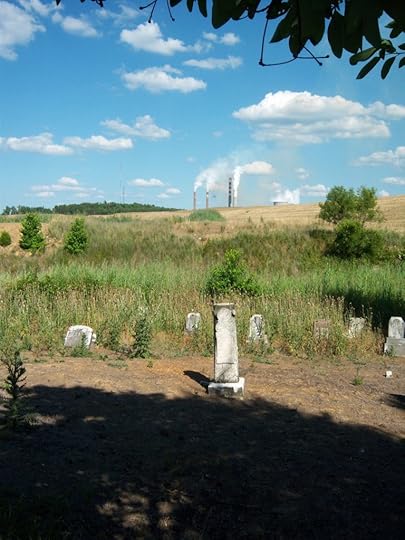
The view looking across that old graveyard at the heaps
leftover from mining, with the smokestacks discharging their
cloud into the sky really summed up what happened to Paradise.
What a lump I had in my throat! Oh how it must have felt to
those good people!
Thanks for the story.
John’s message renewed the feeling I had when my aunt and I visited Muhlenberg County in 2013—and I was almost tearful to think that someone else looked for and found Katie and Estel. How can you feel happy and sad at the same time? It’s possible if you learn about Paradise, Kentucky. The people there were salt-of-the-earth people. They worked hard as coal miners, farmers, loggers, small shop keepers, and teachers of the children whose families had lived in Paradise for generations.
Recently I read that the big coal company that scraped away a town in 1959 is now closing the operation completely due to bankruptcy. The company gave good jobs to some of the folks who stayed in the area, but at what cost? Paradise is now described in Wikipedia as a town that “was,” not “is.” A whole town was dug up, stripped of the black coal its soil covered, and left to fry in the summer sun like a dead carcass. It’s ironic that the only sign of life that remains is the Weir Cemetery, where a few dozen men, women, and children rest their bones. Those grave markers are the only signs of lives that once inhabited Paradise.
I have more to write about this place and its people. Check back or subscribe to my blog. Thanks for reading!