Who Was Ghost Story Writer "Mary E. Penn"?
The identity of Mary E. Penn, a late-Victorian author of ghosts stories and crime and mystery tales, is a complete enigma. Scholars of the macabre have been unable to discern any details of her person, origin or character (assuming she was indeed female). We only know that from the 1870s to the 1890s this author published a number of stories in periodicals, most commonly in The Argosy (Ellen Wood’s monthly publication). Some of her early contributions were anonymous (later attributed to Penn in The Wellesley Index to Victorian Periodicals) and her name only appears from 1878 onwards. Her first story, At Ravenholme Junction, was published anonymously in The Argosy in December 1876, but was later ascribed to Penn on stylistic grounds by eminent supernatural fiction scholar Richard Dalby. Her other ghostly tales were Snatched from the Brink (The Argosy, June 1878), How Georgette Kept Tryst (The Argosy, October 1879), Desmond’s Model (The Argosy, December 1879), Old Vanderhaven’s Will (The Argosy, December 1880), The Tenant of the Cedars(The Argosy, September 1883), In the Dark (The Argosy, June 1885), and The Strange Story of Our Villa (The Argosy, January 1893). The Tenant of the Cedars also appeared in two instalments in Philadelphia’s Saturday Evening Post in August 1885.
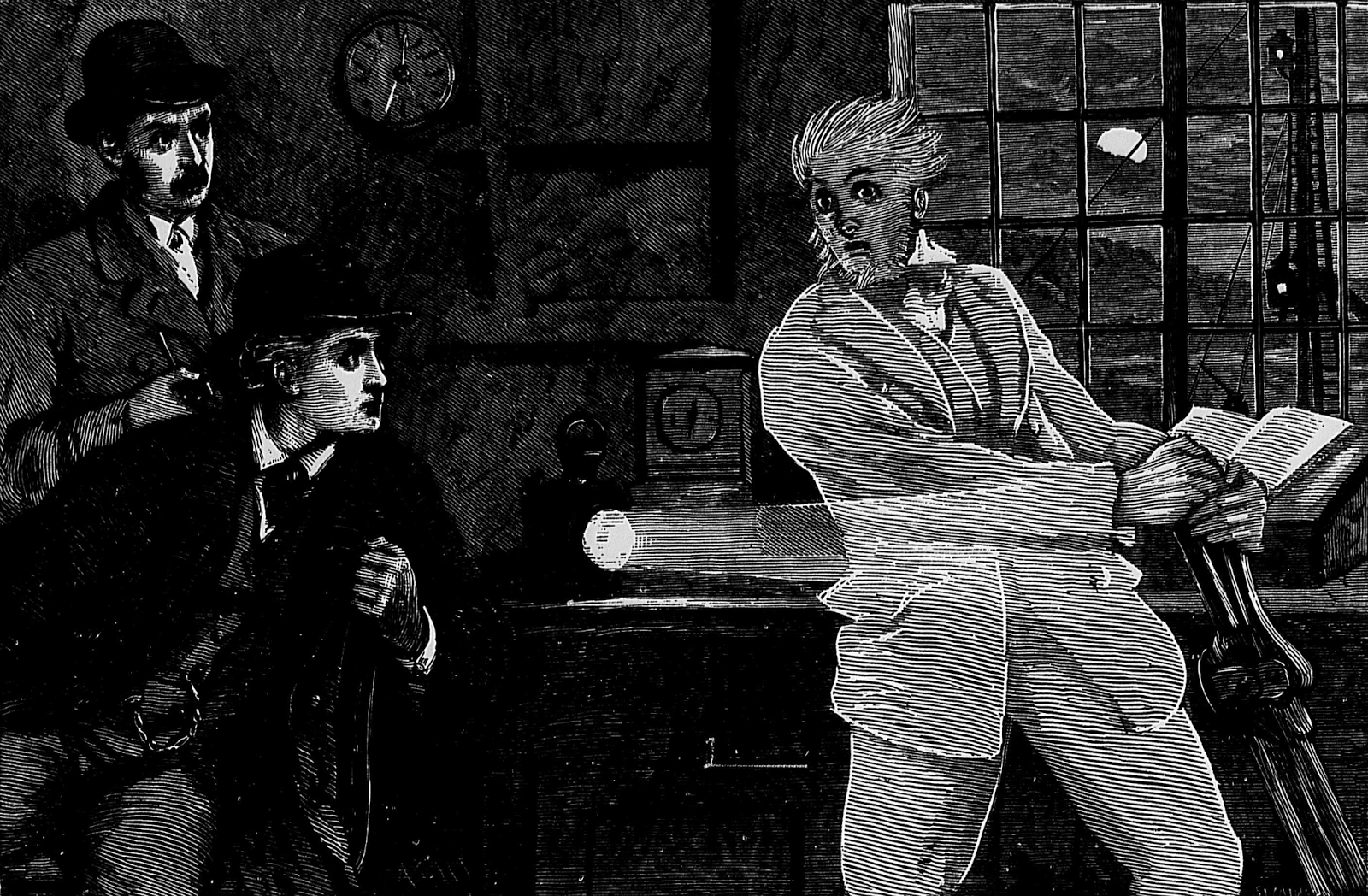 Illustration from "At Ravenholme Junction", The Argosy, 22 (December 1876).
Penn’s eight ghost stories were not collected together until the print-only publication titled In the Dark and Other Ghost Stories by Sarob Press in 1999, the second volume of the late Richard Dalby’s Mistresses of the Macabre series. Sarob’s limited-edition volume (only 250 copies were produced) is now almost impossible to find.Mary E. Penn wrote more than just a few ghost stories. She also wrote nineteen other short stories (see bibliography below), mainly in the crime thriller and mystery genre, all of them for The Argosy, except the two tales that appeared anonymously in Temple Bar in 1878 and 1879. She also appeared with a couple of small fiction pieces in the Saturday Evening Postin late 1884. Penn’s last known story was The Secret of Lyston Hall which appeared in The Argosy in August 1897. After this Mary E. Penn disappeared from the literary world completely, as mysteriously as she had first appeared. Tellingly, between January 1893 and March 1894, the author apparently changed her name from “Mary E. Penn” to “M. E. Stanley Penn” (the two surnames are hyphenated in one occurrence), perhaps signifying a marriage, or the inclusion of a maiden name. However, I have been unable to identify her from these scant details alone. There are no marriages listed in the British Civil Registration indexes that would suggest “Penn” or “Stanley” as a maiden or married name for Mary. Neither are there any births or deaths listed after civil registration began (in 1837) that can be easily identified with the mysterious Mary E. Penn, at least not without some wild speculation. There is, of course, the possibility that Penn was born abroad. Another possibility, of course, is that the name was a pseudonym. In this case I would make the tentative suggestion that Mary E. Penn was actually author Ellen Wood (1814-1887), more commonly known as Mrs. Henry Wood, the editor of The Argosy. Ellen Wood (née Price) was born in Worcester in 1814 and until the age of seven was brought up by her paternal grandparents. In 1836 she married Henry Wood, the proprietor of a banking and shipping firm in France and it was whilst living in Dauphiné that Ellen began to publish sporadically in the New Monthly Magazine and Bentley’s Miscellany (although she had written from a young age). After her husband’s business failed around 1856, the family returned to live in Upper Norwood, near London. Short of money, Ellen stepped up her writing career by winning a competition for a ‘temperance novel’ called Danesbury House (1860), which she had written in only a few weeks. Her next novel, East Lynne (1861), became hugely successful after a favourable review in The Times. Her career took off and she published a further twelve novels in the next four years, chief amongst them being A Life’s Secret (1862), Oswald Cray (1864), Mrs. Halliburton’s Troubles (1862), The Channings (1862), Lord Oakburn’s Daughters (1864) and The Shadow of Ashlydyat (1863).
Ellen’s husband died in 1866. That same year, after suffering a severe backlash by publishing a scandalous tale of bigamy, the owner of The Argosymagazine, Alexander Strahan, sold the publication to Ellen. She remained its editor (and chief contributor) until her death in 1887, serialising most of her novels within its pages. Her later works include Anne Hereford (1868), Within the Maze (1872), Adam Grainger (1876) and The House of Halliwell(published posthumously in 1890). Ellen Wood was also a prolific short-story writer and wrote some excellent supernatural tales. These are known to extend to three novellas, nine short stories and several stand-alone chapters in novels. Some of her best short ghostly fiction includes The Parson’s Oath, A Mysterious Visitor, Seen In the Moonlight, Reality, or Delusion? and A Curious Experience. Why should we suppose that Mary E. Penn was actually Ellen Wood? Firstly, all except two of Mary’s tales were published in Ellen Wood’s magazine The Argosy, and she is known to have penned most of its content. Secondly, the only American periodical in which Ellen Wood published was Philadelphia’s Saturday Evening Post (its editor Charles Jacobs Peterson was the brother of Ellen’s American publisher, Theophilus B. Peterson); and this was also the only place Mary E. Penn published in America. Thirdly, Ellen Wood is known to have had several pseudonyms. Her most successful was ‘Johnny Ludlow’, the narrator of a long series of short stories published from 1868 until after her death in 1887. Ludlow (whose real identity remained a secret for much of Ellen’s life) recounted many varied tales, some of them supernatural, concerning his adventures in Ellen’s county of origin, Worcestershire. In fact, Ellen was known to be a shrewd user of different literary identities and changed her appellation throughout her career, usually for sound economic or societal purposes. As well as ‘Johnny Ludlow’, Ellen also used the male pseudonym ‘Ensign Pepper’. It isn’t beyond the realms of possibility then that Ellen would later choose another pseudonym, her only female one, in Mary E. Penn.Now, although Ellen spent twenty years in France prior to becoming a successful author, her fiction rarely contained much reference to this period of her life. In fact, only ten pieces refer to France in some way, and all of those were written while Ellen was domiciled in France (she published a further twenty-five pieces during this period which did not relate to France at all). Other stories are also set in Switzerland, near to Ellen’s place of residence, near Grenoble. After Ellen’s return to England in 1856 she wrote nothing more concerning France except for brief passages in the novels East Lynn(1861) and Oswald Cray (1864). It seems odd that the influence of those years should completely disappear from Ellen’s writing after 1856. Now, of the twenty-seven stories attributed to Penn, ten are set in France; a further three are set in Tuscany, two in Belgium and one in Switzerland. The author, then, appears to have an intimate knowledge of continental Europe, and France and the French in particular. There is a substantial gap, of course, between Ellen’s last ‘French story’ (1856) and Penn’s first (1878). However, the Penn stories could represent the re-unearthing of previously-written stories from Ellen’s earlier days, published under a pseudonym (perhaps she was not as proud as she should be of her earlier writing), following her huge success after returning to England. One problem with this assertion is that Penn was publishing up to 1897, whereas Ellen Wood died in February 1887. However, Ellen’s son, Charles Wood, who took over editorship of The Argosy after her death, continued to publish the works of his mother right up to 1899, two years before The Argosyceased publication. So, it isn’t unreasonable to suppose that, faced with a series of completed but unpublished manuscripts of his mother, under the “Penn” pseudonym, Charles would chose to include them in The Argosy over a number of years. The large gap in Penn’s publications from 1888 to 1893, starting shortly after Ellen’s death, may not be coincidental. But are there any indications in the style of the writings themselves which may indicate that Ellen Wood and Mary E. Penn were one and the same? I believe there are. Firstly, both authors have a similar habit of using very short location-setting, time-setting or time-progression sentences as section openers. So, for example, Penn writes “Three weeks had passed away” (Desmond’s Model) compared to Wood’s “A week or ten days had passed away” (East Lynne); Penn writes “the days passed on” (The Strange Story of Our Villa) compared to Wood’s “Three or four days passed on” (Sanker’s Visit). These are not isolated examples, and the use of the terms ‘passed away’ and ‘passed on’ are common in both author’s works. Compare also Penn’s “A chill September afternoon” (How Georgette Kept Tryst) to Wood’s “It was a gusty night in spring” (Robert Hunter’s Ghost) – both extremely short sentences that place the action both in time, season and within the prevailing weather conditions. Again, this is not an isolated example; regular use of various, though typical, scene-setting short sentences occur again and again in both authors’ works. Compare Penn’s short sentence “A golden summer evening some fifteen years ago” (Old Vanderhaven’s Will) to Wood’s “A sunny country rectory” (The Prebendary's Daughter). Comparing both these authors to the norms of the time, one is struck by the frequent use of sentence fragments, certainly not a common form for the late nineteenth century. There is another similarity that may indicate these two authors were one. It is known from Ellen’s son’s biography of his mother that Ellen found the climate in France extremely oppressive; he wrote “in the extreme heat of summer, she could only sit or recline, clad in thin gauze or muslin” (Memorials of Mrs. Henry Wood, Charles Wood, 1894). This fact is revealed in her writing, where she describes the heat as “overpowering in the extreme” (Seven Years in the Life of a Wedded Roman Catholic). In Penn’s writing there is a similar, almost unhealthy obsession with the heat of the continent; as in “sultry June afternoon” (Desmond’s Model), “sultry September afternoon” (Snatched from the Brink) and “sultry August evening” (The Innkeeper’s Daughter).Although this evidence is somewhat circumstantial, I think there are enough indications to warrant further investigation into the possibility that Ellen Wood and Mary E. Penn were one and the same. Unfortunately, there is no existing archive of Ellen Wood’s correspondence or manuscripts, which will make the task of verifying this claim extremely difficult. But, whoever Mary E. Penn was, she left a legacy of eight extremely commendable tales that stand up well in the huge canon of Victorian traditional ghost stories.
Bibliography:
This is a complete bibliography of the works of Mary E. Penn.
At Ravenholme Junction, Anonymous (attributed by Dalby), The Argosy, 22 (December 1876), pp. 462-468.Snatched from the Brink, Mary E. Penn, The Argosy, 25 (June 1878), pp. 436-449Primrose, Anonymous (attributed in The Wellesley Index), Temple Bar, 53 (June 1878), pp. 193-208.One Autumn Night, M. E. Penn, The Argosy, 27 (March 1879), pp. 226-239.Vautreau the Vampire, Anonymous (attributed in The Wellesley Index), Temple Bar, 56 (July 1879), pp. 413-432.A Singular Accusation, M. E. Penn, The Argosy, 28 (July 1879), pp. 27-41.How Georgette Kept Tryst, M. E. Penn, The Argosy, 28 (October 1879), pp. 293-304.Desmond’s Model, Mary E. Penn, The Argosy, 28 (December 1879), pp. 476-490.A Night in a Balloon, Mary E. Penn, The Argosy, 29 (January 1880), pp. 56-63.Old Vanderhaven’s Will, Mary E. Penn, The Argosy, 30 (December 1880), pp. 475-494.Forrester’s Lodger, Mary E. Penn,The Argosy, 31 (March 1881), pp. 186-200.In the Mist, Mary E. Penn,The Argosy, 32 (October 1881), pp. 306-320.On the Night of the Storm, Mary E. Penn, The Argosy, 33 (June 1882), pp. 427-445.A Dramatic Critique, and What Came of It, Mary E. Penn, The Argosy, 34 (November 1882), pp. 373-385.A Painter’s Vengeance, Mary E. Penn, The Argosy, 35 (May 1883), pp. 396-400.The Tenant of the Cedars, Mary E. Penn, The Argosy, 36 (September 1883), pp. 196-212.At the Mill, Mary E. Penn, Saturday Evening Post, 64 (30th August 1884), p. 12.Out of the Way, Mary E. Penn, Saturday Evening Post, 64 (6th September 1884), p. 12. In the Dark, Mary E. Penn,The Argosy, 39 (June 1885), pp. 471-479.Monsieur Silvain’s Secret, Mary E. Penn, The Argosy, 44 (June 1887), pp. 15-29.In a Dangerous Strait, Mary E. Penn, The Argosy, 44 (November 1887), pp. 363-378.The Inn-keeper’s Daughter, Mary E. Penn, The Argosy, 45 (June 1888), pp. 471-491.The Strange Story of Our Villa, M. E. Penn, The Argosy, 55 (January 1893), pp. 18-27.An Innocent Thief, M. E. Stanley Penn, The Argosy, 57 (March 1894), pp. 256-263.Under a Spell, M. E. Stanley-Penn, The Argosy, 59 (February 1895), pp. 161-175.A Violinist’s Adventure, M. E. Stanley Penn, The Argosy, 59 (April 1895), pp. 474-480.The Mystery of Miss Carew, M. E. Stanley Penn, The Argosy, 60 (September 1895), pp. 349-357.Freda, M. E. Stanley Penn, The Argosy, 61 (June 1896), pp. 760-767.The Secret of Lyston Hall, M. E. Stanley Penn, The Argosy, 64 (August 1897), pp. 230-242.
The Ghost Stories of Mary E. Penn is available on Amazon Kindle, Nook and Kobo here;
Amazon (US)
Amazon (UK) Kobo


No comments have been added yet.