
A piece of rice paper and forgiveness
Dikkon Eberhart
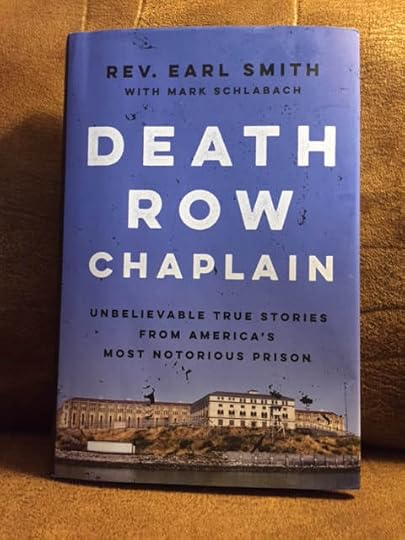
One of my first activities since I joined Kairos Prison Ministry is to begin reading everything I can about Kairos and about prison ministry in general. For those interested, I recommend Rev. Earl Smith’s memoir Death Row Chaplain which recounts his 23 years as chaplain at San Quentin Prison (the book is not specifically about Kairos). Simply and unhesitatingly written, this is the story of a young thief, drug runner, gang member, and fighter who—after being shot six times in a drug deal—turned his life around and dedicated himself to bringing redemption as a possibility into the lives of incarcerated men jailed on the shore of beautiful San Francisco Bay.
San Quentin is “a dark and isolated place,” as Smith describes it, but there he found “many examples of redemption, kindness, love, patience, courage, compassion, generosity, joy, and yes, even humor.” However, he continues, “I think the primary thing I learned during my tenure was the value of forgiveness” (page 179, emphasis mine).
Friends of mine in Kairos, who enticed me to join with their excitement about their ministry, often said that the most vivid experience they had during years at Pocahontas was closely to encourage and to observe the redemption of men who were otherwise considered by the general population to be the “least of these” (See Matthew 25:34-40).
Forgiveness occurred; redemption happened.
Inmates have nothing that we of the free world prize. These men, though, come to a Kairos “walk” (a four-day weekend, intensive experience presenting them with the possibility of Jesus’ redemptive grace for them) because they hope to gain everything.
During my first walk, I saw men confess, give themselves to Jesus, become saved, and then turn around, bathed with relief, to try and save their fellow inmates. My friends would say words to me like, “I promise you, Dikkon, they have given me far more than I can ever have given them.”
We of the free world, figuratively, we have everything. Yet having everything already, we of the free world sometimes are secretive about what we need to give away—which is not our things but our emotions, that is, our hurts, our defenses, our fears, our selfishness.
As an imprisoned inmate might do, some of us choose to hold onto our hurt. Alas, we of the free world, sometimes we imprison ourselves.
If you are reading this post during the afternoon of December 1, 2018, I was back in prison that morning.
We Kairos volunteers were at Pocahontas State Prison in SW Virginia for a reunion with inmate members of our Kairos #15 walk, which occurred last October, and with other prisoners who desired to attend.
I’m writing this post earlier in the week, so I don’t yet know what Christian theme was explored during Saturday morning, but my personal theme for that reunion will be forgiveness. Not just their forgiveness, but mine , too.
In an earlier post about my new experience of Kairos (see 10/19/2018, under the GOD heading), I stated that there were four major high points for me as take-aways during my first 4-day “walk” inside. In that post, I reflected on one of them, on agape love—and I reproduced the agape letter that I wrote to each of our prisoner attendees.
Another experience of a Kairos walk is the forgiveness ceremony, which occurs late in the afternoon of the third day. By then—three-quarters through the whole walk—attendees have heard many talks delivered by Kairos volunteers. These talks are designed to build a rising tide of awareness among the inmates that they are personally responsible for their condition of incarceration. Their personal choices have incarcerated them. It was not those others whom they may have hated as their enemies. Each talk lasts about 20 minutes and involves confession by the man giving the talk regarding his own pathway through the theme of that talk.
Then the inmates gather in small groups at assigned tables and discuss the ideas of the talk with assigned Kairos volunteers. Their comprehension of the issues is also stimulated by graphics: the inmates draw and color a poster dramatizing what they’ve discussed. Often, throughout the three days, the word forgiveness occurs—choice and forgiveness are among many Kairos themes.
By the end of the third day, inmates have had three intense days of being prepped for an upcoming event. And we’ve all had plenty of singing, music, worship, prayer, and cookie eating (yay!).
So…what is this forgiveness ceremony?
Early on the third day, all inmates and volunteers are given a square of rice paper and a pencil and encouraged during the day to write down the name of a person or of several persons to whom, in their hearts, they now feel they should provide forgiveness. We are challenged to consider real forgiveness, not mere casual forgiveness—real forgiveness of the sort that for three days we volunteers have been attributing during our talks only to Jesus’ glory.
And these rice papers, with the names we write on them, are to be kept secret, until….the forgiveness ceremony.
Since I’d received my paper, I had thought a good deal, and I had prayed some, too. I had put one single name on my rice paper. Sometimes I thought to erase it. But then I thought, no.
I thought, “I’m a spectator here, a helper only. This ceremony isn’t for me. It’s for them, the ones who are in figurative chains and behind actual bars. The ones here on the inside. Not for me. Should I even participate in this ceremony, whatever it is? Well, I suppose so, yes. After all, I did write a name on my paper.”
An hour later, I stood in one of two long lines of volunteers and inmates. Each of us held a paper in hand. All of us were quiet. One by one, we stepped forward and eventually knelt on a mat. Before each of us was a bucket of water. On the other side of each bucket was one of us volunteers, a professional pastor, equipped to pray.
I bent over the bucket, paper in hand. My volunteer brother nodded, “Drop it in.” I did. The paper and the name dissolved. He asked me, “What?” I named the name that had now dissolved and our relationship, and I said only one sentence more. He reached across the bucket and laid his hands on my shoulders and began to pray.
Three minutes later I could barely stand, so shaking was I. My tears were so copious I could not see. One of my Kairos friends saw this and came over and helped me up. We embraced tightly.
“See?” he asked.
I nodded.
I sniffed, wiped my eyes. Soon, I believed, maybe my knees would begin to function again. I embraced my friend a second time.
I thought, “I should have put more names on.”
Then I thought, “I’ll have another chance…during our next walk.”
Rev. Smith speaks about the societal purpose of incarceration. He uses two words, rehabilitation and regeneration. Times change in society and ideas about how best to address public problems come and go. Yes, evil-doers must be kept separate from the general population, for its safety.
Rehabilitation means to change back to the person the inmate was before he began his life of crime—or, if he has been a criminal always, then back into the ideal person he could have been, as he was when he was an infant and in God’s palm. A rehabilitated criminal is able to enter the free world and to live a successful and productive life without recidivism.
But Rev. Smith speaks of regeneration as the ultimate goal. Regeneration comes from, among other things, forgiveness as well as salvation. It comes from forgiving the ones against whom the inmate has continued to stoke his rage, and forgiving himself with the realization that he is not his crime.
He does not need to continue to imprison himself. Yes, he did the crime(s), deserves the punishment(s), is doing the time. But also he is a fallen and a loved child of God.
As Rev. Smith concludes, “Regeneration sets the standard for kingdom choices” (page 201).
My theme regarding myself on December 1 is forgiveness. I’ll be at the prison where we outsiders and those insiders bond. We will have fellowship, some good rockin’ gospel music, some exciting theological talk, a few intense prayers, perhaps the moment of salvation for one or two more of those who are chained.
I can’t wait for Kairos #16 next year in April.
I’ll choose to put more names on my paper. I’ll choose to forgive them. I’ll drop some more of my own chains.


No comments have been added yet.
The Longer View

Many excellent bloggers concern themselves with what is happening right now. That is important. My blog is called The Longer View. I attempt to report how the past or the future impacts me as I live i
...more
- Dikkon Eberhart's profile
- 11 followers

