Which is the Real Little Italy?
When Europeans flooded into the United States from 1880-1920 in what is now called the Great Migration, Little Italys sprang up in locations as diverse as the bustling metropolises of New York and Chicago and small cities like Omaha, Nebraska. The Little Italys from this era, some which continue to thrive, others that are now defunct, are considered by many Italian-Americans to be akin to sacred ground. This is especially true for Italian-Americans whose forebears lived and struggled in these enclaves for years following their arrival.
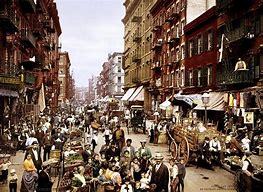
Mulberry Street, NYC
The largest community of Italians outside Italy lived in New York City during and after the Great Migration. As befitted an important commercial port serving also as the largest gateway for immigration into the country, this boast was not confined to one Italian enclave, but was distributed among several Little Italys. Those with even a passing interest in Manhattan know about the Little Italy at the south end of the island, of Mulberry and Thompson Street fame. Fewer have heard about another celebrated Italian enclave, the Little Italy of the Bronx.
Many will be surprised to learn the more famous Little Italy, the one in Manhattan, has been shrinking for years. With soaring rents and family business buyouts, the delicatessens, butchers, grocers, and restaurants that gave the area its ethnic flavor have been slowly disappearing. What was 50 square blocks of largely Italian-American homes and businesses is now no more than 3 city blocks, hemmed in by Chinatown’s growth. And while 70 years ago half the residents in this Little Italy were Italian-Americans, by 2000 fewer than 6% of residents in the downsized neighborhood identified this way.
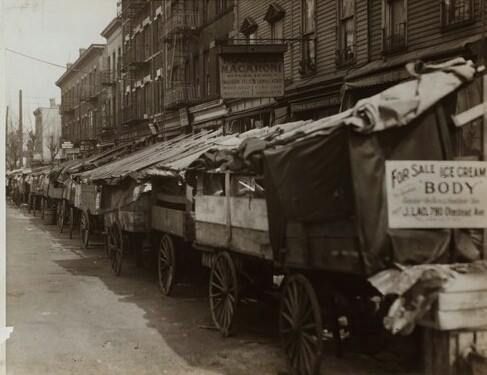
Pushcarts, Bronx, NY
Quite a different story for the other Little Italy. That Little Italy, contained in the Belmont neighborhood of the Bronx, had its struggles, but a takeover by a neighboring enclave was not one of them. The Little Italy of the Bronx still has the boundaries set by Italian immigrants that lead to its branding as an Italian neighborhood starting in the late 1800s. Its establishment would lead to a simmering rivalry decades later, and the claim of being the “real Little Italy” all along.
Most immigrants could access the neighborhood only because a 3rd Avenue elevated train line ran through it. Once arrived, they found the area, nestled between Fordham University, the Bronx Zoo, and the borough’s Botanical Gardens, a favorable one for business. Yet, it did not always look as if this Little Italy would be a tourist destination or a fit home for inhabitants, even. During the 1970s the strife in the South Bronx led to an outflow of the European-descended residents of the North Bronx, including this Arthur Avenue-centered neighborhood, and an inflow of Hispanic and African American residents. The demographic shift led banks to believe mortgage lending was an unsafe proposition, and historic Belmont was redlined.
But fate would not give up on an area featured in movies including A Bronx Tale and Marty. After the Bronx recovered from the destructive toll of the 1960s and 70s, a housing resurgence in the 1990s began a new era for the Belmont neighborhood. Its location near major city landmarks continued to be an advantage. And it never lost the attraction of its many Italian family-owned businesses or of being the largest shopping district in the Bronx. An allure so great that in 2016 Arthur Avenue was named one of “America’s Greatest Streets” by the American Planning Association.
Meanwhile, Manhattan’s Little Italy saw the children of its 2nd and 3rd generations leave for the suburbs. From the 1970s on, while its businesses were bought out, the locale was increasingly seen as less an ethnic enclave than a tourist destination.
It was New York’s Italian-American community that saw in this change an opportunity to celebrate Italian-American culture and to educate tourists about the immigrant group’s contributions to America. The idea came on the heels of a 1999 exhibit about Italian Americans in New York attended by 50,000 people at the NY Historical Society. The enormity of the turnout made it clear a great many more visitors could be drawn to a permanent museum for honoring and studying the culture, history, and accomplishments of Italian-Americans. Soon thereafter, the Italian-American Museum (IAM) was founded, led by Museum President Joseph Scelsa. With Manhattan’s Little Italy already a tourist destination, the museum’s initial home on West 44th Street was moved to the former Banca Stabile on the corner of Mulberry and Grand Streets, in what remains of Manhattan’s Little Italy.
It can probably be expected that other Italian-American oriented businesses will follow into Manhattan’s Little Italy as the IAM grows in influence and stature. And it doesn’t look as if Bronx’s Little Italy is going anywhere soon. So the question remains: Which is the real Little Italy? I will leave it for you to decide.
 If you wonder about the Old World life your ancestors left behind or how people from both sides of the Atlantic came to terms with each other, read Little Italy Diary. Its pages tell far more than the history of one man’s family: they are an American history. Available in Amazon.
Little Italy Diary is Angela Edwards' first book. She is also an accomplished poet whose work has been published in Tribeca Poetry Review, Potomac Review, Journal of NJ Poets, Turnings, and other places.
Mulberry Street, NYC
The largest community of Italians outside Italy lived in New York City during and after the Great Migration. As befitted an important commercial port serving also as the largest gateway for immigration into the country, this boast was not confined to one Italian enclave, but was distributed among several Little Italys. Those with even a passing interest in Manhattan know about the Little Italy at the south end of the island, of Mulberry and Thompson Street fame. Fewer have heard about another celebrated Italian enclave, the Little Italy of the Bronx.
Many will be surprised to learn the more famous Little Italy, the one in Manhattan, has been shrinking for years. With soaring rents and family business buyouts, the delicatessens, butchers, grocers, and restaurants that gave the area its ethnic flavor have been slowly disappearing. What was 50 square blocks of largely Italian-American homes and businesses is now no more than 3 city blocks, hemmed in by Chinatown’s growth. And while 70 years ago half the residents in this Little Italy were Italian-Americans, by 2000 fewer than 6% of residents in the downsized neighborhood identified this way.
Pushcarts, Bronx, NY
Quite a different story for the other Little Italy. That Little Italy, contained in the Belmont neighborhood of the Bronx, had its struggles, but a takeover by a neighboring enclave was not one of them. The Little Italy of the Bronx still has the boundaries set by Italian immigrants that lead to its branding as an Italian neighborhood starting in the late 1800s. Its establishment would lead to a simmering rivalry decades later, and the claim of being the “real Little Italy” all along.
Most immigrants could access the neighborhood only because a 3rd Avenue elevated train line ran through it. Once arrived, they found the area, nestled between Fordham University, the Bronx Zoo, and the borough’s Botanical Gardens, a favorable one for business. Yet, it did not always look as if this Little Italy would be a tourist destination or a fit home for inhabitants, even. During the 1970s the strife in the South Bronx led to an outflow of the European-descended residents of the North Bronx, including this Arthur Avenue-centered neighborhood, and an inflow of Hispanic and African American residents. The demographic shift led banks to believe mortgage lending was an unsafe proposition, and historic Belmont was redlined.
But fate would not give up on an area featured in movies including A Bronx Tale and Marty. After the Bronx recovered from the destructive toll of the 1960s and 70s, a housing resurgence in the 1990s began a new era for the Belmont neighborhood. Its location near major city landmarks continued to be an advantage. And it never lost the attraction of its many Italian family-owned businesses or of being the largest shopping district in the Bronx. An allure so great that in 2016 Arthur Avenue was named one of “America’s Greatest Streets” by the American Planning Association.
Meanwhile, Manhattan’s Little Italy saw the children of its 2nd and 3rd generations leave for the suburbs. From the 1970s on, while its businesses were bought out, the locale was increasingly seen as less an ethnic enclave than a tourist destination.
It was New York’s Italian-American community that saw in this change an opportunity to celebrate Italian-American culture and to educate tourists about the immigrant group’s contributions to America. The idea came on the heels of a 1999 exhibit about Italian Americans in New York attended by 50,000 people at the NY Historical Society. The enormity of the turnout made it clear a great many more visitors could be drawn to a permanent museum for honoring and studying the culture, history, and accomplishments of Italian-Americans. Soon thereafter, the Italian-American Museum (IAM) was founded, led by Museum President Joseph Scelsa. With Manhattan’s Little Italy already a tourist destination, the museum’s initial home on West 44th Street was moved to the former Banca Stabile on the corner of Mulberry and Grand Streets, in what remains of Manhattan’s Little Italy.
It can probably be expected that other Italian-American oriented businesses will follow into Manhattan’s Little Italy as the IAM grows in influence and stature. And it doesn’t look as if Bronx’s Little Italy is going anywhere soon. So the question remains: Which is the real Little Italy? I will leave it for you to decide.
If you wonder about the Old World life your ancestors left behind or how people from both sides of the Atlantic came to terms with each other, read Little Italy Diary. Its pages tell far more than the history of one man’s family: they are an American history. Available in Amazon.Little Italy Diary is Angela Edwards' first book. She is also an accomplished poet whose work has been published in Tribeca Poetry Review, Potomac Review, Journal of NJ Poets, Turnings, and other places.


date newest »
newest »
message 1:
by
Lori
(new)
Feb 09, 2020 04:28PM
 This is interesting to ponder and very well-written. It would possibly make for an interesting research study across the U.S. as as a whole because it seems as though every major city in the U.S. has its own "Little Italy" as well as other ethnic communities. How have these communities been affected over the past decades? There may be some interesting statistics available after this year's 2020 census.
reply
|
flag
I had overlooked the Bronx “Little Italy”, but yeah, there was (is) one. It is sad that banks seemed to “red line” communities—a decision which has left scars on our country’s psyche. I personally have found Baltimore’s Little Italy a small, yet pretty impressive model for the phenomenon of “Ethnic Enclaves!” Looking forward to your next blog post.
 Lori wrote: "This is interesting to ponder and very well-written. It would possibly make for an interesting research study across the U.S. as as a whole because it seems as though every major city in the U.S. h..."