Bihar, Part II
Hello sir. I am back and I had refrained from responding to your very very encouraging mail because I knew this longer write-up was anyways on the line.
The day after Gaya was my longest stretch traveled in Bihar. My friend from Rishi Valley and batchmate at Ashoka sent his car and his driver to carry me to his home at Patna. En route I hit Barabar Caves, several monuments and ruins of Rajgir, and the heritage site of Nalanda. One of my important learnings on this journey occurred early in the morning but it did not end; I only eventually realised that it was a constant – I am thinking of Bihar’s reliance on fodder. Kharif crop has ended sometime back as we know. The stubble, as my driver interjected, was burned: he says this was the cause of the unintelligible distances and blurry skies. And the stalk of the paddy was turned into fodder. Thanks to the narrowness of the road, the activities on both sides were by my elbow. This fodder was rolled up and covered with hoods. Jacketed buffaloes and unending huts of paddy were the mascot of the day.
The man who drove me, Vinod Singh said with regret that Bihar was in need of company. Only agriculture will not do, he says. My conversations with Vinod ji, the driver of the car the day before (who gave me the punchy line on maghi) suggested something profound. Governments are not working. People across India, and definitely, the world over, blame governments for their failure. They resent stifled policy and curse stunted welfare measures. Implicit in these cases at large is the sentiment that state ought to and if indeed intends, can in fact effect great change. That, I did not hear in Bihar. I read not pessimism but something a step ahead; something like a spiritual resignation. This was echoed later in a different context by my friend’s mother when she said Bihar aisa hi rahna hain.
Notwithstanding anything, I always had art and heritage to take recourse, especially this day. Around 10 we arrived at Barabar (Marabar of EM Forster). Visiting a place like that, a beginning point, a sprout, a moment of inception is something I always fail to describe. Here were four caves, the first sculpted ones in the subcontinent, commissioned during the reign of Emperor Ashoka to the Ajivikas. They didn’t have the splendid paintings of Ajanta or anything close to the sculptures of Badami. The only things that stood out were the Brahmi inscriptions but the walls! The granite walls were as smooth as they could get. All the sculptors’ precision and nimbleness were directed towards that single activity – making the walls smooth. The chief cave named after Lomas Rishi is said to have housed Lomaharshana. Lomaharshana, as I remember from reading Thomas Trautmann, was the author of Gaja Shastra. The Ayurvedic branch that dealt with elephants.
Now on to Rajgir. My Buddhist pilgrimage continues. As we drove through this roads, I could not stop thinking about how much our books speak of these very stretches as the cradle of our classical civilisation. Jarasandha’s capital according to the Mahabharata. The city of Bimbisara and Ajatashatru; the site of the Buddhist conference where the Pali Canon was compiled. A small raised platform with remains of pillars is said to be Bimbisara’s fort and there is a claimant for Jarasandha’s battlefield even.
Finally I arrive at Nalanda. I think it would have helped to quote again all that I recollected with you when I messaged from Buchanan. Nalanda has a very confusing numbering my the Archaeological survey but I believe that can be ignored. I hear that this is the best maintained site in all of Bihar. It shows. One can imagine worship in the temples and students residing in the monasteries. The imposing structure, the posterchild for Ancient India, Temple 3 is barricaded and that was deeply disappointing for me. There are few sculptures that survive at Nalanda, most of them are on the granite Stupas that face Temple 13. The structure of the temples are reminiscent of Gupta architecture, rebounding straight from Deogarh and Bhitargaon. The sculptures are miniatures of those at Sarnath with smooth noses, gentle curves, and meditative visages. I am not surprised. The first datable temple at Nalanda is from the time of Kumaragupta (although most patronage occurred during the Pala times); a final thought: it is brilliant to be a traveler at Nalanda. Most of our sources are travel accounts: Xuanzang and Yijing, the Tibetan historian Taranatha, and much more recently, Buchanan and Cunningham!
I reached my friend’s house at 8:30 and the city of Patna a hour before that. The statistic obviously says all that there is to, about traffic at Patna and its management.
Over the next three days at my friend’s house while accommodating my travel I finished reading Piketty. A perfect companion to my moment! A book that reveals how in the present moment, thanks to broken state institutions, income was increasingly becoming that which was accrued from assets than hard labour is profound in any moment. But look where I was! ************* I was learning from reading as always, and from seeing – at that moment.
The next day, more Buddhist pilgrimage. Let me reproduce an entry I made elsewhere on Vaishali.
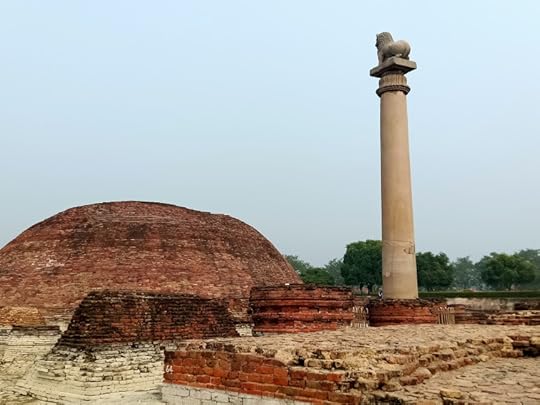
In this pilgrimage that I have set out on, of Buddhist holy places, yesterday was reserved for Vaishali, located seventy kilometres to the North of Patna city. Vaishali is said to have been named after the mythical king Vishala (the remains of a fort here are credited to him) of the Puranas. Students of history remember it as the capital of the Licchavi Gana (sometimes translated as a republic and other times, oligarchy) of Vajji. It was hence the birth place of several historical figures including Kumaradevi, the wife of Chandragupta I. Much of what we hear about Licchavi administration comes from the Attakatha, commentaries to the Pali canon. Much before the Guptas however, Vajji had been annexed by the state of Magadha (perhaps during the reign of Ajatashatru). This was around the time of the Buddha that is. Buddha has immense connection as I said with Vaishali. He spent his last monsoon here. This was also the site where Amarapali, one of the most interesting characters in Indian literature (now largely associated with the attire only) is said to have turned into the Buddha’s devotee. Before turning into the Buddha, Siddhartha had his hand at enlightenment under several teachers first at Vaishali. One of the Buddha’s dearest disciples, Ananda attained nirvana at this very site. The Stupa visible in the image commemorates that very event and the figure. Finally, the second Buddhist council where the first schism in the Buddhist Sangha is said to have occurred also was held at Vaishali. While driving back I realised that I had visited four of the eight primary pilgrimage sites in Buddhism.
Three of those were obviously visited in this very tour. The other is Sarnath. I noted that I mentioned a Stupa in the description. I will message you its photograph. Oh, how could I forget! I also saw the Ganga on this day. The going and returning, 150 kilometres costed me six hours. Not a surprise after having already spent four days here.
My fifth day in Bihar I visited the remains of Pataliputra and a broken Ashokan pillar at Kumrahar. In the morning I spent at the museum. A supremely ambitious project! They are of course still sorting the logistics. It is a mess to navigate still with the end of one hall not leading to another. There is a helping of misery here too. As I showed you, the artefacts are all labelled with codes by ASI with markers! Here I saw a repeat of Mathura-type sculptures, excavated however Gaya and Sarnath-style ones from Nalanda. The primary attraction, and unique to the land are the Pala bronzes, the only ones in my opinion that can parallel Chola ones. And how handsome the Bodhisattva Avalokiteshvara Padmapani is. There is another pattern of sculptures I have noted, unique to Bengal, one that I call – Shiva giving a swab test to Gauri. These are available both in bronze and stone (the latter kind in this model finds a sample in Delhi’s National Museum also by the way). I have held you up to talk of one masterpiece.
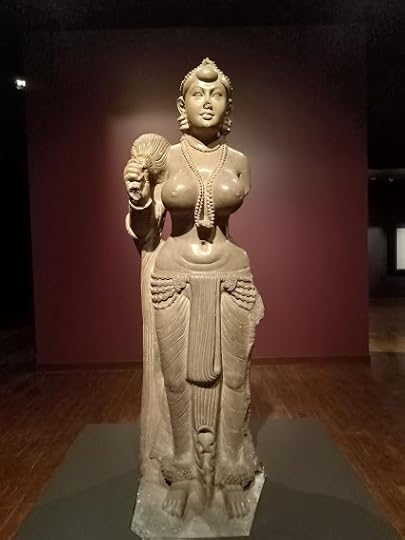
Most museums have a star. It’s the Bharhut Sculptures in India Museum of Kolkata. Kanishka at Mathura. And Krishna with Govardhana in Bharat Kala Bhavan in Varanasi. Likewise I always held that if there were one reason one had to visit Patna it was for this splendid image – the Didarganj Yakshi. This neatly polished and glistening sculpture remains a testimony to the standards of an India of the distant past, an India that is a foreign country to us now. The Yakshi with one arm lost, is obviously not the subdued Yakshi of Puranic Hinduism. She is a deity in her own right. Yet she mysteriously holds a fly whisk a sign of course of subordination. She has full and large breasts, not too narrow waist and a wide hip. And look at the ornaments that adorn her hair! And the now-lost front bun that is typical of the Mathura school of art. It is the remarkableness of the statue that has made it one of the most sought-after pieces of art from India in exhibitions across the world. The story of the Yakshi is also very interesting. It was discovered at Didarganj village by a Maulvi where it first became a deity that was worshipped before getting passed into the hands of the curator of the then-Patna museum.
Images do have lives!
That finally brings me to the last day at Bihar. Patna Airport was the climax. It was Gaya plus a thicker beed. So overflowing dustbins, rusted flooring, and long queues near the departure gates. It is a horror story for the very old, the very young, and the very wary.
I wonder if this letter has gone too very long. Do let me know your thoughts…