Bihar, Part I
I spent the first week of December this year, when India was in its Unlock Phase X, in Bihar in the Gaya-Patna region. Unlike my other travel writing, this is my reportage of the journey verbatim from a letter I wrote to one of my dearest people, a teacher and a mentor. This mail was, and this post is, in two parts.
****
Dear Sir,
Here is my mail to you on Bihar as I promised. This has been a trip like none other for me. Unlike my former journeys, this was filled with a diversity of experiences and moments. And of course, needless to say, Bihar is a place like no other. It is a land that all must visit to understand the idiosyncrasies of history and time, learn patience, countenance their own privileges, and experience adventure.
I must of course begin at Gaya. I found on landing unusually, an affinity with Delhi – in the brown duskiness of the horizon which followed me everywhere I went. The airport was far from the name. The building reminded of me teawater but I was not too disappointed, because the town as far as I understood merited an airport only to serve foreign tourists who sought to visit Bodh Gaya.
At the airport itself I learned another curious thing about Bihar, at least this region of it. The state has a knack for putting Stupas on every public building. At this airport, on offices, on police stations, and even overhead tanks! I suspect that the government thinks that this is a substitute for policy and welfare. We (I was accompanied for two days by ****, a native Gaya-ite who lives in Delhi but who appeared a very ‘wannabe’ personality; he picked a French accent following one trip to France – and ******, a reporter for France 2 formerly in ***** and since September, at Delhi) headed to Tekari, with a ruined fort of an erstwhile Zamindar. The team wanted to capture some footage of dereliction. It is of course another matter that they got green-uniform military men to be Sepoys of 1857.
Although I had nothing to do here, I think it was an important fragment of the journey. I, as I wrote to you in my message then spent some time talking to a couple of boys without their masks on (with my mask on of course). They had huddled up together while rejoicing that they had been given furlough from school to avoid beed. Corona was a large festival that gave them an extended holiday and allowed the Prime Minister to market for sanitisers and masks. It was still a pleasure hanging out with them; I shared their feeling of wonderment as a drone-camera ascended to the sky to catch the ruins of the fort.
One last comment on that evening. A line from a car-driver: “The big gaadi folk speak Maithili. The smaller gaadiwalas we only speak Maghi.”
That night is what I have in mind when I say this is a trip like no other. The duo apparently wanted to milk their organisation. As a result I slept at what is certainly the most expensive night stay for me so much so that I was afraid I would not be able to fall asleep due to discomfort.
The hotel was at Bodhgaya and its location revealed much about who our imagined “audiences” were. A gulf existed between the gate of the compound and the village outside. It was a hamlet without a road servicing it, filled with spread-out sole mud huts. Scattered across the place were fodder stacks covered by hay roofs. I must interject with an adorable sight though. As is the tradition in these belts, the goats here are dressed in sweaters and even kurtas. The buffaloes are covered with gunny bags knit to each other. I was agonised by the indifference, the rude looking-away by the two men who I traveled with. One of them was busy narrating how he had a hazy “hook-up” in Brazil.
(There is another unusual relationship that this universe shares with goats. The narrowness of the roads force kids to hop into the path of fast bikers leaving the ominous mark of squashed animals. Never had I seen this with such frequency in rural India).
Even before breakfast, we moved to the Vishnupad Temple of Gaya where the shoot was scheduled. Not impressive at all, as you will agree, after my immersion in South Indian temple culture. The current structure dates to the reign of Ahilya Bai Holkar; the arches, domes, and towers are quite the Mughlai intervention and darkened today. While Antoine got busy capturing Orientalist fancy with bald men sharing space with cows, and families crowding up to perform Shraadh, Sidhu and I explored the location for a good view of the Vimana.
Here I must tell you about what excited you in my message: my acting. My interview of course went quite well. Where are we? Why does Jules Verne choose this? Why 1857 and why Nana Saheb? How realistic is his India? Where do his sympathies lay? Questions of that species… This segment of the show is called in Sidhu’s English interpretation to me, Inspiration. It portrays vignettes of spaces that inspired artists to create. Very fascinating indeed! Back to my acting though: I must say it was delightful! I realised that a libido had surged in me all these years to do something like this.
An actor only needs a gesture, a little twitch on the eye brow, a subtle stride to prove his mettle. I am from that order. A lot of footage was recorded of my walk. I was to be “natural” and belong to the habitat. So I was to, and did with great dexterity, fake candids. I was then asked to walk up the staircase of the Phalgou River (I was not surprised that it was dry and only sand remained) where I added a smile here, a friendly wave there. The team also only had one camera so they recorded multiple shots of me reading particular passages off the book. I should add quite immodestly that my reading was very handsome, the visual I mean. France 2, to the world of Gaya was the Government of France itself so we were given permission to enter the Garbha Griha were I was told to act like I was praying. The first one was real, I should say. But the second and third, a big no.
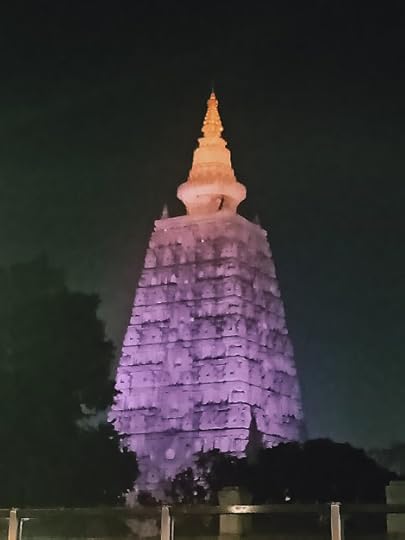
Past noon, I passed. I moved to a rugged hostel at Gaya. In the afternoon I went to the Temple of Bodh Gaya. The journey, riskiest of all and in complete odds with my trip thus far, was on a sharing auto. I arrived at the town and Gaya repeats. Brown horizon and add a clumsy fruit market in front of the Mahabodhi Temple. I can’t stop myself from rushing to talk about the temple. I really hope and pray that I will keep returning to the shrine and it will stay with me for long. What a brilliant patch of earth! The shrine is small and there is no temple besides the perimeter of the tower. It is surrounded by countless little votive stupas with inscriptions from various Asian languages. After all this site was the centre of the Buddhist Earthly cosmos.
Never have I felt such a distance from my other usual distractions: clicking photos, constructing theories about the world, squatting on my phone. One has to visit the temple to learn what it means to live in the moment. I should say that Mahabodhi is the new standard for me for tranquility. I sat and looked at the tree for many minutes, walked with the dogs which display some curious behavioural traits; they rush towards meditating monks as if they are hunting prey and lick them. The trees and silence of the complex make it a sanctuary for the birds of the town I guess.
Signs of Alexander Cunningham’s service and rampage are visible in the artificially stuck-up Stupas and statues (I was also reminded of Buchanan’s very curious account in the Gaya volume). I spent some time, hinted by Frederick Asher’s book on Eastern Indian Art I read in preparation of this site the weekend before, closely noting the Vedika (railing) of the temple, that belongs mostly to the Sunga times and betrays the Mathura school of Art. There are episodes from the Jataka tales too! I was reminded of my trip to Sanchi, except here Gajalakshmi does not ride the elephants but feeds them. Hilarious.
My best moments were spent having a tea party with a couple of Tibetan Lamas. Someone complimented that I had very good Karma. I could not ask for better flattery for the day!
It’s getting late here. I will write tomorrow again with Part II covering the rest of the trip.
Warm Regards
Revanth