Galaxies embedded in gigantic structures?
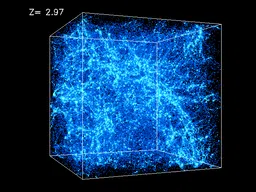
It is beginning to seem that the Lambda-Cold-Dark-Matter model of how the universe is, and how it came to be, may be severly lacking. This is because research is revealing big anomalies of alignment and co-movement.
The story starts in 1989 when it was found, by analysing redshift data of galaxies, that there was a “Great Wall” – a sheet of galaxies 500 x 200 million light years, but only 15 million light years thick. That was the first “large-scale structure” found. Since then other sheets, and connecting filaments of hydrogen gas and dark matter, and knots and voids have been discovered. Whilst these gigantic structures are too far apart to affect each other by gravitation – at least as we understand it – they seem to be linked in some way. Distant galaxies appear to be moving synchronously, rotation axes of distant quasars appear to be aligned, galaxy spin axes appear to align with filaments, satellite galaxies are mostly grouped in a single flat plane around the major galaxy.
All this suggests that the distribution of matter is embedded into ‘something else’ on a gigantic scale. Which suggests that we are so small that we are only really seeing some of the spaces between galaxies, with no idea of the overall picture. Similar to what we might experience sitting on an atom – we would see a few other atoms a long way away, but we would have no idea that we were in a DNA molecule, or an iron bar, or in a flame.