Facing the Heart of Darkness
Adapting Joseph Conrad's challenging work for ,Radio 4 drama.
My interest in Conrad is longstanding. My first theatre play was a notoriously terrible adaptation of Lord Jim, with a student theatre company. Thirty years and sixty plays later, my interest was rekindled when I read about oil prospecting under swamp forest in Republic of Congo. This alongside the toxic mineral-grab in Eastern and Southern DRC made me think of Heart of Darkness, an updated version where corporations replace colonial powers as the exploiting force. I was really excited by the idea, but also daunted by both the book’s literary status and cultural legacy. I was aware of Chinua Achebe’s critique.
I was also very struck by the outburst of wildlife cameraman Vianet D’jenguet's in his documentary 'My Congo':
,'Whoever wrote Heart of Darkness was wrong; this is a place of light'.
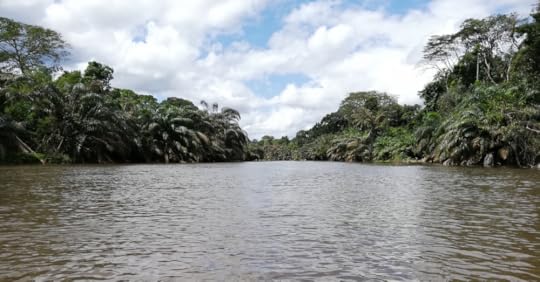
I was determined that my own version would put DRC characters at the heart of the story as active protagonists who spoke for themselves, in their own languages. That the landscape would be rich and beautiful, with 'light glancing off the stained-glass wings of enormous dragonflies, and iridescent Congo sunbirds'. I also knew I was carrying an ‘intolerable presumption’ of understanding, and a big responsibility.
I pitched the idea to the BBC radio drama in February 2020 and was commissioned in October 2020. This was to be an accelerated ‘fast track’ production, with just three months from green-light to recording. That timeframe is important as two things had happened between pitch and contract: Covid 19 and Black Lives Matter.
Covid 19 had big practical implications for my research phase. When writing stories about things I have not experienced, I meet and talk with people who have lived it. This can involve individuals, whole groups, and even opposing groups, sometimes encountering the story as it happens. I back this up with a lot of reading. Exiled from Paradise, Just Whores, Gull Therapy, Countrysides and many other of my plays followed this research model. During Covid 19 I wasn’t able to do this. I was able, however, to work remotely with Ange Kasongo and Tracey Nyemba. I asked Ange particularly as a DRC political commentator, she would not pull her punches. I found Tracey through her wonderful Lingala teaching YouTube channel. They were both supportive and generous, but I really missed the actual sitting down and talking, growing a network of experts and their stories.
Black Lives Matter sent ripples through the project. My first though was that I should be telling this story; although I never doubted it should be told, as it touches so many current issues. I felt I should drop out of the project, but my producer encouraged me to continue. In that process, the story changed in one important way. I had originally imagined Maya (Marlow) as a Nigerian-British woman, encountering central Africa for the first time. We decided not to do this because it felt like such big story to tell on top of Conrad’s that we couldn’t do justice to both in 60 minutes. All the other characters stayed the same from pitch to recording: the cast brought their diverse perspectives to the text, on the lookout for blind spots and assumptions.
Recording was done remotely. Each actor performed at home in their DIY sound booths (in one case, a wardrobe), across the UK. Voices were connected by high bandwidth recording technology, engineered from Cardiff by Nigel Lewis. Me and director James Robinson communicated by WhatsApp. It was worked amazingly well.
Thank you to Georgia Henshaw, , , Ashleigh Haddad, and .
So the process had its challenges and I perhaps I wasn’t the right person to write the script. But I trust that the people around me had the integrity to challenge me and interrogate the text. I have loved the journey.
I start and finish with my love of the novel. It was so in advance of its time, in narrative and construction. The brutal truth of Conrad’s lived experience blazes through every page. I believe when Conrad talks about ‘darkness’ he isn’t talking about a people, a landscape or a continent, but the dark potential at the heart of all people. We lose sight of it, wrapped in the normal constraints of law, family, religion, political-stability and satellites. But when those things fail we are forced to look inside ourselves. Do we find values of self-governance and compassion? Or are we the ‘flabby, pretending, weak-eyed devils of rapacious and pitiless folly… going at it blind’.
That’s the horror. It’s as current now as it ever was.