FRBs in the news again
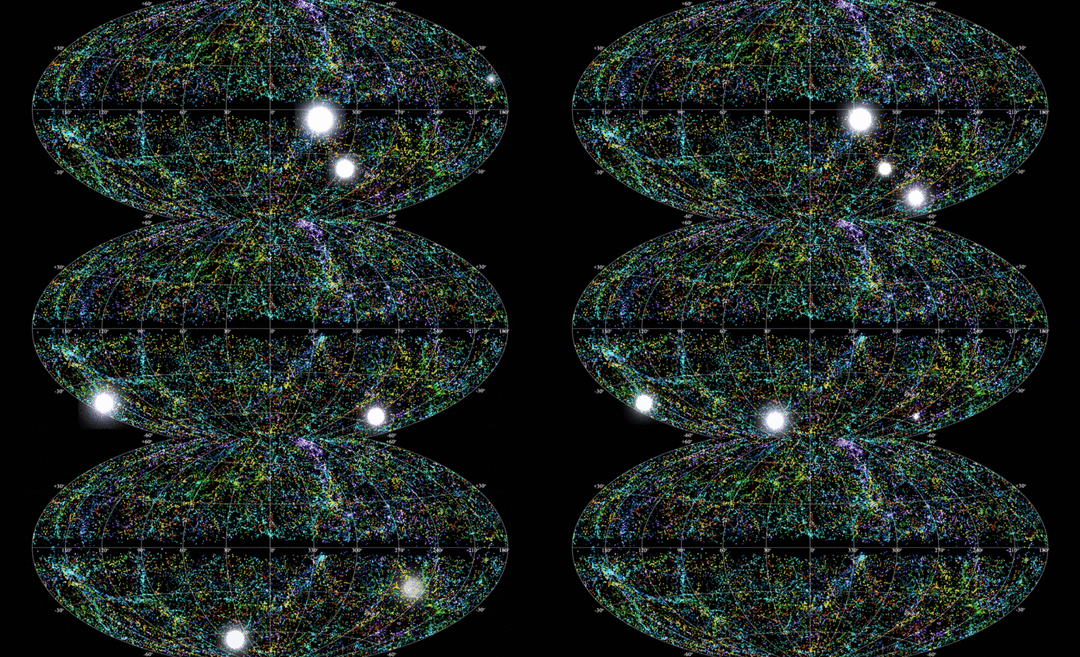 Random origins of FRBs in the universe. NRAO Outreach/Vimeo
Fast Radio Bursts (FRBs) are one of my favourite astronomical phenomena, because their cause or origin is still completely unknown (but see latest post 3rd April 2020!). They are very short bursts of radio-frequency radiation, lasting just a few milliseconds, but of colossal intensity (the equivalent of 50 million times the sun’s energy in those few milliseconds). There have been only about 37 catalogued to date, all one-offs except FRB 121102.
FRB121102 is a “repeater” – a series of bursts were observed coming from the same source in 2012, then again on several days in 2015, and 15 more bursts during 30 minutes in 2017. The origin appears to be a galaxy about 2 billion light years away.
Although spinning black holes and neutron stars are possible candidate for generating the FRBs, there is no regularity of pulse in the transmissions as there is with spinning pulsars. One outside, but not discounted, possibility is that the source of the FRBs is some sort of extraterrestrial intelligent action – an attempt at communication or the utilisation of power for some purpose.
The new news is that researchers have re-analysed the data from August 26, 2017, when 21 bursts were detected, and they have found another 72 pulses by using AI – a convolutional neural network.
Update 8th Jan 2019: A new Canadian Observatory called CHIME has reported finding another 13 FRBs including another repeater.
Update 14th February 2019: Observations reported today suggest that Superluminous Supernovae give rise to magnetars that then emit FRBs. More observations to follow.
Link to Scientific American article
Update 27th Jun 2019: Astronomers using the Australian Square Kilometre Array Pathfinder (ASKAP), a network of 36 radio telescopes, can now auto-detect and successfully triangulate to pinpoint the source of FRBs. Today they detailed one from the outskirts of a very different type of galaxy than the repeater mentioned above. This weakens the existing theory of the cause of FRBs.
Update 15th August 2019: The Canadian Observatory called CHIME has reported detecting many more FRBs – importantly 8 more repeaters. Repeaters are especially important because they make it much easier to locate the exact source, and therefore to study that source with other instruments. Given the variation in time between repeats it could well be that all FRBs are repeaters – some are just more active than others. However the repeater bursts last a little longer than one-offs, and the repeaters all seem to exhibit a downward drift in frequency, with each burst getting lower. The source galaxies of the repeaters are now being determined by the direction from which the burst came, as well as the distance – which can be determined by the signal dispersion. Intriguingly, one of the repeaters is relatively close by. In addition the polarisation of the signal indicates how extreme was the magnetic environment at source. One of the new signals had very low polarisation so it is now known that not all FRBs originate near black-holes for example.
Update 12th Feb 2020: A new paper published in Nature has revealed that one of the Sources of repeating FRB’s (in a relatively nearby spiral galaxy) seems to be repeating on a 16-day cycle. This promises to be a massive clue in deciphering the mechanism behind FRBs, though such a mechanism is not immediately obvious. Most repeating patterns rely on rotations, but the rotation rates of neutron stars, pulsars and black holes tend to be many orders of magnitude faster than 16 days.
Update 3rd May 2020: On April 28th a radio-burst was detected for the first time within our galaxy. This made it possible to triangulate to the source accurately – a magnetar SGR 1935+2154. There was also an X-ray burst. Accompanying X-ray bursts in other galaxies would be undetectable. The analysis is still preliminary, particularly to see if the spectrum matches the type detected from FRBs. But this may finally be the explanation of the source of FRBs.
Magnetars are a type of neutron star with an extremely strong magnetic field (origin not understood). The inward gravitational force is disturbed by outward magnetic forces producing deformation of the shape and instabilities. Magnetars are often observed to flare in X rays or gamma rays, but this is the first time a flare in radio frequencies has also been observed. It has been proposed that magnetar flares could also be detected emitting gravitational waves because of the oscillation of the shape of the magnetar.
Research article on the possible creation event of magnetars
Update 8th June 2020: Long-term observations on a particular FRB source have revealed a 157 day cycle: flare for 90 days, quiet for 67 days. The favourite explanation for repetitions is a wobble in the axis of a magnetar. However, this might be expected to result in a periodicity of tens of days, but 157 days seems unlikely. (The below article also contains an FRB converted to audio.)
Update 23rd October 2020: The magnetar within our galaxy that was observed emitting an FRB earlier this year, has been active again – 3 bursts during 2 or 3 seconds. It has been studied intensely since the first FRB – it has been found to emit a radio pulse regularly, corresonding to its rotation period, 3.2 seconds. This is only the 6th magnetar to be observed with a radio-pulse. The working hypothesis now seems to be that a magnetar evolves into a pulsar over time. They are of course both a type of neutron star.
Update 4th November 2020: A recent research paper has proposed a new theory on the mechanism of production of FRBs – that they are caused by asteroids or exoplantes orbiting a pulsar of magnetar. Those orbiting objects would interrupt the highly relativistic, highly magnetic ‘solar’ wind. Each orbiting object would facilitate a permanent radio signal, but would only be detectable by us when Earth momentarily lines up with the orbiting object and pulsar or manetar. Randomness could originate in multiple orbiting bodies and/or wind turbulence.
Update 14th June 2021: A new repeating FRB has been discovered in th relatively nearby galaxy M81. However, the source of the FRB has been tracked to a globular cluster in that galaxy which contradicts the emerging theory that FRBs come from magnetars, since globular clusters are ancient and would not contain magnetars. This, coupled with the dearth of discovered magnetars, not enough to account for the number of discovered FRBs, is suggesting that there must be another mechanism in addition to, or an alternative to, FRB production by magnetars.
Youtube discussion by Anton Petrov