Is the Universe finite or infinite?
We already know that the universe is flat – in 3D terms – i.e. parallel lines stay parallel. When considering these questions we often drop a dimension to make the ideas easier to visualise. So a piece of paper (2D) is flat – parallel lines drawn on it remain parallel, however long they are drawn. And the plane of the paper could go on for ever – it could be infinite. However if we wrap the piece of paper round to make a cylinder, it remains flat in the sense of parallel lines, but its size – at least in the direction going round – is now limited – it is not infinite. And if we further wrap around the ends of the cylinder to make a torus (doughnut) shape, then the size in all directions becomes finite.
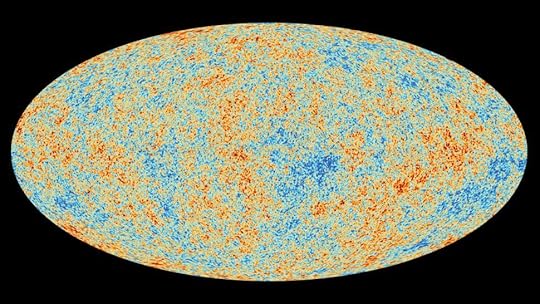
So a flat universe (geometrically) can still be finite or infinite (topologically). And it initially seems quite improbable that we could ever find out which it is in reality. But an exciting new study has approached just that. They reason that when the universe was young, then being a million times smaller, if it was finite, it would be much more likely to show the ‘joins’ within the then observable universe. Thus, looking at the CMB (Cosmic Microwave Background) (or ‘first light’ that we still see today), any variations would not be bigger than the distance across the then universe. And indeed any large perturbations are apperently lacking in the CMB. They then set about running computer simulations to assess what the CMB would look like starting from various sizes of simulated universe. The results give a best fit to a finite universe which is currently 3 or 4 times the size of our currently-observable universe…
https://arxiv.org/abs/2106.13205
https://arxiv.org/abs/2106.13205 https://www.livescience.com/universe-three-dimensional-donut.html?utm_source=notification