
The Unknown
We went to Ypres, in Belgium: a city perhaps most notable nowadays as the location of one of our most significant war memorials.
The Menin Gate is the site for the ‘Last Post’ ceremony, taking place every evening at 8pm, since July 1928 (except while the city was occupied by the Nazis, in the Second World War).
The scale of the Menin Gate is alarming: a barrel-vaulted passage wide enough for traffic to flow into and out of the city. On walls that stretch much higher than one can comfortably study, there are names inscribed: each name a soldier who gave his life in the 1914–1918 conflict. As the visitor glances from panel to panel, they realise how little they really know about the defining conflict that was optimistically termed the “War to End All Wars.” All those regiments raised among the Empire, for example: included are the names of 400 Indians who died far from home.
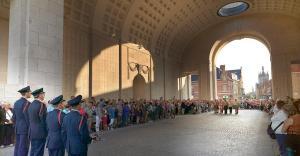 Last Post Ceremony
Ypres is a beautiful city, nowadays. It’s home to some good people and some great beers. The cuisine is fine and the countryside beyond the walls is lovely as well. Perhaps these were worth fighting for, back then.
We’re not done with the scale of the place, though. Halfway down each side of that inscribed, vaulted tunnel is a passageway. Each leads through to a double stairway that gives access to the city battlements – and like the main vault itself, these stairways are lined with panels bearing the names of the dead: so there are names recorded not only inside the Menin Gate, but also on its periphery. More names; more young lives lost.
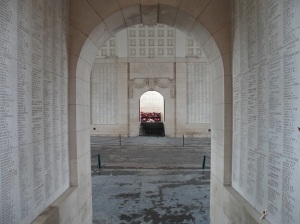
On one of these outer sections I noted the relatively small number of casualties recorded for the Heavy Section of the Machine Gun Corps – an early name for a new kind of soldier: tank crews. Their new weapon would ultimately play a large role in ending the deadlock of the trenches, and I was grimly satisfied to see relatively few casualties recorded.
This was a mistake, though, as you will appreciate if you understand the purpose of the Menin Gate memorial.
Back inside, an inscription reads:
“Ad Majorem Dei Gloriam – Here are recorded names of officers and men who fell in Ypres Salient, but to whom the fortune of war denied the known and honoured burial given to their comrades in death.”
You see, this massive structure doesn’t record the names of all who died: it’s a place to remember the missing; the unrecognisable; the lost. Those who could be identified acquired a grave: perhaps one among the vast array of headstones that you can see at Tyne Cot, and elsewhere. The tank crewmen in which I had taken an interest were not miraculously unscathed: they were just more readily identified if found in the wreckage of their vehicles – and thus buried elsewhere, with a marker showing their name.
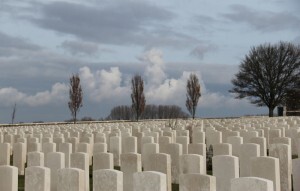 Tyne Cot Cemetery
The Menin Gate commemorates only those for whom there is no known resting place – and only Commonwealth troops, which is to say only those on one side of the fighting. 54,395 of them. That lump in your throat, when you first see all those thousands of names inscribed on the walls… magnified when you realise that there are thousands more lining the four stairways that lead up to the ramparts… well, these are only the troops from Britain and the Empire… oh, and it doesn’t include the men from New Zealand and Newfoundland who have their own memorials elsewhere. Finally, get this: there’s a cut-off date. The memorial is full, so the names of another 34,984 soldiers who died after August 15th 1917 are inscribed on the Tyne Cot Memorial to the Missing instead.
Every soldier had not just a name, but a story. A pair of boots. Some personal effects… and likely some loved ones who would never see him again.
Overwhelming.
[image error]The excellent podcast series 99 Percent Invisible offers an interesting counterpoint to this piece on our unknown servicemen, in the form of a recent episode, “The Known Unknown.” You really ought to listen to it – although if you do, you may find yourself outraged by the underhanded actions of US authorities when seeking to procure an “unknown” service casualty from the Vietnam War.


