
Q&A WITH KATE THOMPSON
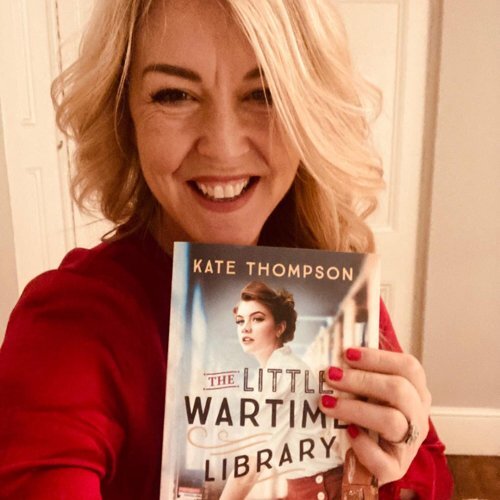
Readers who follow saga authors on Facebook cannot have missed the wonderful posts by author, Kate Thompson where she writes about libraries, librarians, and readers. This is to celebrate publication of The Little Wartime Library; however, the research is so meticulous, and the writing so interesting could there possibly be more than first meets the eye…?
Let’s enjoy Kate’s informative answers to my questions and find out more.
Welcome, Kate and congratulations on your latest book, The Little Wartime Library. I’ve been fascinated by the articles posted to your Facebook page about librarians and library memories. Can you tell us why you decided to write these historical pieces?
Firstly, thank you so much for having me. It’s always such a treat to appear on your blog, Elaine.
As always, with my fiction, it’s inspired by a true story or real events. The Underground library at Bethnal Green struck me as magical and surprising, full of intrigue and jeopardy, the perfect setting for a novel.
Contrary to popular belief, during the Second World War, not all shelterers slept in an amorphous huddle on a dirty Underground platform.
Bethnal Green’s secret Underground wartime library offers up a remarkable story that reveals how, even in the darkest of times, working-class East Enders had access to books, entertainment and culture.
On 7 September, 1940, a bomb had crashed through the roof of Bethnal Green Central library. In a split second, what had been an orderly and well-equipped library became a scene of destruction. For borough librarian George F. Vale and his deputy, Stanley Snaith, the underground village that had developed at Bethnal Green station was the perfect opportunity to set up a makeshift library and provide the local community with access to free books once more. “The opportunity of founding a Tube shelter library was too good to miss,” librarian Stanley wrote in an article in Library Review in the spring of 1942. “It is, perhaps, the least pretentious branch library yet built. Fifteen feet square, it is mere sentry box of a place. We could have done with more room but the powers that be did not see eye to eye with us.”
The library, which had a captive audience during a raid when the doors to the shelter were locked, was open from 5.30 - 8pm every evening and loaned out 4,000 volumes that survived from the bombed out library above. Romance sat alongside literary classics, children’s books, poetry and plays. Treasure Island, Secret Garden and many other classics, including Enid Blyton, nourished young minds and helped children to escape the nightmares above.
“Libraries in converted shops, in village halls, in mobile vans, are common enough. But libraries in Tube shelters are something new under the sun,” Stanley wrote with pride.
Can you imagine growing up in a Tube station, your childhood unfolding next to the tracks, all your rites of passage taking place in the booking hall or along the tunnels?
Patsy Crawley, 84, from Essex doesn’t have to. The first six years of her life were spent mostly down Bethnal Green Tube shelter. “It sounds funny now, but back then it was just normal. I knew no other life,” she laughs. “My mum Ginnie volunteered at the Tube shelter cafe. She was such a lovely, smiley lady, always bustling round a million miles an hour in her apron. When she was working, I’d knock about with my six male cousins. We had such fun running up and down the tunnels like little tube rats. We used to dare each other to go in the room of horrors as we called the ventilation shoot. It was strictly forbidden but being adventurous kids, we climbed up. All the kids used their imaginations, playing hopscotch, skipping, IT and kiss chase up the tunnels.
“During the war, the facilities were amazing down the Tube; it had everything you needed. There was even a mobile hairdresser, who used to come down the tunnels doing people’s hair out in rags before bed so they woke up with nice curly hair. Terrific!
“When war was over, I missed life underground, and even now when I go to Bethnal Green and see the Tube sign, I feel a warmth spread over my chest. To others, it’s a transport network; to me, it was my home.”
That little wartime library lingers long in the memory and in many cases, triggered a lifelong love of reading.
I have a memory, from when I was three years of age when my mum took me to our local library to choose a book. What is your earliest memory of visiting a library?
Aah I’m so pleased you asked this. I invite you to think of your childhood library without a nostalgic smile, it’s impossible isn’t it!
As a child, in the 1970s and ’80s, I loved visiting my local library. Coming from a noisy household, I embraced the feeling of solitude and order. As soon as I caught the intoxicating scent of old paper and polish and heard that satisfying thunk of the librarian’s stamp, I relaxed. It was no red brick, or arts and crafts architectural beauty, more of a concrete civic centre box, with scratchy grey carpets and spider plants behind the desk, but that didn’t matter. It was a destination and I can still vividly remember the feeling of calm and freedom that came over me as I walked through the door. It was my haven.
First came the ritual of choosing the book, then I’d take it to the furthest end of the library, rather like a dog scurries off with a juicy bone, sit on a small green plastic chair and fall into a book, while my mum stood at the counter and gossiped (in a theatrical whisper) with smiley Jacky the librarian, who always let her off the late fines. I vividly remember thinking as a small child, how interesting, so rules can be broken!
What did your childhood library look, feel and smell like? Bet you can remember!
Like most, when it came to Enid Blyton I virtually read the print off the page. Malory Towers gave me the keys to a boarding school experience I’d never have. Black Beauty the opportunity to own the horse I so desperately wanted, The Secret Garden the delicious possibility of finding undiscovered doors.
It unlocked my imagination in a way that always made me feel safe. Without weekly trips to my local library, I’m fairly certain I wouldn’t be a writer today and I’m forever grateful to my mum for taking me.
You have written many interesting accounts of libraries during the war years. Has there been one that surprised you, or perhaps triggered an idea for another novel?
Funnily enough, I loved hearing about The Peckham Bag Wash Library, as described to me by Ida Brown. The Bag Wash library was an unofficial and free little library set up in a launderette in South London in the post-war years. I love the potential to escape into a world beyond the mundanity and domestic drudgery of life.
‘You could donate and borrow all free of charge,’ Ida told me. ‘Everyone was so honest and considerate in returning the books so that others could enjoy them too. The Little Bagwash Library triggered a love of reading that has lasted all my life.’
A library doesn’t have to be grand or substantial to make a difference. Just as the little wartime library triggered a lifelong love of reading to so many East Enders, so too did a shelf of battered paperbacks in a London bag wash to Ida Brown. The point is that the best libraries change and transform lives, introducing us to books that make us view the world differently.
As a full-time writer can you share how you plan your writing day, especially during school holidays!
Ha good question, that suggests a level of planning and organisation on my part. I’m typing this now as my children eat dinner and are otherwise occupied. In truth, not a lot of work gets done in the summer holidays. I’m acutely aware how short childhood is so don’t want to spend most of it working, so it’s really a case of juggling.
In term time, I’m much more disciplined. Once the boys are packed off to school, I’ve walked my two rescue Lurchers, Ted and Sapphie, then it’s bum on seat and just stay there until I’ve done a decent chunk of writing.
There’s no point waiting for ‘inspiration’ or ‘magic’. Writing is hard graft and I do feel you have to show up every day and commit to the book, until that wonderful moment where your characters start to feel real and alive.
I spotted that you like to give talks about your books. Can you give a couple of tips to newly published authors who may be contemplating stepping out of their comfort zone to speak to readers?
Oh lord, I wish I did feel comfortable and confident, but the honest truth is, I’m terrified every time I do it. Being centre stage is not a place where I am naturally at ease so I do make sure I am fully prepared and have thought through exactly what I want to say. That and plenty of Rescue Remedy helps! The biggest draw, and the thing that keeps me going and makes me step outside that comfort zone, is talking to readers afterwards. Connecting with your readers, listening to their stories and hearing why your books resonate is a joy, it’s the chief reason why writers write I think, so we can connect to people. I had an email from a lovely expat in Australia last week who told me how much she loved the Wartime Library as it took her back to, and reminded her of, her childhood library in England and all the books she used to read as a kid, like Enid Blyton. The book made her feel happy and took her out of herself. You can’t ask for more than that.
What can we expect next from author, Kate Thompson?
Good question. After I’d written a number of books set in the East End, I wrote a non-fiction book based on the lives of all the real women I had interviewed as research for my books. That was called The Stepney Doorstep Society. I am now thinking about something similar as a way of using all the amazing stories I have heard from all the librarians I have interviewed. A library is a microcosm of society and all life flows through its doors. I have heard some eyewatering tales. It strikes me that a librarian is a front line worker, in the way that a social worker is. Library Stories could be a way of sharing all those incredible little tales. Watch this space.
Where can we purchase a copy of The Little Wartime Library?
From September 1st at Tesco, Amazon, Waterstones and of course, for free from your local library. The book will also be available from mid-October at Sainsbury’s.
 The Little Wartime Library
London, 1944.
Clara Button is no ordinary librarian. While the world remains at war, in East London Clara has created the country's only underground library, built over the tracks in the disused Bethnal Green tube station. Down here a secret community thrives: with thousands of bunk beds, a nursery, a café and a theatre offering shelter, solace and escape from the bombs that fall above.
Along with her glamorous best friend and library assistant Ruby Munroe, Clara ensures the library is the beating heart of life underground. But as the war drags on, the women's determination to remain strong in the face of adversity is tested to the limits when it seems it may come at the price of keeping those closest to them alive.
Based on true events, The Little Wartime Library is a gripping and heart-wrenching page-turner that remembers one of the greatest resistance stories of the war.


Elaine Everest

- Elaine Everest's profile
- 190 followers

