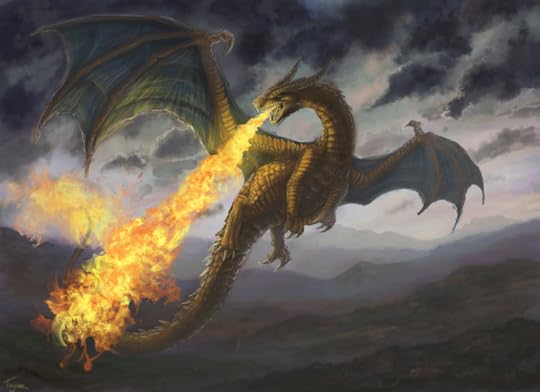
Fire breathing Dragons
Dragons are among the most well-known and persistent of the world's mythological creatures, with millennia of belief in their existence.
Dragon stories can be found throughout the world, from the Americas to Europe, and from India to China. They have a long and rich history in a variety of forms, and they continue to appear in our literature, movies, and television shows as courageous heroes strive to slay the beasts on a regular basis. It's unclear when or when dragon myths initially appeared, but the massive, flying serpents have been recounted since the time of the ancient Sumerians and Greeks.
When Christianity expanded over the world, dragons took on a more ominous meaning and became associated with Satan. Most individuals who heard about dragons in medieval times knew them from the Bible, and it's possible that most Christians at the time believed in their physical existence. After all, Leviathan, the gigantic creature detailed in Chapter 41 of the Book of Job, sounds like a dragon: "Its back has rows of shields tightly sealed together; each is so close to the next that no air can pass between. They are joined fast to one another; they cling together and cannot be parted. Its snorting throws out flashes of light; its eyes are like the rays of dawn. Flames stream from its mouth; sparks of fire shoot out. Smoke pours from its nostrils as from a boiling pot over burning reeds. Its breath sets coals ablaze, and flames dart from its mouth."
Dragons were believed to be based not only on mythology but also on hard proof, or so people thought long ago. For millennia, no one understood what to make of the massive bones that were sometimes discovered around the world, and dragons looked like a natural alternative for those unfamiliar with dinosaurs.
While most people can easily imagine a dragon, people's conceptions and descriptions of dragons vary greatly. Some dragons have wings, while others lack them. Some dragons have the ability to talk or spew fire, while others do not. Some are merely a few feet long, while others are several miles long. Some dragons reside in underwater castles, while others, like Smaug in JRR Tolkein's "The Hobbit," can only be found in caves and inside mountains.
The name "dragon" comes from the ancient Greek word "draconta," which means "to watch," implying that the beast guards valuables, such as mountains of gold coins or gems. But this doesn't make sense because a powerful monster like a dragon shouldn't have to pay for anything, right? It's probably more of a metaphorical treasure, a reward for valiant warriors like the Knights of Camelot who would defeat the evil beast, rather than a treasure for the greedy dragon.
Dragons are one of the few monsters in mythology who are primarily depicted as a powerful and terrifying foe to be defeated. They don't exist solely for their own sake; they mostly serve as a foil for daring adventurers. Other mythological creatures, such as trolls, elves, and fairies, interact with humans (sometimes maliciously, sometimes usefully), but their primary function is not warfare.
Legends of pure and godly saints battling and vanquishing Satan in the guise of dragons were produced by the Christian church. According to English Heritage, the most famous of these was St. George the Dragon Slayer, who, according to legend, came upon a village endangered by a huge dragon. He saves a beautiful woman, wards off the beast with the sign of the cross, and kills it. The residents of the town are promptly converted to Christianity after witnessing St. George's faith and bravery.
Scholars believe that dragons got their fire-breathing ability from medieval images of hell's mouth, such as works by Dutch painter Hieronymus Bosch and others. The entrance to hell was frequently represented as a monster's mouth, with Hades' signature fire and smoke erupting out. The connection is logical if one believes not only in the literal presence of hell, but also in the literal existence of Satanic dragons.
Aside from medieval theology, few people today believe in the physical reality of dragons in the same way they believe in Bigfoot or the Loch Ness Monster. The dragon (or at least the one most recognized to Westerners) is simply too large and magnificent to be taken seriously. It's simply improbable that any huge, winged fire-breathers inhabit Earth's lands or skies unnoticed in this day of satellite imagery and smartphone photographs and movies.
Regardless, dragons have existed in some form or another for millennia. They have sparked our collective imagination through epic fantasy fiction by J.R.R. Tolkien and others, and show no signs of dying out anytime soon.