Anandavardhana and Humma
It is difficult to overstate, the eminent position that poetician and aesthetician Anandavardhana enjoys in the poetics tradition and, the praise he receives from critics of all times and from across the world. While the tussle had always been about pointing at particular features of Kavya for the essence of poetic value, Anandavardhana altogether smashed the tradition by asserting that all meaning and beauty of a poem came from what was not said. Notwithstanding whatever the words and form in poetry and art, something else is suggested –and that is the true meaning and there lay its beauty (Abhinavagupta his commentator and best champion of course claimed that this supplied by the reader/Sahrudaya). And I believe Maniratnam, completely unknowingly I am sure, has taken a page from Anandavardhana’s Dhvanyaloka.
Let me just zoom into one particular discussion between Ananda and his adversaries the Alankarikas (those who claim that the figures of speech like simile and metaphor make up poetry). He had already destroyed them once by claiming his view of poetry was distant from their claims for the simple reason that they are chained by the meaning that emerged from words. But now they come back ever stronger and with a fair argument – what about Samasokti, Apeksha, Anukti, Nimitta, and Paryayokti – where there is a through and through double meaning. To that, not so easy, says, Anandavardhana. For example he takes up Samasokti (“Condensed metaphor”) and an instance where the moon pushes itself into the night sky, which celebrates with glee and all its stars not minding the enlightenment of its darkness. To the Alankarikas, this is truly a metaphor a girl not paying attention to her top falling off as her boyfriend kisses her. This is not all that far from the landing of the bee or the dragonfly on the lotus or any other plastic flower in vintage Indian films to suggest sexual. Worse, there is that embarrassing shot of flowers kissing to imitate our kissing couple. These scenes have been substantially and rightfully been jettisoned – for they are utterly prudish.
To Ananda however the problem with Samasokti is not that it is prudish – but that instead it is not creative. This is not the highest order of poetry. Why? He says that in these Alankaras (he takes up not just Samasokti but all the sophisticated ones) the implied meaning emerges after one processes the literal meaning – hence the former is still subjugated to the latter. Now that is not what is suggested meaning to him. He sets up instead, a master example. In summary it goes like – on what hill did that little parrot commit a penance to earn the opportunity to bite a fruit like your lips? All hail Anandavardhana! All the narrator wishes to say is that he wants to kiss the girl but not once does ‘he’ occur in the example. At the same time unlike Samasokti, the meaning is not too elliptical and not chained to metaphors – in fact it is entirely straightforward and at the same time completely suggested.
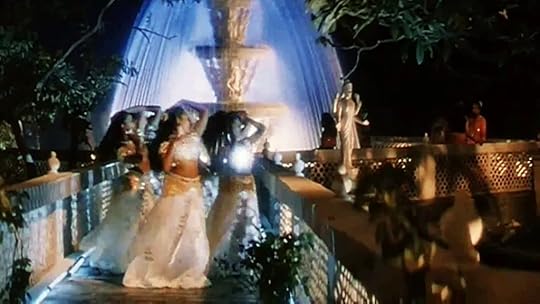
Like bees and flowers, Humma Humma in Bombay suggests the consummation of the marriage of the lead couple Manisha Koirala and Aravind Swamy but here, the dancers Sonali Bendre and Nagendra Prasad are no metaphors to a man and woman having sex. They are simply dancing. There is no neat connect but at the sametime any adult person watching the video of Antha Arabi knows that the song stands for the sexual moment. Love-making is entirely suggested and it takes no complicated algorithm to figure that out. And the genius of the song composed by AR Rahman is in instead channeling the mood and flavour of the act – no one line in the song or no phrase in the dance directly metaphorises sex but simply watching this piece of art dips you in the rhythm and movement of the act, the quirkiness of the participants, the unknowabilty and excitement of the moves, and sheer amazement. Is it any wonder than that Humma never came under fire for being prudish despite not depicting sex as it is?
Rahman and Maniratnam have created something Anandavardhana would approve of.