
MTF Sparks Rijeka
Last month, I spent a week in Croatia running a Makeathon for fifty students aged around 12-14.
The purpose of the event was actually to teach a group of teachers from around the country in how we organise and facilitate these kinds of events. At MTF Labs we’ve had a good deal of success in EU Erasmus-funded youth education programmes that bring together arts and technology, and we’ve developed some good methodologies for this. In fact, in our last Erasmus project we were evaluated at 100/100 for a 2-year project that was modelled on and further developed our hands-on education methods.
It’s fair to say that 100/100 is a pretty good evaluation for a publicly-funded education project that runs multiple makeathon events across five countries in two years during a global pandemic. So we got asked to teach others how we do what we do.
As part of this, I wrote a 40-page handbook for the teachers and I’ve set it up in such a way that we can update and develop it as we progress our work in this area.
MTF Sparks Rijeka was commissioned to be part of an EU-funded Croatian project called STEM(AJMO!) – a wordplay on Science, Technology, Engineering and Mathematics (STEM) and (in Croatian) “Let’s Go!”.
Our instructions were simply that a) the students should make something, and b) the teachers should be trained in our methods. Whatever the end result was to be, it would be showcased in a larger event called STEM Piknik, held in the city on the Saturday morning.
We decided they would make robots.
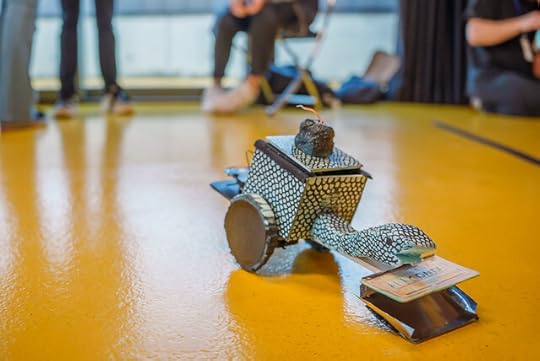
It’s important to note that in our methodology, these events are designed to be collaborative and not competitive.
Tom Fox from the MTF team created a game in which all of the students won when their robots successfully collaborated to achieve an objective that was tied to the UN Sustainable Development Goals, which was another thread of our educational input.
The students worked incredibly hard, made amazing inventions (despite a few technical challenges) and, in the game, ‘Humanity was saved’ to much celebration.
Sadly, the organisers insisted that we give out prizes to ‘the best teams’ – and instructed us that this was a mandatory component of the event. To soften the blow a little, we prioritised creativity, collaboration and peer mentorship as the criteria, but even so, it had the effect of undermining the whole collaboration lesson – and of course, upset quite a few of the students who’d done brilliant work, but ‘failed’ to win a prize.
All the same, we’ll definitely use this approach again – and next time we’ll insist right up front (rather than assume its obviousness) that we will celebrate collective success – and prizes will not detract from that. Either everyone gets an award or certificate – or nobody does.
If you’re interested in these sorts of events, feel free to have a read of the Makeathon Manual. I’d be more than happy to work with you on something like this.
The post MTF Sparks Rijeka first appeared on Dubber.

Andrew Dubber's Blog
- Andrew Dubber's profile
- 2 followers

