
Nostalgia
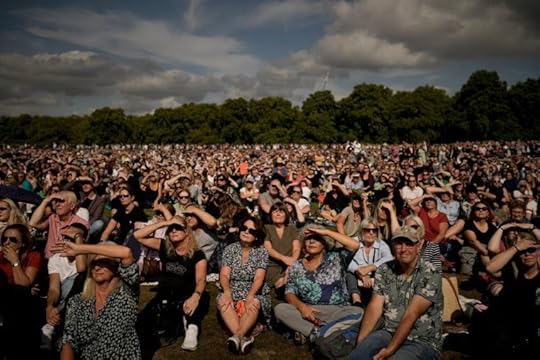
It’s the summer concert season when London becomes host to an extraordinary number of major recording artists performing on stages in and around the capital. From Hyde Park, to Wembley, Tottenham Hotspur Stadium, The Emirates, Twickenham, Finsbury Park, Gunnersbury Park, Brockwell Park, Victoria Park, The 02, Alexandra Palace, Kew Gardens, Somerset House, Crystal Palace, there doesn’t seem to be a square inch of space where some enormous PA hasn’t been installed, along with the attendant merchandise stalls, burger vans, mobile phone recharging units, and portaloos.
Depeche Mode, Arctic Monkeys, Beyoncé, The Red Hot Chilli Peppers, Harry Styles, Def Leppard & Motley Crue, Blur, The Weeknd, Pulp, 50 Cent, The Who, Iron Maiden, Kiss, Peter Gabriel, Wu Tang Clan, Roger Waters, Duran Duran, Fat Boy Slim, The Human League, Iggy Pop, Blondie, Primal Scream, Noel Gallagher, Pink, Guns ’n Roses, Bruce Springsteen, Billy Joel, Take That, Lana Del Rey, and Black Pink, have all blown into town during the last eight weeks to perform. And that’s just the more notable headliners.
Many of the ticket prices have been well north of £150, yet thousands of punters have been willing to pay. Despite the sneering comments of some, the gigs have been well-attended, most of them sold out. There is clearly an appetite for an ‘experience’, to be part of whatever is going on. The hangover of being locked away during the Covid crisis of 2020-21 is only now being shucked off, the public eager to make the most of their freedom. No matter the cost of living crisis, a ‘live today, pay tomorrow’ attitude is at hand. But it’s combined with something more.
Beyond the need for a sense of the communal, to be part of something shared that’s happening right now, is also the nagging feeling that when it comes to some of the artists — both the old and middle-aged — this might be the last time to see them. Certainly it might be the last time when the artist in question is able to put on a performance of worth, or at least one that captures — if only fleetingly — their energy of old. Close your eyes and you might possibly find yourself transported back to that gig at The Rainbow, The Hammersmith Odeon, The Astoria, The Roundhouse before its makeover.
An exercise in nostalgia is in full effect, one full of joy and happy memories. And that’s no bad thing, except that it’s finite. There are only so many times you can dig out such memories, activate the same poignant recognition of what the songs meant to you the first time around.
Blur is a perfect example. They performed their first reunion gig in 2009. It was an excellent show, a pleasure to celebrate hearing the songs of the last ten years once again. The band reformed again in 2012. I can’t remember why — money perhaps, or maybe because the the Hyde Park concerts had been received so well. They then played a series of shows in 2015. This summer — some 8 years later — the group have reformed once more, playing two nights at Wembley and various other gigs around the world. Yet they have released only one new album since their heyday, The Magic Whip, (to no great acclaim), though are about to release a new set of songs in the coming weeks. But most of their set-list is pulled from tracks released between the years 1991 and 2003, allowing a generation of 40 and 50 years olds to relive their youth; the sun-blanched days of Britpop, Euro 96, and holidays in Greece. Kids become parents, parents become grandparents.
The collection of concerts currently taking place in London reflect this generational separation. Pop music, once essentially the persevere of the young, has now become a signifier of where you are in life and the soundtrack that shaped your identity. There is some bleed-through, but watching the crowd arriving for Bruce Springsteen last Saturday night, it was noticeable that most of the 20-somethings were the kids collecting rubbish or working the gates. No doubt the demographic make-up for Black Pink was skewed in the other direction, the same youngsters however still doing the lousiest, mind-numbing, and lowest-paid jobs.
What this means going forward is anyone’s guess. How much longer will people turn up to see the icons of Rock and Pop trawl through their repertoire, one that rarely changes from one tour to the next. Will people need to see The Rolling Stones one more time? Or McCartney for that matter? And when such ‘legends’ are gone, who will replace them? Will the likes of Blur and The Red Hot Chilli Peppers continue to draw a similarly loyal crowd.
Next year, all the talk is of Taylor Swift and her five nights booked at Wembley. There’s also of course the perennial debate about a potential Oasis reunion and how much the Gallagher brothers will need to be paid for it to happen. But scanning the landscape it’s hard to see what might keep audiences coming back year after year and in such numbers. The familiarity of the experience is bound to have a diminishing effect.
Or maybe not, each generation behaving like the one that’s come before, looking to enjoy an evening of reminiscing and a good old-fashioned sing-along.
Whether this results in interesting music or pushes the dial of creativity on however, remains questionable. The live music experience, certainly when it comes to outdoor events, has transmogrified into something very different from the intense and intimate, sometimes spellbinding, shows that occur in theatres or clubs. But maybe that isn’t so important to people anymore. To be present at such moments one has to show commitment, to pay attention, to turn up early, before a band has found a mass audience. There are too many distractions, demands on most people’s time to expect such thing. Far better to wait until a band has proven themselves, established a body of work you can trust. That’s when it make sense to shell out the money, guaranteed of a good time, a handful of songs you know, and an extensive food and drink menu to keep you going.
9/7/2003


