Sculling
What is Sculling?
I don't mean saying cheers in Swedish: skål, or Icelandic: skál. Sculling is a term used to describe two ways of propelling aboat using oars. One of those can also be used to propel a boat using apaddle. As a kayaker and canoeist, I'll focus on efficient paddle technique, but here is some context first.
Sculling or rowing?Technically, there is a difference between sculling androwing, particularly in competition, although the two terms are often used indiscriminately. Rowing (or sweep rowing) requiresat least two oars, one oar for each rower. In other words, at least two people are needed to row, one oar each side. Only one person is needed to scull, using a pair of oars, one ineach hand. But there is another way to scull. A single person can propel aboat using a to-and-fro movement with one oar, usually over the stern, although sometimes at the bow or over the side.
Grab and pull method. (Or grab and push).The sculler, facing the stern of the craft, grabs the waterwith both blades and pulls against them to propel the boat forward. Thefamiliar sight of racing sculls with the scullers sitting low to the water, facing the stern using two oars, is a classic example, but many people scullsmall boats using two oars while facing forward. In this case the sculler grabsthe water with both blades and pushes the craft forward.
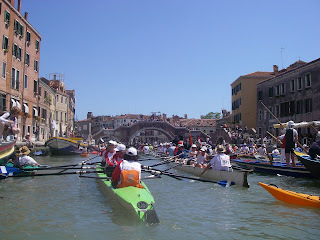 The three scullers facing the stern of the green boat worktwo oars each. The helmsperson (coxswain) in the back faces forward. Venice Italy.
Side-to side method, single oar.
The sculler swings a single oar thwartwise (from side toside) with the blade aligned to push the boat forward with every sideways swing.
.JPG)
Sculling a sampan with a single oar over the stern, using aside-to-side movement. Suzhou China.A combination of the two techniques
Gondoliers use a modified version of sculling, using asingle oar while standing in the stern facing the bow. They use the scull witha rowlock (the forcola) to one side of the stern, using a combination of the “grabthe water and pull” action, and the “to-and-fro” movement. They never switchsides and mostly keep the blade in the water during recovery between strokes.The gondola is asymmetrical to make steering easier since the gondolier usesthe oar to both propel and steer, always on the same side. The elevatedposition of the gondolier allows the oar blade to stay closer to the hull, makingthe gondola easier to navigate through the narrow Venetian canals. A sculler ina racing scull sits low, the oars reaching wide.
 A gondolier sculls using a single oar to one side of the hull near the stern. Venice Italy.Over-stern sculling
All over the world, especially in Asia, a similar scullingmovement is used over the stern of the boat. The back of a single oar or paddle,whichever is used, is engaged in a pushing mode. The leading edge of the oar isslightly closer to the stern than the trailing edge.
 Sculling a Sampan with single oar blade in pushing mode atstern, Suzhou China (Above and in Video below)
Over the bow sculling
Coracles are circular, bowl shaped, so the bow in this case is more of aconcept rather than a design feature. The paddler kneels or sits, sculling thecraft with the face of the blade engaged, in pulling mode at the front. Thecoracle is used for fishing with a net, when the short paddle used single-handedlyfrees the other hand to work the net. Coracle - Wikipedia.
The sculling draw, to move sideways.Canoeists and kayakers use sculling to pull their craftsideways with the face of the blade engaged. (We also use a similar blade actionbut starting with the blade flat on the water and moving the blade across thesurface in the manner of a knife spreading butter, to aid or to recover balance.I’ll go into how to use that, another time.)
The blade action is a to-and-fro movement, with a slightadjustment of blade angle with each swing. The blade movement is most easilyunderstood if we first imagine a pendulum action with the blade in neutral. Thatis, sliced edge-first with no pressure on either the face or the back of theblade.
If we angle the leading edge of the blade slightly away duringeach swing of the pendulum, the blade will try to climb sideways away from us.This is the pulling mode. This is the style used to pull a canoe or kayaksideways, or a coracle forward.
 Pulling mode, heredragging the dock toward the right. For clarity, blade is shown partly immersedbut it should be fully immersed when in action
If we angle the leading edge of the blade slightly closerto us than the trailing edge, the blade will try to climb sideways closer tous. This is the pushing mode, used for over-stern propulsion, and also to pusha kayak or canoe sideways.
 Pushing mode, here pushing the dock toward the left. Forclarity, blade is shown partially immersed. It should be fully immersed inaction.Refining the paddle stroke.Keep blade upright to go sideways, or flat to aid support.
The stroke is most effective at pulling the craft sidewayswhen the blade is held upright: perpendicular to the water, with the bladefully immersed. The closer the bladeangle approaches horizontal, the less effective it gets at pulling sideways; itclimbs to the surface rather than sideways from the craft. When it climbs tothe surface it may be used to aid balance or recover it. A 45-degree angle tothe water surface will offer a lot less sideways pulling effectcompared to a 90-degree angle.
Here, the blade is used one-handed in pulling mode, the shallow waternecessitating a low blade angle to the water of about 45°. While less effective at this angle, you'll notice it did offer some balance support. Lake Toba Indonesia
Positioning the top hand directly above thebottom hand throughout the stroke will prioritize the sideways pull, while lowing the top hand to thelevel of the deck will make the blade more useful in maintaining balance.
To maximize sideways movement, rotate your torso to faceyour direction of travel, hold your top arm straight, horizontal at shoulderlevel, over the water perpendicular to the side of the kayak. Control the blade angle withyour lower hand. Pause momentarily at the end of each swing while you changethe blade angle.
Try using the paddle in the manner of a pendulum, with the tophand in a fixed position and compare the effectiveness to when you move botharms together, keeping the top hand vertically above the bottom hand. Doestorso rotation help your draw stroke?
Figure of eight. Watch your blade carefully throughout the stroke. During thepause at the end of each swing, when you change the blade angle ready for thereturn swing, your kayak or canoe will slide closer to the blade. To allow forthis, the blade must creep a little farther from the hull during the followingswing. This makes the motion of the paddle naturally describe a figure of 8, (8 onits side against the hull as shown) even when you try to simply pendulum the blade in straightlines.
 There is no need to deliberately focus on describing a figure of 8 withthe blade, as this will occur naturally. Any deliberate pull toward the hull at the end of each swing will tend to makethe kayak yaw while moving sideways.Steering while moving sideways
You can steer by sculling with a lesser blade angle in onedirection than in the other. You can also turn by sculling only at one end ofthe craft, leaving the other end almost stationary. Play with it!
Find more tricks and tips in my book, The Art of Kayaking.
Learn more about the author at nigelkayaks.com