
The First Cousin’s War? The Two Matildas and the Anarchy
The Wars of the Roses of the Fifteenth century is sometimes known as the “Cousin’s War” because of the relationship of the leaders. Henry VI of England was a cousin of Richard Duke of York and Edward IV, Edward was by turn a cousin of the Earl of Warwick, etc.
My second book which will be a biography of Henry VI’s Queen Margaret of Anjou, covers the Wars of the Roses, but today I’m going back to a period four centuries earlier to examine some of the key players of a period known as The Anarchy.
The Anarchy was a civil war which raged in the first half of the 12th century between Maud (or Matilda) the daughter of Henry I and Stephen, the nephew of Henry who claimed the throne when she was still living with her husband in France.
Maud and Stephen were of course first cousins, as the offspring of two children of William the Conqueror. Stephen was the son of Adela, the Conqueror’s daughter.
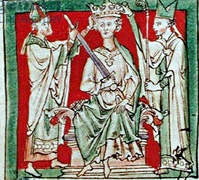
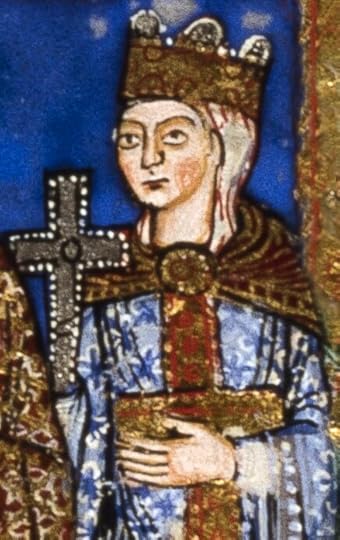
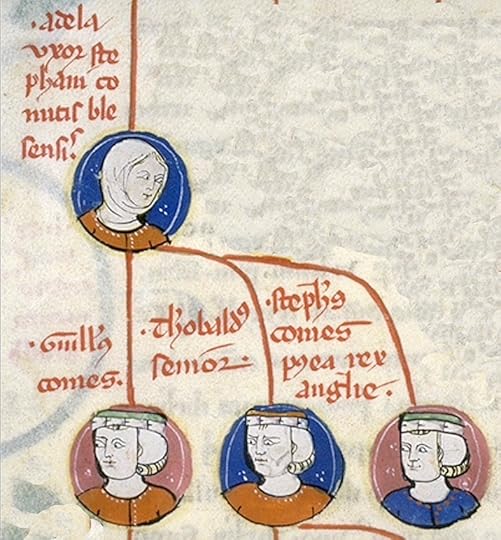
However, what is not widely commented upon is that Stephen’s wife, who was also named Matilda, was also the first cousin of his arch-rival Maud. Maud’s mother was Matilda of Scotland (her birth name was Edith) the daughter of St Margaret of Scotland a woman of Saxon heritage and King Malcolm III of Scotland. Stephen’s wife, Matilda of Boulogne was the daughter of Mary of Scotland, Matilda/Edith’s younger sister.
Matilda and Henry arranged Mary’s marriage to Eustace, Count of Boulogne sometime in the first decade of the 12th century. She was only a few years younger than the English Queen, and both seem to have been educated at Wilton Abbey, then lived at the royal court.
Mary herself, despite being married to the Count of Boulogne retained strong connections with England and was buried in the Benedictine Abbey which once existed in Bermondsey.
Although Maud is more famous, Matilda of Boulogne, her cousin, was actually crowned Queen of England, something Maud never managed to achieve.
Matilda also proved to be a capable leader, and even acted as a general when her husband was captured and imprisoned during the civil war, using a combination of force of arms and diplomacy to force her cousin’s hand and secure the release of Stephen.
The author of the anonymous Gesta Stephani or the “Deeds of Stephen” called Matilda “a woman of subtlety and a man’s resolution ” who “bore herself with the valour of a man” when she entered London after her entreaties to Maud to free her husband was rebuffed.
She proceeded to lay siege to the Tower of London. When her opponent retreated back to her centre of operations in Winchester, Matilda followed and laid siege to that city for two months.
Another interesting detail which reveals how Matilda was viewed by her husband and some of her contemporaries is that she was depicted on a coin alongside Stephen.
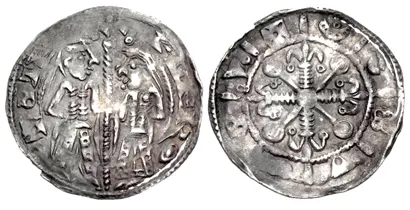 Coin showing Stephen and his wife Matilda of Boulogne
Both were shown sitting on thrones next to each other. It was extremely unusual to see women depicted on English coinage during this period, although Maud had coins struck showing herself. Her husband was a mere Count.
What we do know is that for a time, in 1142-43 an unprecedented situation existed in which a war for the throne of England was being waged between two women, both of whom were acting in the capacity as commanders.
What is most interesting about Matilda’s legacy is that whilst her cousin Maud derived her claim to the throne from her own mother’s descent from the House of Wessex and Alfred the Great, Matilda of Boulogne was of the same bloodline.
Even though her husband’s claim to the throne of England was weak and based entirely on descent from the Conqueror, her sons, William, and Eustace could boast of being direct descendants of Alfred the Great through their mother. Arguably, their claim was just as good as Maud’s. Had the events of The Anarchy transpired differently, it is possible that William or his brother might have chosen to press that claim. We could have had a King William III before the 17th century or even a King Eustace.


