What’s a Pandora Doll? A Seamstress, A Soldier, and A Secret
Susana and her sisters have just discovered that they are going to participate in the Season in York, and they are excitedly planning how to manage wardrobes for the seven older girls when they have scarcely enough money for one. Thankfully, Susana is a quasi-professional dressmaker, and she can help them create a wardrobe that all can share with enough clever disguises.
 “You know, Susana, I think there are some gowns and things of Mama’s up in the attic. Perhaps from our stepmothers as well, although I believe Martin removed his mother’s things for Chloe.”
“Well, he can just bring them right back, since our stepsister is to be presented too.” They knew Chloe well; she’d lived with them until her mother’s death, when her brother Martin and their guardian, their mother’s brother, took her in. She visited her half-sisters Emma and Merri occasionally. And Martin, relieved to have Patience take on Chloe’s presentation, had eagerly provided funds to pay for the ball. And her wardrobe, so that was one sister Susana did not have to clothe.
“Let’s take a look.”
It had been years since she had perused her mother’s things. Nine years since her death, when the maids had packed up her possessions and banished them to the attic. And fortunate indeed that they had made their way to Starbrook after the family had been exiled from the main house. No doubt the newest Lady Seahaven would have organized a bonfire for all of her predecessors’ belongings.
Not a nice thought, she chided herself. But it was hard to think well of the usurping Seaheavens, who had inherited and dislodged them from the home they had known all their lives.
Mama, she thought as they opened one of the chests that held her things. You were the same age as Barbara when you left us. How I wish you were still here.
The Lady Seahavens hadn’t moved much in society, as their thoughtless husband saw no need to take them along when he traveled to London, for Parliament, and other things. His ladies had no need of extravagant gowns. But they did socialize with the local gentry, so Doro and Susana did find a few of their mother’s evening gowns. Of course, they were nine years out of fashion, but Susana thought she could make them work with a few alterations. The trims were a bit worse for wear, but there might be a way to revive them.
“Oh, look at this!”
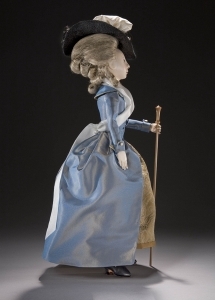
Doro held out a doll, about sixteen inches long, wrapped in delicate tissue paper. The head and body were carved of a single piece of wood; the legs were of wood too but separately attached to the torso. The upper arms were formed of stuffed linen, also attached to the torso, wooden lower arms and hands attached to those.
“I remember this!” cried Susana. “Mama showed it to me once and said it was made to resemble the Duchess of Devonshire. See the hairstyle and the wide bonnet! She has all the undergarments too! And the sash: she’s dressed for the 1784 election campaign. Mama said her grandfather had it made for her. It wasn’t a toy, though. It’s a Pandora. A fashion doll. That’s why she wouldn’t let me play with it.”
 “It’s beautiful,” said Doro wistfully. “It shouldn’t be left in old trunk.”
“If we put it out somewhere, we’ll have to be sure Emma and Merri don’t get their hands on it.”
“And Jane,” Doro added absent-mindedly. “Look at the quality of the material—the stockings, the chemise, the petticoats. And there’s a corset too—looks exactly like the real thing!”
Susana ran her finger along the blue silk overdress. “The silk is very fine. I would say French, coming from that era.” She turned to the reverse side and gasped. “It’s English. It’s stamped Macclesfield Silks.”
Macclesfield Silks. Where Blaise had gone to work. With a man called Thomas Pemberton.
“Doro,” she said slowly. “What was our mother’s birth name?”
Doro squeezed her eyes shut. “We never met them, for some reason. Mama never spoke of them. I suppose they disapproved of her marriage, although most people would be over the clouds happy for their daughter to marry an earl.” She grabbed Susana’s arm. “Pemberton! Her name was Maryann Pemberton!”
Susana’s mouth fell open. Could it be true? She and Doro and Barbara related to the Thomas Pemberton of Macclesfield Silks?
“A cup of tea,” she said. “I need a cup of tea.”
Pandora DollsMany of you know that I collect fashion prints. I have a ton of them and love them all. But in the time prior to fashion prints, there were fashion dolls. One of them was called a Pandora.
How on earth was a fashionable lady in the 18th century able to keep up with the latest trends? The answer was the Pandora, or miniature dolls dressed up in the latest modes. Keep in mind, this was long before magazines were invented—and the first ones were incredibly rare and expensive, as they were hand-painted by groups of (probably shockingly underpaid) little girls and young women! Clothing was also far more expensive than it is today, so it was important to know all the details of the cut, colour and fabric that you wanted.
In 1712, when Britain and France were at war with each other, Pandora dolls were exempt from the ban on enemy imports, and even received a military escort! Marie-Antoinette, when preparing to go over to France from Austria, got sent a host of these dolls in different fabrics and fashions.
https://thatmuse.com/2019/11/08
Today, fashion victims use fashion magazines, shows etc. to become informed about fashion news. But what sources did they use in the 18 th century to catch the latest trends when none of these media existed? Long before the first Barbie appeared, there already existed a doll that wore lavish wardrobe and matching accessories but didn’t function as a toy at all. This paper examines how a doll called Pandora was sent abroad by French dressmakers to promote and sell Parisian fashion around the world. First, Pandora had to conquer the royal houses in Europe. Then, she made her way into the department stores and finally into the bourgeois home. Interestingly, her triumphal procession did not stop there: By the middle of the 18th century she had even crossed the Atlantic to be exhibited in Boston and New York….
The doll’s body and head were carved by hand from one piece of wood, which had been turned on a lathe. The legs were made separately and attached at the hips and knees to the Pandora’s body. The lower arms and hands were also crafted of wood; in contrast the upper arms were ‘[…] made of either soft linen fabric or kid leather, attached to the torso’. Most dolls had painted eyes, but some of them had sparkling glass eyes, which was more labour-intensive because for this purpose the doll maker had to carve diamond-shaped holes into the head and then inserted blown glass balls….
Furthermore, the fashion dolls all had either painted hair or wore wigs made of flax or wool. The hair of the dolls was designed to be worn in the popular style of the time because it was absolutely essential that besides wearing the right clothes, the Pandora had the latest hairstyle as well as accessories that matched her wardrobe. Interestingly, although most 18 th century dolls represented women or girls, there also existed male, boy and even infant dolls. Unfortunately, the vast majority of these fashion figures of the late 17 th and early 18 th century have not withstood the test of time. This is due to two reasons: Firstly, the unwieldy size of the dolls and secondly, the material that was used to make them….
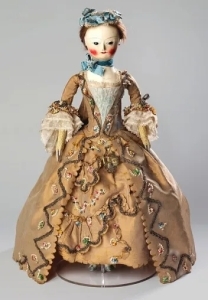
An English 18th –century fashion doll in the Fashion Gallery at the V&A. There are 6 fashion dolls in the same room.
Intended as advertisement for the French fashion and the dressmakers, the dolls functioned as mannequins and were dressed in a petite-size version of everything a fashionable woman needed to wear, including the proper foundation garments, which meant that the Pandoras were outfitted head to toe and displayed the latest fashions concerning clothes and hairstyle. ‘By the seventeenth century, when these French figures were known as “Pandora,“the dressing of the head and hair was as important as the garment’. The doll’s outer garment was a dress made of highest quality cloth: linen, cotton, wool brocade or silk, followed by a petticoat or multiple layers of petticoats, which gave the dress or skirt the desired fashionable shape. The hoop petticoat or wicker, also known as panier, was part of the women’s underwear and consisted of a basket. ‘They [the petticoats] could get as wide as 18 feet (5 metres), and satirists talked of hoops of 7 or 8 yards (6 or 7 metres) wide’. The extremely wide framework of the hoop made it difficult for women to walk through the doors, sit down on a chair or in a coach. Some even wore a stomacher, which was in fashion throughout the 17 th and 18 th century in Europe and North America. The stomacher was a v-shaped piece of fabric made either of the same material as the dress or of contrasting materials. It was worn across the chest and stomach and embroidered or decorated with pearls or other gemstones. Other key characteristics of women’s clothing that were also part of the fashion dolls’ outfit were corsets and linen shifts. Knitted stockings, shoes, a muslin cap and jewellery often completed the outfit.
Another question is: who were the potential buyers of the fashion dolls? First, the dressmakers and tailors purchased the fashion doll. Above all the Pandoras functioned as display and show items. Since fashion was extremely expensive, the rich costumers wanted to have a look at what they were going to spend their money on….
The French doll makers received orders from all over the world, since almost every British women of that time wanted to have their one little mannequin to keep abreast with the latest Parisian fashion trends. In the Augustan Age it was very common not only to adopt the French customs, etiquette, lifestyle and manners but also the clothing fashions. It is remarkable how widely the dolls were distributed geographically in the 18 th century. They were not only dispatched throughout Europe but were also shipped across the Atlantic. Travelling around the world in the name of fashion, the Pandoras took over two functions: on the one hand, they were the ideal advertising vehicle for French fashion; on the other hand, they served as a kind of diplomatic representation of France. The fashion doll became one of the most important and popular French export goods.“New” Fashion Dolls on EtsyAnd then I discovered that newly-created French court fashion dolls can be purchased on Etsy. You might have to sell your family heirlooms to buy them, but one can dream!