5 science-backed mood-boosters
If the subject line has you thinking you’re about to read some affiliate-link-filled ad for essential oil diffusers and de-stressing seltzers, I promise you: this is not that.
In fact, I wrote this newsletter and its namesake book to explore options that go beyond that—the industry of wellness, built on individual products—and amplify this—a culture of wellbeing, built on [socially-prescribed] community activities.
Thanks for reading The Connection Cure! Subscribe for free to receive new posts and support my work.
I wrote it to help us realize, now, while we’re still alive, what we’ll all remember on our deathbeds: how what really mattered were the joys we experienced, the meaning we discovered, and the relationships we built—true wellbeing sources that money can’t buy.
And yet, I also wrote it because actually doing that — practicing that deathbed wisdom— is really f&@king hard.
I’m proof. Yesterday, after discovering my new refrigerator stopped working, my food spoiled, and my kitchen became home to a vicious family of flies, I admit, I didn’t think to myself, “I could really use a social prescription right now.”
Instead, after shouting some expletives, calling PC Richard & Son as if they were 9-1-1, decorating my home with fly glue ribbons like they were party streamers before inevitably walking into a ribbon and getting fly glue stuck in my hair, I spent the the day ruminating: sulking in my glue-filled pity party, doom-scrolling and little-treating myself, convinced I had suffered the gravest injustice imaginable.
Our culture makes it easy to do this: To ruminate and isolate and make our bad moods worse. But who can blame us? Especially when we’re faced with the more mundane everyday mood-kills—Sissyphian inboxes and infinite media feeds, piled-on finances and endless errands, passive aggressive texts and tedious to-do-lists, social prescriptions feel like another chore; why would we “prescribe ourselves” a community experience, like dancing or birdwatching, when our time feels so limited as is? If we can get new age products that *optimize* for *peak satisfaction*, why would we choose age-old, communal pursuits…activities that might bring us some wellbeing, sure, but might bring us some discomfort, too (and, at the very least, require us to get off the couch)?
Except, here’s an inconvenient truth: these age-old community activities actually do help us feel better, and they’re probably more effective and long-lasting than that mood-boosting candle is.
You probably already know this. Have you ever noticed how sh*tty moments feel less sh*tty when we have some other moment to look forward to after? Or how rejections feel less painful when we have other sources of meaning we can rely on? Or how bad moods feel less bad when we have people we can vent to/ laugh about/ problem solve them with?
We also know there’s a difference between wellness and wellbeing: Between what gives us pleasure and what gives us joy. Between how our jobs’ conception of our purpose and what we see as sources of meaning. Between a small-talky shallow acquaintance and a 3am-fear-sharing, true-weird-self-accepting friend.
Social prescriptions for community activities can help deliver these deathbed virtues. But even though we know this, intuitively, it’s hard to remember them, practically. When presented with some mood-killer—a breakup, a layoff, a loss, or some other stress-sadness-worry-anger-loneliness-inducing event— it’s much easier to pick a quick fix.
But what if it were easier to pick the community activity? What if we could find the right “precision” medicine for our precise slice of bad mood? What if social prescriptions for wellbeing were as practically accessible and culturally sexy as products for wellness?
Enter the Crowdsourced DSM—the before-and-after testimonies of people in The Connection Cure (including yours truly) who’ve been through its five featured medicines—movement, nature, art, service, and belonging, when they deal with five different kinds of bad mood— sad, overwhelmed, anxious , grumpy, and lonely. The website also gives us practical options of free or donation-based local community activities we can “prescribe ourselves” when we pass through these five moods.
This, too, is part of the social prescribing movement. For as great as it would be for the policy and insurance overlords to magically make social prescriptions universally available in healthcare, it’s going to take all of us to see them as essential to our health. It’s going to take all of us to support not just an industry of quick-fix wellness, but a culture of long-lasting wellbeing. And it’s why I couldn’t be more thrilled that some of the biggest platforms in wellness—like Kourtney Kardashian’s POOSH, Gwentyh Paltrow’s GOOP, Jason Wachrob’s mindbodygreen and a bunch of other wellness podcasts—recently endorsed social prescriptions as part of the equation of what makes us well.
I don’t imagine these five “mood boosters” will be cure-alls. And hey, if you want to sulk in your glue party, who am I to judge? But I hope these guides, and the big wellness names supporting them, help you practice the deathbed wisdom you already know: your bad mood won’t last forever. And there are ways to feel better, faster, for longer, together.
Come see me talk about social prescribing with some really brilliant people in in Los Angeles, San Francisco, Rutland, Washington D.C, Philadelphia, and more!
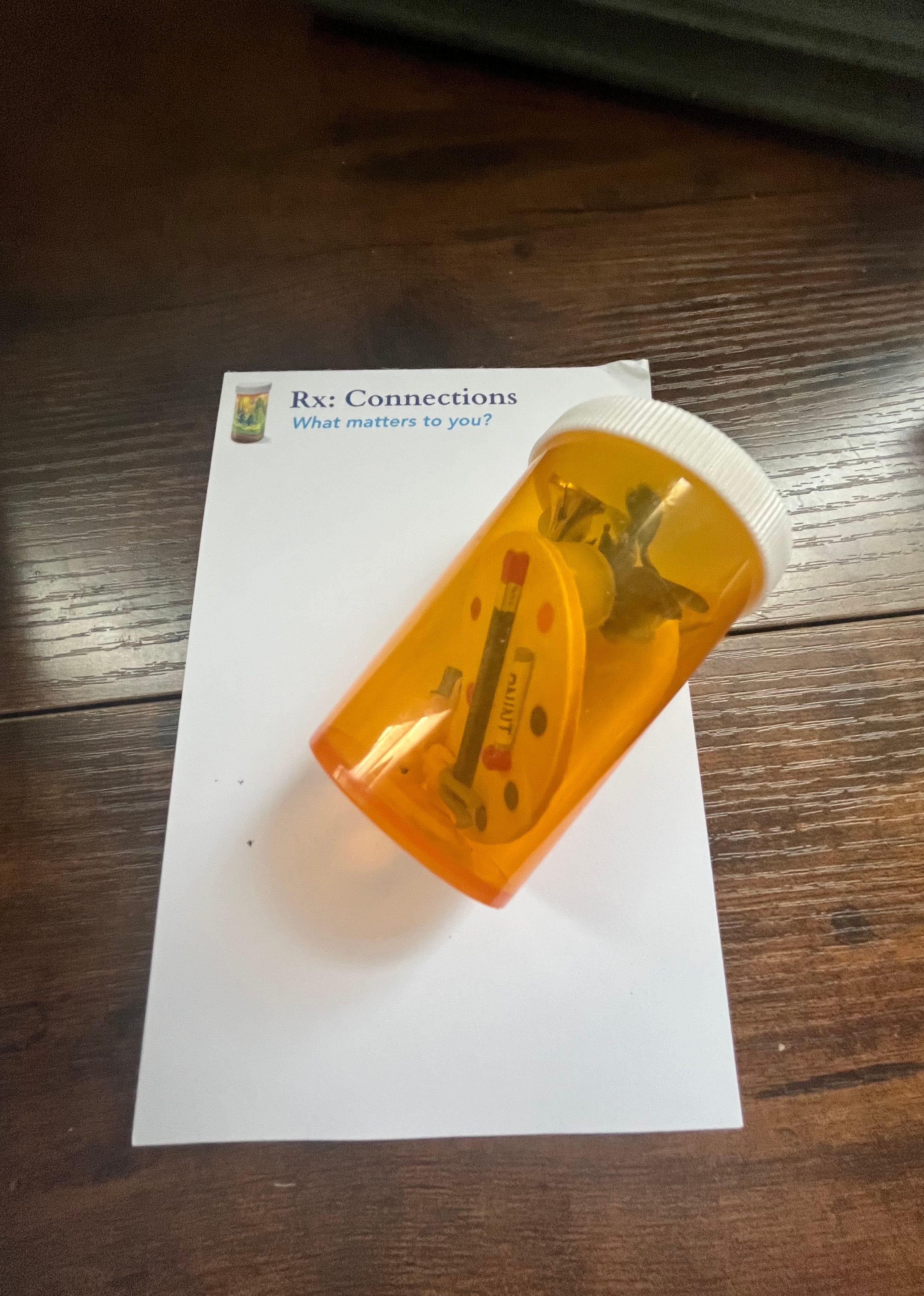
And, p.s. speaking of remembering “what matters to you?”, here’s a chance to win your very own “Rx: Connection ‘What matters to you?’ notepad and social prescription pill bottle (see below)! What better way to remember social prescribing than to have physical reminders on your desk?!?
Here’s how you can enter to be one of five winners:
Leave a review of The Connection Cure on Goodreads/Amazon (only if you’ve actually read some of it! We want genuine reviews only :))
Email back a screenshot of proof, and your best mailing address!
Thanks for reading The Connection Cure! Subscribe for free to receive new posts and support my work.