Advice from C.S. Lewis on Writing
This letter from C.S. Lewis found me, on one of my increasingly infrequent checks of my Facebook account; and it spurred a dive into the author’s correspondence that gave me great appreciation for the 8 suggestions contained in the epistle below.
One discipline he kept […] was replying to the 20-30 letters he received each day from fans on the day of receipt. It's estimated he wrote as many as 20,000 letters during his lifetime. Maintaining this practice consumed hours every day and was especially taxing as his health began to fail.
—Tom O'Boyle, Pittsburgh Post-Gazette, The Next Page / The eternal C.S. Lewis: now, more than ever, August 28, 2011.
Personally, #6 resonates the most with me at this phase in my writing life. I’ve abandoned journal writing for the present moment, but still hang onto the copiuos volumes I filled between 2017-2021. Writing nowadays is a consistent balance of managing data in google drives, icloud document folders, the notes app, and on scratch paper like reciepts or napkins. I view all those sources as seeds to be planted. And if necessary, cut at the stem and buried in the dark earth until the bulb itself gathers the energy to bloom again.
Which suggestion resonates the most with you, right now?
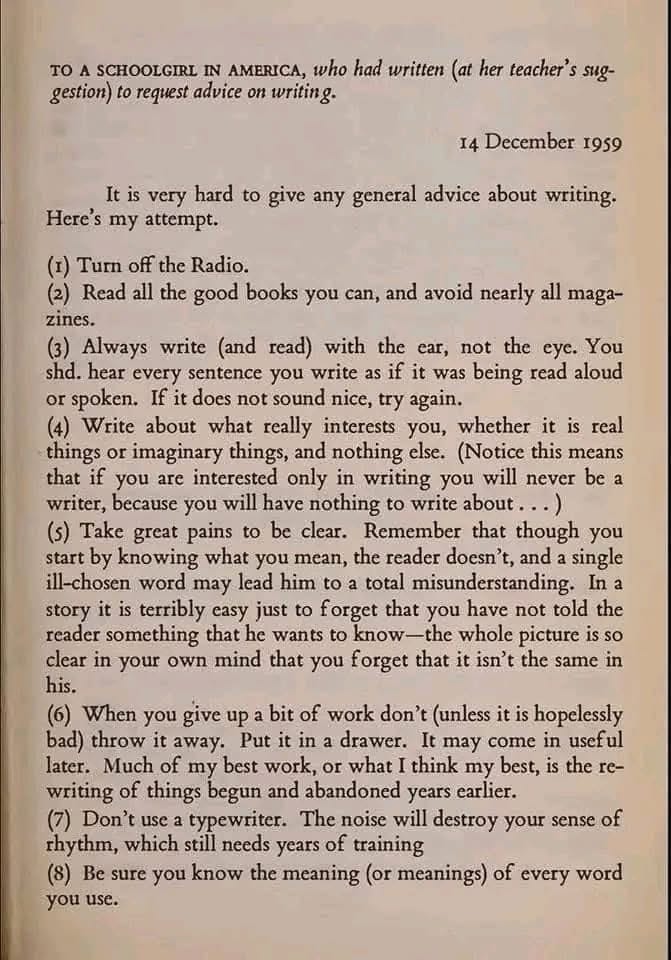
TO A SCHOOLGIRL IN AMERICA, who had written (at her teacher’s suggestion) to request advice on writing.
14 December, 1959
It is very hard to give any general advice about writing. Here’s my attempt.
Turn off the Radio.
Read all the good books you can, and avoid nearly all magazines.
Always write (and read) with the ear, not the eye. You should hear every sentence you write as if it was being read aloud or spoken. If it does not sound nice, try again.
Write about what really interests you, whether it is real things or imaginary things, and nothing else. (Notice this means that if you are interested only in writing you will never be a writer, because you will have nothing to write about. . . .)
Take great pains to be clear. Remember that though you start by knowing what you mean, the reader doesn’t, and a single ill-chosen word may lead him to a total misunderstanding. In a story it is terribly easy just to forget that you have not told the reader something that he wants to know—the whole picture is so clear in your own mind that you forget that it isn’t the same in his.
When you give up a bit of work don’t (unless it is hopelessly bad) throw it away. Put it in a drawer. It may come in useful later. Much of my best work, or what I think my best, is the re-writing of things begun and abandoned years earlier.
Don’t use a typewriter. The noise will destroy your sense of rhythm, which still needs years of training.
Be sure you know the meaning (or meanings) of every word you use.
Original image