Podcasts About Books and Other Writing Stuff
Not only do I read and write a lot, I do a lot of walking. It’s one of the few exercises really good to keep my heart disease stable(ish) and when I walk I listen to a lot of different podcasts. Normally I listen to humor, history, music, and political podcasts but lately I’ve found a couple of science fiction book review podcasts out in the wild. I thought, wow! Great! Someone else doing what I am doing only with way more episodes and apparently a ton more time than I have.
I subscribed to a couple of them, listened to a few episodes of each, then unsubscribed. I was bummed and for a couple of reasons. I make my gateway into stuff like this to find a book that I’ve read and liked among the catalog of episodes and I listen to see where we agree and disagree. In the case of the two different podcasts I disagreed. The book reviews I explored were Roadside Picnic by the Strugatsky Brothers, The Road by Cormac McCarthy, and Starship Troopers - as stated here, my all time favorite book - Robert Heinlein.
I definitely didn’t expect all three podcasts to have such negativity towards all three books, the discussion of Roadside Picnic was a sort of forum discussion with a couple of folks who enjoyed it and one who didn’t. The accompanying podcast about the film version, Stalker, devolved into name calling. It wasn’t awesome. The other podcast was a british guy and a german woman discussing science fiction books that only the british guy has read. So the cohost sort of plays the color commentator to the other host. I like this setup and it was sort of how we used to do it on TWWWBLY (by the way that is still be reposted each week so go listen if you haven’t). The big complaints about Starship Troopers was that it wasn’t action packed enough and it wasn’t satire enough… you know, like the movie was… and while the host did a little research on Heinlein for his review it was almost all from a cursory read of the Heinlein or the Starship Troopers Wikipedia page. I know Starship Troopers is a polarizing book, Heinlein knew it too, and wrote several articles about the book and the ideas within it. All you have to do is hunt around for them a little and you’ll find some, like “Who are the Sons of Patrick Henry” where he explores the idea of powered armor as a metaphor for nuclear weapons when presented with a potential army of soldiers vastly larger, in the case of the time period, China and the USSR. Either way, they appreciated its place in science fiction history but prefered more modern books. As for The Road, the host railed about it being a shit book and unreadable, cliched trash, then revealed he didn’t finish it, and finally that he doesn’t read books he listens to them. His cohost asked incredulous questions and joined in poo pooing Cormac McCarthy’s writing as “art writing pretending to be dystopian science fiction” and while I don’t give enough of a shit about his taste to write a rebuttal, it did illuminate a question that I’ve been wrestling with for a while. Namely, is reading different than listening enough that when discussing work is it like discussing two different things? As if two people are looking at the same painting but are seeing differnet brush strokes.
At any rate, it doesn’t matter. I was irritated by both of them that I stopped following them. One of them was defunct as of 2019 so that was a pretty easy choice, but the other is still going strong at like 550 episodes.
As for the reading vs. listening discussion, I generally don’t think there is much of a difference at least for discussing the story, between the two but when it gets into the discussion of the writing then it is. Take The Road as an example, and I have experience with Cormac McCarthy having read All the Pretty Horses, Cities on the Plain, and Blood Meridian. Much of McCarthy’s work is in the modern western genre, like, cowboy stories, or stories set in the old west. They are beautifully written genre fiction. The Road is also genre fiction and manages on the page to convey the slow death of all things with the death of language, first with missing punctuation, then with shorter sentences, smaller ideas, and eventually a smaller language pool of words. All of that is captured in the TEXT of the book but not in the audio version. I’ve said before on the Bunch O Stuffcast that I read and listened to Blood Meridian and while I marveled at the writing I couldn’t keep the events of the story straight as I could get lost in reading and rereading gorgeous paragraphs and studying how he created images etc… and when I listened to the book the story became front and center and I wasn’t lost in the language, all of the events and excitement fell into place.
Same painting, different brush strokes.
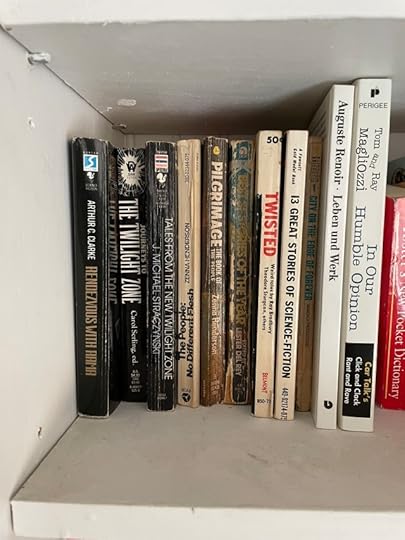
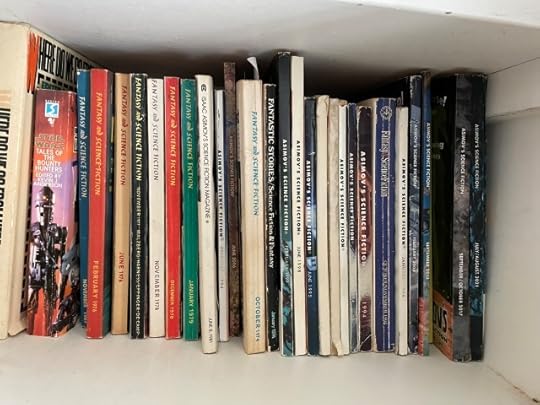
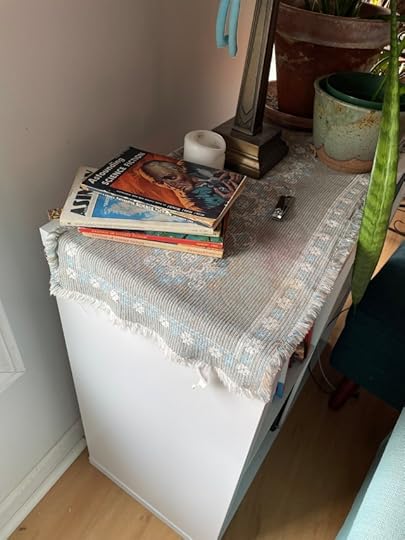
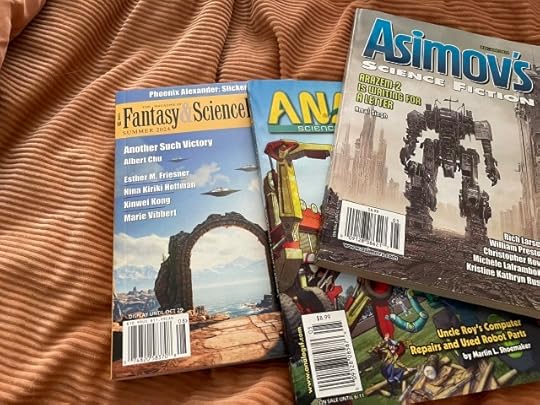
I’ve picked up a lot of modern science fiction short stories lately as I still am trying to figure out what editors are buying in the very limited paying markets. I’ve picked up and anthology of 5 issues of the magazine Planet Scumm and I am enjoying it. I have a story in their slush pile and I was intrigued enough to order the anthology. It’s a monthly or quarterly or something. I love the way it’s laid out and it has a cool cover. I also picked up the most recent version of Asimov’s, that I read a few stories in then gave up on, and the most recent issue of The Magazine of Fantasy and Science Fiction which turned out to be Summer 2024, so I think they might be dead now.
In all three cases I found stories that were like outlines of stories that were picked and showcased in these magazines. There were ideas but no plot, or a plot so convoluted and nonsensical that the story was unreadable and the ideas were lost. Some of this may be that a lot of modern science fiction short stories tend to be slipstream which is a sub-genre I just do not get at all.
I read a lot, a real lot, of science fiction short stories with magazines from the 1950s through last month with a good representative sample of each decade and movement in popular science fiction, and it feels like the genre got lost somewhere around 2005 or 2010 when some newer, younger, editors entered the scene. I don’t know if the work that editors do with writers is the same as it was when John W. Campbell or Groff Conklin were editing, but it is definitely different. Maybe it’s because the editors weren’t writers first or something or weren’t science fiction readers maybe? Feel free to reply to this post if you know the answer.
I definitely don’t like rereading stories because I can’t make sense of what the author is trying to convey. The “this is science fiction so it should be as avant-garde and esoteric as possible,” approach that will really draw in the dwindling audience for this medium seems short sighted.
There are some other cultural issues in the marketplace that have shifted too and more diverse voices means competition is fiercer. This is very good thing for science fiction and short story writing in general. Traditionally underrepresented writers are having a real resurgence now and a lot of the 21st century shorts that I’ve really enjoyed have been from writers who aren’t like me.
The story I wrote and submitted to the Murderfish anthology didn’t get picked up but I did get a nice personal note from the editor and he told me that I made it through the first round of choices so that’s something. I have no idea where the hell I am going to sell a story about a juvenile greenland shark, but I am still submitting it anywhere that it might fit. I don’t think I’ve write stuff specific to anthologies anymore, it is a lot of work to end up with a story that is so focused that nowhere else will take it if it doesn’t get picked up by the anthology. I have another story, Two to Tango, that suffers a similar fate. The anthology I wrote it for went silent after submission and as far as I can tell it is now defunct. Space westerns are hard to sell, apparently, as Two to Tango has been bounced 4 or 5 times.
I started this as an intro to the Heinlein Marathon entry on The Door into Summer but at almost 1600 words this’ll be a standalone entry. Heinlein Marathon to appear here in the next few days or so.
As always, my books are available at Amazon, and several short stories are there for kindle readers. I sometimes make these available at no cost, so to parlay an old sci-fi tropey saying, keep watching the skies and you might be able to get one.