Bristol Needle Spiking: Getting to the Point
The needle spiking social panic has reared its pointy head again, this time in the nightclubs of Bristol.
ITV news reported recently that Bristol University students Ella and Sophie (not their real names) had a ‘drink or two’ in their flat before heading to a nightclub.[i] The practice of having a few drinks before going out is called pre-loading and is perfectly understandable – booze is extortionately expensive in UK pubs and clubs.
An hour later they were catatonic with eyes rolling, despite, they claim, not drinking more than usual. We need to inject a note of caution here, though. Young people are not always very good at gaging how much they have drunk…
When they got home, Ella was incapable of walking from her bed to the toilet and had to be dragged by her boyfriend. The next day Sophie found a bruise with an apparent needle puncture wound. Ella said, “I went to the doctors, and they confirmed that I’d had a needle injection.” How this was confirmed and how the doctor knew the wound wasn’t a routine cut, scratch or insect bite was not explained.
As a result of these and other unconfirmed claims of needle attacks, nightclubs have started intensive searches of customers, consolidated surveillance with CCTV and employed private paramedics to patrol the clubs. Plain clothes police are on the lookout for the mysterious bogeyman with his dastardly weapon of choice – the drug-laden syringe.
But this is nothing new. The first reports of needle spiking incidents in recent years were in the UK in the autumn of 2021. This was a time when lockdown restrictions were easing, students were returning to campus and nightclubs were opening again. By October, news and social media were filled with shocking accounts of young people being drugged by sinister but elusive needle wielding maniacs. Police received 1,392 complaints of needle attacks between October 2021 and January 2022.[ii]
By Christmas 2021, there were multiple cases of similar attacks with syringes in Australia. By May, there had been 300 reports in France.[iii] In the Netherlands on 21 May 2022, six people at an outdoor party in Kaatsheuvel presented to the first aid post with symptoms of suspected needle-spiking.[iv] On the same day in Belgium, women at a football match started collapsing in the stands one after another. As emergency services rushed the victims away, more began to collapse. Fourteen people in total were suspected to have been targeted in a mass needle-spiking attack.[v]
Still in Belgium, on 25 May 2022, the Hasselt Festival was halted as 24 girls suffered from nausea, hyperventilation and headaches. Some of the victims had felt something prick them…[vi]
However, needle spiking is, for want of a better word, hysteria. It’s a delusion, a social panic born of anxiety. There are no malicious needle spikers skulking round the bars of Bristol with syringes dripping with date rape drugs in search of their next innocent young victim. The needle spiker is a myth, a hobgoblin of our times.
The Needle Spiking Myth
Let’s look at the evidence.
Needle spiking is virtually impossible. As Professor Adam Winstock of the Global Drugs Survey noted, effectively administering an injection is not easy in ideal circumstances, never mind in a dark club through the victim’s clothes. Keeping the needle in the victim long enough to inject the drug would also be extremely challenging. Furthermore, injecting someone in a busy nightclub would pose a very high risk of being caught.[vii]Evidence is lacking. No drugs have been found in the systems of the victims. No culprit has been caught on CCTV or by the many potential witnesses. No prosecutions have been made.The symptoms are identical to being drunk. The signs and symptoms that you’ve been needle spiked include loss of balance, feeling intoxicated, blurred vision, lower inhibitions, confusion, nausea, throwing up and unconsciousness. You’ve probably noticed that these bear a startling similarity to being drunk.It makes no sense. The victims are not sexually assaulted or robbed in alleged needle spiking, so what’s the motive for the crime? Needle spiking reports spread from Nottingham in 2021 to the rest of the UK, then across Europe and New Zealand – are we meant to believe that hundreds, perhaps thousands of men are hiding out in clubs with drug filled syringes looking for victims to jab for no reason?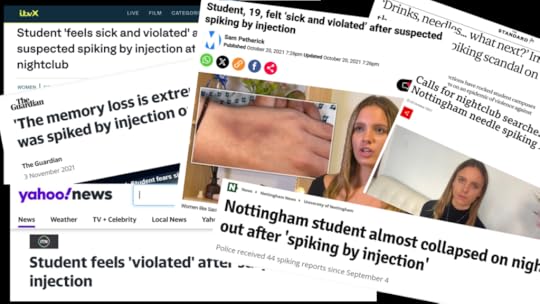 Some headlines from the 2021 panic
Needle spiking panics have a long history. There were waves of what tabloids called ‘drug needle attacks’ in Britain in the 1930s. It was believed at the time that young women were being injected with narcotics so they could be swept into a nearby car and whisked off to a life of sex slavery in a South American bordello. Police thought ‘drug needle gangs’ were hard at work kidnapping innocent young girls around the country, though all their investigations found nothing. No perpetrators, no named abductees, only vague and suspicious accounts of suddenly feeling unwell after a chance encounter with a mysterious stranger in a public place. The needle gangs didn’t exist.
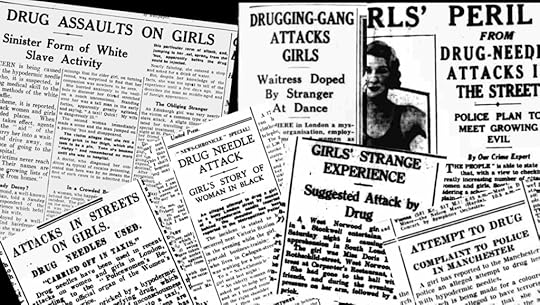 1930s Drug Needle Panic
In the 1980s, stories of AIDS patients deliberately jabbing random people with HIV infected blood spread round many countries. The AIDS victims were deliberately infecting as many women (or men) they could to avenge themselves on the woman (or man) who had infected them. These were hoaxes and urban legends. The 80s AIDS needle spikers didn’t exist.[viii]
What’s happening in Bristol is a phantom attacker panic. We project our fears and anxieties onto our environment, and this creates a fear of an imaginary assailant lurking in the shadows. These panics have been common throughout history. Mysterious attacks that come from nowhere and then spread across the country in waves before fizzling out and disappearing. Many of the victims turn out to have imagined or invented the attacks.
In the case of the Bristol wave of needle spikings, it seems likely that clubbers are misinterpreting the effects of alcohol, anxiety or panic attacks for being drugged. The needle wounds found on the victims are more likely mundane cuts and scratches.
In our book Social Panics and Phantom Attackers, Robert Bartholomew and I give a detailed history of needle spiking and other similar panics. They occur regularly around the world, though the context and the fears these panics reflect change in interesting and strange ways. There are mad gassers, phantom slashers, robot monkeys, penis thieves, satanic cat killers and spring-heeled fire-breathing demons…
Humans have rich imaginations, and phantom attacker panics are just part of the human condition. We can’t help fearing, imagining and sometimes hoaxing monsters in the shadows.
Epilogue
In Bristol, nightclubs, medics, police, security staff and customers are all taking precautions. That sounds like a good idea. Better safe than sorry and all that.
But here’s a lesson from history. In 1630 Milan was gripped by the ‘Great Poisoning Scare’. There was an intense fear that the French or the Jews were smearing surfaces with a ‘pestilential ointment’ in order to spread the plague. When suspicious people were seen in the cathedral, the health authorities investigated but found no evidence of poison. To reassure the populace any suspicious items were removed and piled up outside the cathedral.
This didn’t reassure anyone – it made the panic worse. The actions were taken to reassure the panicked citizens but instead reinforced their fears. The precautions convinced the populace that the rumours were true. Many innocent people were beaten by lynch mobs, imprisoned or killed as the people of Milan were swept up in a hysterical panic over phantom foreign poisoners.[ix] Phantom attackers exist only in the imagination, that’s why they can be so dangerous.
Unnecessary precautions add to the fear and anxiety, and it’s from this primordial soup that social panics like needle spiking are born.
For more on needle spiking and other episodes of mass hysteria see below:
Top Three Extraordinary Popular Delusions of the Modern Day
Spiked or Spooked? The Myth of the Drink Spiking Bogeyman
[i] https://www.itv.com/news/westcountry/2025-03-31/needle-spiking-paramedics-patrolling-nightclub-dance-floors-to-tackle-threat
[ii] House of Commons Home Affairs Committee, Spiking: Ninth Report of Sessions 2021-2022. Available at: https://committees.parliament.uk/publications/21969/documents/165662/default/
[iii] https://time.com/6183433/needle-attacks-spiking/?fbclid=IwAR3sbvkWIPZC-FtvTIU9f4WNW5JOlRNevtU28tP05hZyqNElAVVBdCwR8dw
[iv] https://nltimes.nl/2022/05/22/six-people-say-pricked-kaatsheuvel-young-woman-unwell
[v] https://www.brusselstimes.com/227255/syringe-spiking-14-people-attacked-during-mechelen-rc-genk-football-match
[vi] https://www.brusselstimes.com/228745/hasselt-festival-closes-as-24-teen-girls-fall-ill-after-suspected-needle-spiking
[vii] https://www.bbc.co.uk/news/newsbeat-58994755
[viii] Robert Bartholomew and Paul Weatherhead (2024). Social Panics and Phantom Attackers (Palgrave Macmillan)
[ix] Robert Bartholomew (2015). A Colourful History of Popular Delusions (Prometheus) pp.29-30