Wigan Liz – the Lenten Ghost
If you’re wandering the Lancashire moors towards the end of Lent, look out for the ghost of Wigan Liz. You’ll recognise her by her flowing black hair and her deathly hollow eyes framed by thick black eyebrows. Her black dress and cape and old-fashioned bonnet complete the picture. Some say the spectre carries a cigar box, others say she carries a towel, though the reasons for these ghostly props are unknown.
Locals say she is the spirit of a woman who was murdered in the late nineteenth century, and whose ghost returns to the scene of the crime every Lent in search of her murderer. She has been seen in a cottage in Withnell and disappearing among the tombstones of the church.
Wigan Liz the Lenten Ghost was a regular feature in the press in the 1920s, though at the heart of the story is a dark tragic twist. Liz was a real person and had indeed died in mysterious circumstances…
Follow Me
The earliest accounts of the ghost of Wigan Liz I can find come from the early 1920s. In April 1921, the village of Withnell near Bolton was said to be in a state of terror. One Mr Forshaw said that the ghost with her black cape and hollow eyes had visited his cottage three or four times a week recently.
Forshaw said that his daughter had woken to find the ghost in her bedroom. ‘Follow me,’ the spirit commanded, and the girl obeyed following the ghost downstairs. A few moments later, she found herself alone.
According to newspaper reports, a local man named Martin had visited the house. This is his story:
We turned out the lights and sat there in the darkness, Forshaw and myself. Then I sang two of my favourite hymns. Just as I was finishing the second, Forshaw clutched my arm and cried out, ‘It’s there.’ Then, as the ghost appeared he began to call out for mercy. Shortly afterwards the ghost disappeared.
Mrs Forshaw told the press that the family were looking for a new house, so disturbed were they by the ghost.[i]
Blowing Bubbles
Wigan Liz hit the headlines again a couple of years later around Lent 1923. Mrs Forshaw, who appears to be quite a character, was widely quoted in local and national press about her family’s experiences with ‘Lizzie’.
Mrs Forshaw had ‘grown haggard’ with the haunting, and said that the ghost even appeared during the day and that she ‘can tell when it is there.’
Although Mr Forshaw claimed that he had been the first to see the ghost in 1921, in 1923 Mrs Forshaw gave a different version of events: ‘At first the children saw Lizzie but we did not believe their stories, and even thrashed one to break it of what we thought was a nervous habit.’[ii]
Even the family dog saw the ghost. He growled and dashed at the apparition as if to attack, but the spirit paid no attention to the animal and it passed straight through the ‘misty shape’ and then ran yelping to his kennel, his eyes bloodshot with terror and his fur standing on end.[iii]
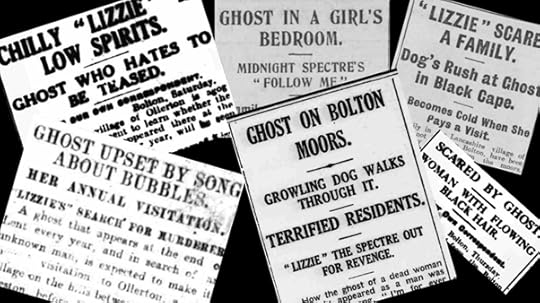 Some headlines from the 1920s
By this time, the stories about Lizzie were getting rather surreal. It was widely reported that the ghost had a particular dislike of the song ‘I’m forever blowing bubbles.’ Supposedly, Mr Forshaw had sang the song to comfort his child after she had seen Lizzie, but (according to his wife) ‘the spirit appeared, and I don’t think he will ever sing that song again.’[iv]
Mrs Forshaw claimed her family were living in constant fear and so often brought neighbours over for late night vigils and hymn singing, presumably in an effort to lay the spirit. ‘There is no one in the house now who dare to make fun of the thing,’ she told reporters, ‘for when we have done that we have had good cause to regret it. Lizzie always comes if we mock her.’[v]
Slide, Lizzie Slide
By 1926, Lizzie had become a regular newspaper feature, as had the Forshaws who were always happy to provide journalists with a spooky tale or two. Although the familiar elements – the black clad spectre with hollow eyes and flowing hair seeking vengeance on the man who murdered her – were all present and correct, a few new details were added.
Now the whole village was agog with excitement as the end of Lent approached, and it seems ghost hunts and psychic investigations had been performed regularly at this time of year for some time.
Even the gloomy ghost was lightening up a bit. One of the Forshaws’ children said that Lizzie slides down the bannisters at midnight, and it’s nice to think of the old spectre having a little fun after many years of baleful haunting.[vi]
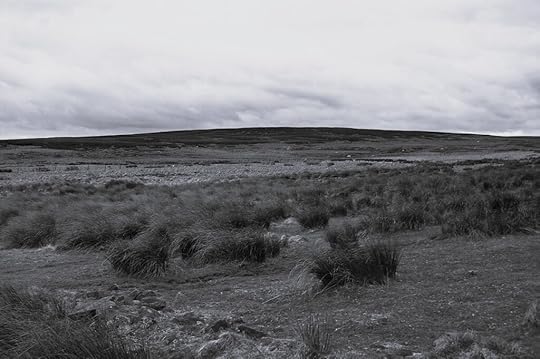 Withnell Moor (Ian Greig)
The Mysterious Death of Wigan Liz
So, who was Lizzie?
Elizabeth Wright was a single mother of three who lived in a small cottage in Withnell, and was a well-known character in Wigan in the late nineteenth century, hence her nickname of ‘Wigan Liz’. On 24 March 1895 Liz went shopping in Blackburn where she bumped into John Livesey, a quarryman in his late twenties who was widely known as Jack of the Woods. The two had been lovers on and off over several years and went for a drink together.
They were seen in a number of pubs between Blackburn and Wigan as they walked home. They were clearly very drunk and had been refused service in one place. At another, Liz appeared dishevelled as she called for some rum. She had lost her bonnet.
Meanwhile, back at her cottage, Liz’s eldest daughter Mary (13) was worried that her mother had not come home, and was waiting up anxiously. She was startled by someone hammering at the door shortly after midnight. It was John Livesey, though Liz was not with him. Livesey looked as if he’d been in a fight; he was bleeding and had a cut above his right eye. Though it was not a wet night, Livesey was soaked.
He later claimed in court that his wounds were caused by him and Liz falling down drunk on their walk home. He also later said he was ‘proper drunk’ and could remember nothing more of the journey back from Blackburn.
He told Mary he had come to stay the night and pushed into the house. Mary demanded to know where Livesey had left her mother. He replied that he’d left her down at the canal bottom. Mary asked what she was doing there. ‘Floating’, was Livesey’s reply.
Mary asked Livesey to leave but he refused. He then sexually assaulted Mary, telling her he would cut her throat if she screamed.
The following day, Livesey left early and Mary went to a neighbour to relate what had happened. Liz was reported missing. On Wednesday 27 February two young lads made a grim discovery when they were having a snowball fight in a field near Withnell. In a ditch some 200 yards from the nearest road was the body of Wigan Liz.
There were no bruises or marks of violence about her person. The inquest concluded Liz had died of exposure to cold accelerated by a heart condition.
Many in the village believed that Liz had been strangled or otherwise murdered by Livesey. Livesey escaped punishment for Liz’s murder (if he was indeed guilty) though he was convicted of sexual assault on her daughter and given two years hard labour.[vii]
The tragedy would haunt the village of Withnell for many years to come.
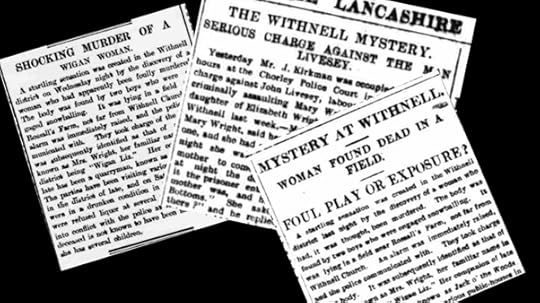 Some headlines from 1895
Epilogue
The sad ghost of Wigan Liz made regular appearances in the press at Lent in the 1920s, and the same stories were recycled by the Forshaws. The last reference to Wigan Liz I can find in the newspaper archives is from 1933. The report sadly notes that in the last six or seven years of ghost hunts and psychic investigations every Lent have been fruitless with no sightings of the ghost.
‘No ghost,’ one headline lamented. ‘Lenten visit fails to materialise.’[viii]
Hopefully Wigan Liz has found peace.
[i] ‘Ghost in a girl’s bedroom’, Dundee Courier, 4 April 1921, p.5
[ii] ‘Tale of a ghost’, Daily Mirror, 20 April 1923, p.3
[iii] ‘Ghost on Bolton moors’, Liverpool Evening Express 19 April 1923, p.7
[iv] Tale of a ghost’, Daily Mirror, 20 April 1923, p.3
[v] ‘Ghost on Bolton moors’, Liverpool Evening Express 19 April 1923, p.7
[vi] ‘Ghost upset by song about Bubbles’, Belfast Telegraph, 30 March 1926, p.5; ‘Chillie Liz in low spirits’, The People, 4 April 1926, p.6
[vii] ‘Shocking murder of a Wigan woman’, Wigan Examiner, 2 March 1895, p.6; ‘The Withnell mystery’, Lancashire Evening Post, 6 March 1895, p.3; ‘The supposed murder of a Wigan woman’, Wigan Examiner, 9 March 1896, p.6; ‘Sentences’, Manchester Courier, 23 March 1895, p.11
[viii] ‘No ghost’, Hull Daily Mail, 17 April 1933, p.5