How can we use tiny experiments to learn more about ourselves?
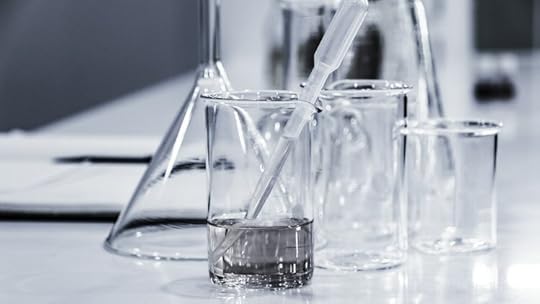
Src: Hans Reniers Beakers Unsplash
Last weekend, I visited my youngest daughter and we experimented with paper-making for her wedding — a tub of water, a small picture frame and modified splatter guard screen, lavender from her yard, and early drafts of my memoir torn up and added to old tax paperwork. The high-pitched grinding of paper pieces in the Osterizer sent her cat into the next room.
She swirled the pulp in the large tub of water before using the make-shift mold and deckle to scoop up the mush onto the screen. After shaking a few times and tipping to let the excess water drain, she flipped the speckled sheets onto various fabrics to try different textures: towel, dishcloth, and pillowcase. A dozen or so experiments dried in the hot sun on her deck. She ironed one to see if the custom invitation stamped onto the paper would show enough detail.
What are experiments? How is experimenting different than trying something new or exploring? How can we use tiny experiments to learn more about ourselves?what is experimenting?
trailer with Anne-Laure Le Cunff
Who hasn’t done a thought experiment? It all starts with a question – what if? What ifs play out all around. What if I took a different route to work? What if I tried that jammer recipe with no oil? What if I used a handwriting-to-text app to digitize my journals versus using dictation software?
Lots of ideas. I’m usually patient enough to try once or twice. But what if — I created a time-bound, repeated trial where I kept track of what happened and spent time reflecting on the results?That’s a tiny experiment as defined by Anne-Laure Le Cunff, this month’s thought echoes podcast interviewee, neuroscientist, founder of Ness Labs, and author of Tiny Experiments: How to Live Freely in a Goal-Oriented World.
We have lots of opportunities to experiment. Anne-Laure suggests a simple formula — I will [action] for [duration].
Say you want to try meditation, but never seem to have the time. I will meditate 5 minutes for 5 days.
Or you’re looking to spend more quality time with friends. I will call a friend a week for 4 weeks versus only emailing or texting.
Or you want to playfully try different restaurants on date night. I will pick a different restaurant for the next 4 date nights.
One of my questions — would a handwriting-to-text app transcribe my journals faster than typing or dictating them into digital format? Ever since college, I’ve wanted to digitize my journals to fact-check, look for patterns, see how my beliefs and philosophy of life have changed, and sometimes to end an argument over who said what. I’m still a year behind in digitizing them for my memoir background.
My tiny experiment — I will use a handwriting-to-text app AND dictation software for 7 journal entries to see which is faster. And as Anne-Laure says, “There’s no pressure, there’s no right, there’s no wrong, there’s just doing it.”
“A tiny experiment isn’t a complete overhaul of your life. It’s a low-risk repeated action you take to learn something new, spark a shift, or test a possibility. It’s how you can make change not only manageable, but fun.”— Anne-Laure Le Cunff How can we use tiny experiments to learn more about ourselves?
Whatever stage in life you are: starting your career, young parent, mid-life crisis, top of/changing your career, or retired, deep down we all want to live a fulfilling life and often get caught up in our busyness and the global dynamics of the world around us.
As Anne-Laure says, “What if instead of trying to fix everything at once, we got curious and tried something small? That’s the magic of tiny experiments.”
To come up with tiny experiments to try (even in the middle of a hectic week), Anne-Laure has several suggestions, including:
Practice self-anthropology: What energizes you? What drains you? If you hit a slump in the afternoon, try 10-minute walks for 10 days instead of caffeine.
Notice fixed mindsets: Catch yourself saying, "I could never do that,” and brainstorm one small, repeatable action to take to challenge that belief.
As Anne-Laure says, “Success is just collecting the data, conducting the experiment, and learning something new about yourself; about the kind of work that you might want to do, and that's really the essence of a tiny experiment.”
Historically, productivity was all about efficiency in the quantity of time we spend on various activities. Anne-Laure writes about how Greeks valued the qualitative nature of time: Kairos. It recognizes that the value of time depends on the situation. Finding ways to be mindfully productive, “making the most of our time isn’t about doing more, but about being more: more present, more engaged, and more attentive to the quality of our experience.”
Anne-Laure offers many tools to help you navigate the world of tiny experiments. One of the most delightful is what she calls a metacognition tool: Plus Minus Next. After each occurrence of whatever you are doing you note: positive observations, negative observations, and plans for what’s next.
Using the meditation example:
Plus: I noticed being a bit calmer.
Minus: My crossed legs hurt.
Next: I’ll sit on a chair tomorrow.
At the end of your duration, you’ll have a series of observations and adjustments you made. From there, you can decide what you want to do going forward: continue? pivot? or pause.
Head, Heart, Hand is another tool, especially helpful if you feel like you’re procrastinating. Ask 3 questions:
Is the task appropriate? If not, can you redefine how you're doing it?
Is the task exciting? If not, can you redesign the experience so it is?
Is the task doable? If not, is there a way to get help or more training?
With my journal experiment, my hypothesis was that a handwriting-to-text app would be faster than dictating.
I was wrong.
When I finished and discovered dictation was faster, I was surprised. I thought the handwriting experiment failed, but it didn’t. I learned something new. There’s value in learning that something didn’t come out the way you expected.
For my daughter, it turns out the paper experiment didn’t create a flat enough surface to stamp text onto, but they will make delightful seed paper for thank-you notes.
We live in uncertain times, and many feel a bit untethered. Maybe using tiny experiments is a way to initiate incremental progress toward something you’ve been wanting to do for a while. They present a new relationship with learning.
Experimenting is about trial and error with a little mystery thrown in. I welcome a little mystery in my life. Even if what I learn is different than what I expected. What about you? Do you welcome a little mystery into your life and what tiny experiments can you try?
WOULD LOVE TO HEAR YOUR COMMENTS.
If you enjoyed this post, I invite you to subscribe to my monthly