AI & Avalanches: Surviving the Risks of Intelligence—Human and Artificial
Artificial intelligence is reshaping finance, education, and nearly everything in between—including (believe it or not) freeriding on powdery slopes. After a close call with an avalanche that sharpened my sense of risk, I shared some spirited conversation on the “Geld & Pfeffer” podcast. Our era’s true gold rush is digital, and the mountain is steeper than ever.
If Swiss German isn’t your forte, here’s a quick English recap:
AI’s Onrush in Everyday LifeAI is not just a ChatGPT party trick for trivia night. It now quietly organizes hotel staff rosters, nibbles away at food waste, and—delightfully—removes the soul-crushing tedium from data entry in finance. Yet the perception lingers that what’s meant to make life easier has, instead, complicated it. The real plot twist? Most AI tools, if given half a chance, only make the mundane faster. Want a presentation? Let Copilot handle the heavy lifting. Fumble an Excel formula? AI will politely fix it. No existential terror necessary.
The Avalanche: Risk Management from Slopes to StocksAfter my own brush with a snow-triggered slap on the wrist, I became obsessed with managing risk—on skis and in spreadsheets. Freeriding down a mountain is unnervingly similar to making decisions in finance—equal parts exhilaration and existential peril. Both demand risk management with consequences that range from bruised egos to actual danger (of the bodily or financial variety). Finance, like freeriding, is a game of “greed and fear.” You plan ahead or, if not, you find yourself under a metaphorical avalanche… or, as the finance world learned from incidents like Knight Capital, a literal $440 million loss.
AI in Finance: From Repetitive to ReflectiveDespite the headline-grabbing fears, AI won’t vaporize every analyst job overnight. The more repetitive the task, the more likely an algorithm will ace it. Routine reporting? Automated. Data summing? Child’s play. But—here’s the knotty bit—human judgment remains vital, because AI is notoriously literal-minded and sometimes, well, confidently wrong. Not unlike an over-eager intern, it learns rapidly but is prone to imaginative errors if not closely supervised.
Education’s Uphill Challenge (and Opportunity)Education, like risk management, is being force-marched up the technology hill, occasionally trailing breathlessly behind innovation. Lifelong learning is now foundational. AI can deliver wisdom at warp speed, but true competence—especially in new educational models—demands that humans not only consume technology, but critically question it at every turn.
Tools of the Trade: What to Keep CloseSavvy professionals now arm themselves with tools like Perplexity, Bloomberg terminals, and even playful experiments with Alexa gone rogue (who knew dollhouses were a click away?). Yes, automation brings efficiency, but the real edge lies in curating and questioning—separating meaningful signals from statistical snowdrifts.
The Human Touch: Our Enduring AdvantagePerhaps AI’s greatest gift is forcing us to rediscover what makes us distinctly human: judgment, moral grounding, and the knack for sensing meaning amid uncertainty. As machines increasingly influence our world, our advantage lies in questioning boldly, adding empathy to data, and, when it counts, know when to step back from the cliff.
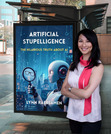
For more insights about what AI can or cannot do, check out my book “Artificial Stupelligence: The Hilarious Truth About AI”.
The post AI & Avalanches: Surviving the Risks of Intelligence—Human and Artificial appeared first on Lynn Raebsamen, CFA.