
LOSING THE CLOT
Part one
You read that right: clot not plot. Forgive the pun, but what author doesn’t like a little wordplay? I toyed with other headers in the same – here I go again – vein: The clot thickens; Clot twist; Clot hole; Out, out damn clot. The aim was to grab your attention, whet your appetite for this post, but maybe a whimsical preamble is my way of putting off relating a story I never in a million years anticipated would be mine to write. And one that even now, in part, I’m reluctant to share.
Whatever, a fun pun seemed an infinitely preferable way to begin this piece than with the stark fact: My life changing stroke
To be specific, an ischaemic stroke in the right posterior limb of the right internal capsule. Put simply, a blood clot in the right-hand base of my brain. Had the clot affected the left side, I probably wouldn’t be writing any story.
It happened in the early hours of 10 September 2024. Rarely for me, I needed the loo. Fortunately, that need to spend a penny probably saved my life. When I woke, I couldn’t lift a finger let alone my left leg or arm. A bizarre, bemusing, increasingly alarming and scary experience. Had I slept on a nerve? Had I heck. After a minute or two, I was pretty sure whatever had happened – was still happening – was serious. I suspected a stroke but it would be hours before this was confirmed.
Curiously, a sense of calm took over as a chain of events took off starting with a phone call leading to the arrival of paramedics. This was followed by a lengthy ambulance wait outside A&E, endless questions and a battery of checks, tests and scans that eventually culminated in my admission to the acute stroke unit.
Back then, I knew next to nothing about the condition. I’ve since spent a year in recovery amassing knowledge and first-hand experience; undergoing months of physiotherapy and picking up some of the reins of my former existence. It was – and still is – the steepest learning curve of my life.
Around 100,000 people a year in the UK have a stroke: that’s roughly equivalent to a stroke every five minutes. It’s the main cause of acquired disability in the UK and the fourth single leading cause of death. Clearly, thank god, it’s not always fatal: currently 1.4million people in the UK are living with the effects of a stroke. Every stroke is unique, every sufferer’s experience, different. Severity and effects vary wildly.
During the nineteen days I spent in hospital, three different doctors told me I’d had a mild stroke. I guess it depends on your definition. Mild is not a description I’d use. I soon stopped using the term stroke completely. It’s far too benign; a word that conjures cute images, casual sayings throwaway remarks: we stroke kittens, wait for the stroke of midnight, sign deals at the stroke of a pen. As for a stroke of luck . . . give me a break.
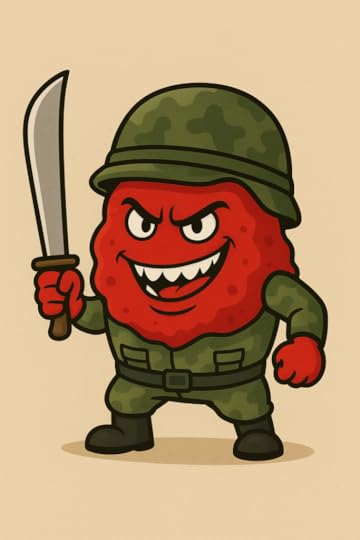
I call a stroke what it is: a brain attack. Think cardiac arrest but in the brain. I visualised a malign scarlet clot in full military fatigues, hacking through blood vessels with a machete, squatting malevolently in neural pathways. In a bid to wipe the smile off its smug little face, I called it Brian. (I’m a writer. I have a vivid imagination.) The aim was to cut the bloody thing down to size and maintain a sense of humour however dark. Initially, I was the one felled and, thanks to Brian, laughs were in short supply.
But not for long. Crying did nobody any good; negative thoughts led to places I didn’t want to go. I was alive if not kicking and lucky to the extent my cognitive skills, speech and senses were unaffected. Meaning, to coin a phrase, I could ‘always look on the bright side’ and I still had – to use the vernacular – the gift of the gab. This linguistic ability was, I have no doubt, instrumental in doctors letting me leave hospital under the Early Discharge Scheme. It took a good deal of silver-tongued persuasion.
Although after eleven days I’d been pronounced medically sound, I could still barely walk, wash or feed myself. I was receiving tremendous care and encouragement from nurses and physios but I was enduring virtually sleepless nights. I was beset by constant lights, the hum and clicks of machinery, the screams and shouts of other patients’ pain, distress and confusion.
Perpetual exhaustion wasn’t just affecting me emotionally and psychologically, I knew it was having a detrimental impact on my physical recovery. It took three lengthy and impassioned pleas before I managed to convince my consultant that I’d be better off in every way at home where I’d not only be able to get essential peace and quiet to rest but would have exceptional care from my husband. I’ll be forever grateful to my consultant for actually listening and respecting my views. Once I’d passed a few more tests and tasks, I was free to leave.
The homecoming was emotional. I cried tears of joy laced with relief. I was convinced that by Christmas I’d be back to my old self: alive and kicking, out and about, up and running. After all, I’d had a mild stroke, hadn’t I? I reckoned three months’ recovery would fix it. I’d wake up one morning throw off the bedcovers and that’d be it – I’d have my old life back; I’d be as good as new. I genuinely cannot believe how naïve I was.
Coming next: From Great Expectations to Hard Times


