Occult Tools Explained: From Scrying Mirrors to Spirit Trumpets
Occult practitioners have always relied on a wide array of tools to enhance their rituals. These tools are extensions of the magician’s Will. They are imbued with symbolic power and often consecrated through elaborate rites, making them far more than mere physical objects.
To the outsider, an altar covered with daggers, chalices, and strange seals might look theatrical. But within the occult worldview, each of them serves an important function: some are protective, others commanding; some serve to summon and bind, while others open the way for visions and revelations.
Tools are not strictly required however, as a skilled magician can operate with little more than concentration and ritual structure. But they remain central to most traditions because they help focus intent, amplify energy, and create a physical anchor for magical operations.
In this guide, we will explore the most important occult tools: their origins, symbolism, and how they are still used today. So whether you are new to ceremonial magick or seeking to deepen your knowledge, this article will help you understand and implement them in your own magical practice.
1. Foundational Tools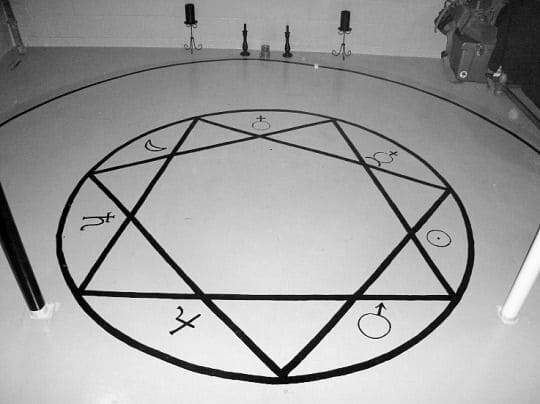
These are the core implements without which most traditional rituals would feel incomplete. They define sacred space, provide atmosphere and create the structure within which communication with the spiritual realm can safely occur.
The AltarThe altar is the magician’s central workspace. It is the axis mundi, or “world axis,” around which the ritual is organized. In ancient temples, stone altars were used for offerings and sacrifices, both animal and symbolic. In ceremonial magick, the altar is rarely a place of slaughter, but it still serves as a table of power.
It holds the magician’s other tools, sigils, offerings, and often a focal symbol such as a pentacle, cross, or planetary seal.
Some practitioners prefer wooden altars for their organic quality, others choose stone or marble to echo the permanence of temples. Portability is also an option: traveling magicians have long used folding or cloth-covered tables as makeshift sacred spaces.
The placement of the altar matters. In Solomonic traditions, it often stands in the center of the magic circle; in Wiccan practice, it may be oriented toward the north or east depending on symbolic associations.
The altar transforms ordinary space into sacred ground, and consecrating it with incense, water, or prayers is a common practice before any major rite.
The Circle and TriangleFew tools are as iconic in ceremonial magick as the circle and triangle. The magic circle, drawn in chalk, salt, cord, or paint, marks the magician’s boundary of protection.
It symbolizes unity, infinity and the containment of power. Within it, the operator stands at the center of their own cosmos, shielded from outside interference.
The triangle of manifestation, often placed outside the circle, is where summoned entities are called to appear. Its three sides symbolize balance and stability, and within it a sigil or crystal may be placed to anchor the spirit’s presence.
The circle protects, while the triangle directs. This is a dual structure that defines much of ritual magic, from the grimoires of the Middle Ages to modern ceremonial practice.
The Censer and IncenseIncense has been part of religious practice since the dawn of civilization. Egyptians burned frankincense and myrrh in honor of the gods; Hebrews offered “sweet smoke” in the Temple; medieval magicians filled their chambers with fumes believed to attract spirits.
The censer, whether a simple bowl, a swinging thurible, or a carved brass vessel, holds this incense. The smoke is more than perfume: it is a medium that both purifies and provides a subtle substance into which spirits can imprint themselves.
Different blends correspond to different intentions. Frankincense is purifying and solar; myrrh carries associations of death and rebirth; benzoin attracts benevolent forces; dragon’s blood empowers banishing.
Using a censer, the magician creates a sensory bridge: the smoke rises as a physical symbol of prayers and incantations ascending into the spiritual realm.
Candles and LampsLight has always been a symbol of divine presence. Candles, oil lamps, and later lanterns are staples of magical rituals, both to illuminate and to consecrate. A single flame can serve as a focus for meditation, while multiple candles of different colors form a symbolic structure of their own.
Each color carries a correspondence: white for purity, red for passion and vitality, green for prosperity, black for banishing and transformation. Planetary and elemental magicians arrange candle colors according to the forces they wish to invoke, while others simply use white as a universal substitute.
Lamps, meanwhile, were sometimes used instead of candles in older traditions. In the Picatrix and other astrological manuals, consecrated lamps were prepared with herbs and oils corresponding to specific planets, serving as talismans that radiated their influence into the space.
2. Tools of Command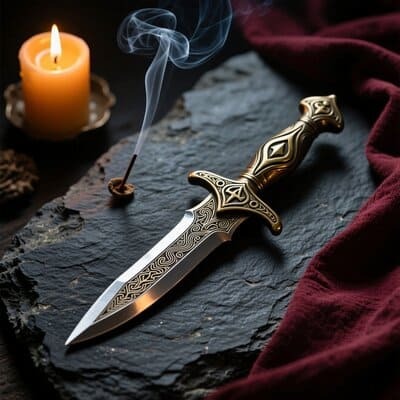
If foundational tools create the sacred space, tools of command give the magician authority within it.
These implements (wands, daggers, and staffs) symbolize the projection of will. In the hands of the trained operator, they are extensions of the voice and mind. They are used to direct energy, summon, and banish.
The WandThe wand is perhaps the oldest and most iconic tool of magical command.
In the ancient world, staffs and rods were symbols of power carried by kings, priests, and shamans alike. Moses wielded a rod to part the Red Sea, Hermes carried the caduceus, and the druids of Celtic lore worked with staves of oak, yew, or hazel.
In ceremonial magick, the wand channels the magician’s will like a lightning rod. Its association is often with fire (in Golden Dawn and Wiccan traditions) or air (in older ceremonial sources), depending on the system.
Wood choice is also important: hazel and oak are favored for their strength, while elder is linked to baneful and protective workings.
The wand may be capped with metal, crystal or left plain. Some traditions recommend inscribing planetary symbols, names of power, or personal sigils. It is not a “beam weapon” in the cinematic sense but a directional tool, focusing the operator’s intention into a sharp, projected force.
When consecrated, often by holding it over flame, water, and incense while reciting words of power, the wand becomes a literal extension of the magician’s arm and an outward expression of his inner will.
The Sword or AthameThe ritual sword or dagger (known in modern witchcraft as the athame) is a double-edged tool of command and defense. Where the wand channels and directs, the blade divides and asserts.
Its roots are martial: in grimoires like the Key of Solomon, a consecrated sword is indispensable for banishing hostile spirits and enforcing authority.
The sword is usually large and ceremonial, engraved with divine names or magical sigils. The athame, in contrast, is smaller (often a black-handled dagger), but serves the same symbolic function.
In both cases, the blade represents the magician’s authority to command, which is reinforced by centuries of association with kingship and divine order.
Practically, the sword is used to trace protective circles, point toward spirits, and cut through astral influences. It is not used to physically harm, but as a symbolic weapon against chaos and intrusion.
Similarly to a wand, consecration of a blade often involves bathing it in fire, water and incense, and reciting invocations of strength and clarity. Once prepared, it is no longer treated as an ordinary knife but as a sacred weapon.
The StaffThe staff is primal and rooted. It is the magician’s walking companion, taller than the operator, and a symbol of their connection to earth and sky. Shamans and prophets alike have carried staffs as marks of their authority and guides for their journeys.
In magical use, the staff combines the commanding force of the wand with the grounding stability of the earth. It is often associated with the element of earth or spirit, again depending on tradition. Some staffs are tipped with metal or crystal, others carved with runes or planetary symbols.
In ritual, it may be struck against the ground to call attention, drawn in the air to form sigils, or planted upright to establish a temporary axis mundi within the ritual space.
To consecrate a staff, practitioners can anoint it with oil, bind it with colored cords, or leave it beneath the open sky on a full moon to absorb natural power.
3. Tools of Vision and Revelation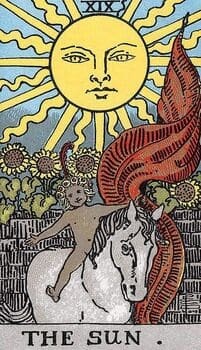
If tools of command are weapons of will, then tools of vision are windows into the unseen.
These implements allow the magician to perceive spirits, and receive messages from astral/spiritual realm.
The Scrying MirrorThe black mirror is often designed as a disc of obsidian, blackened glass, or polished metal. It is one of the most iconic tools of divination.
Its origins stretch back to ancient times: Aztec priests gazed into obsidian mirrors to commune with Tezcatlipoca, while medieval magicians like John Dee used polished crystals and darkened glass as “shewstones.”
The mirror does not show literal images like a movie screen. Instead, it serves as a focal point for altered consciousness. The magician gazes into the black depth until visions arise, be it through symbolic forms, spirit presences or flashes of clairvoyant insight.
To consecrate, a practitioner may cleanse the mirror with water or incense, dedicate it to a specific purpose and keep it veiled when not in use.
It should be placed where no reflections distract, with dim lighting or candlelight providing the right atmosphere. With practice, the mirror can become a reliable gateway to both inner and outer reality.
The Crystal BallThe crystal ball, or sphere, is a close cousin of the black mirror, but with a different symbolic quality. Instead of darkness, it embodies clarity and purity and is therefore often used for revelatory purposes.
Quartz is the most common material, though amethyst, obsidian, or even glass can be used. The sphere’s surface without edges represents totality and infinity. Much like the mirror, it is not about “seeing” literal pictures when using it, but about stimulating inner vision.
Magicians often cover their crystal when not in use, consecrate it by exposing it to moonlight, and avoid letting uninitiated hands touch it. In ritual, it can be placed in the triangle of manifestation to serve as a vessel for spirit appearances as the glossy surface can catch subtle impressions.
Tarot and Oracle DecksCards may not seem as old as mirrors and crystals, but the tarot has been a central occult tool since the Renaissance.
Originally a game of chance in Italy, it was reinterpreted by French occultists in the 18th and 19th centuries as a book of symbols. Each card became a doorway into archetypal forces, a way of receiving messages from the unconscious and the spiritual realm.
Tarot decks (with their major and minor arcana) provide a structured symbolic system, while oracle decks are more freeform, often themed around specific spirits or philosophies. Both can be used for divination, spirit communication, and self-reflection.
Consecration usually involves blessing the deck with incense or candle flame, dedicating it to spiritual work and developing an intimate relationship with the cards through repeated use.
Unlike mirrors and crystals, which are passive, tarot is interactive. The act of shuffling and drawing engages the magician in the act of revelation, rather than waiting for a vision to appear on its own.
Spirit TrumpetsOne of the more unusual tools of vision is the spirit trumpet, which emerged during the 19th-century spiritualist movement.
These were often collapsible cones of metal or cardboard, decorated with phosphorescent paint. Mediums claimed that spirits would use them to project voices during séances, amplifying whispers into audible speech.
Though less common today, spirit trumpets remain a fascinating example that occultism is not a stagnant, but a constantly evolving field.
The trumpet is communal, which is quite uncommon for occult tools. Some occultists also experiment with them as resonance chambers, amplifying subtle vibrations into audible tones.
Consecration typically involved nothing more than prayers and dedication, though some traditions anointed the trumpet or inscribed protective symbols.
4. Tools of Offering and Pact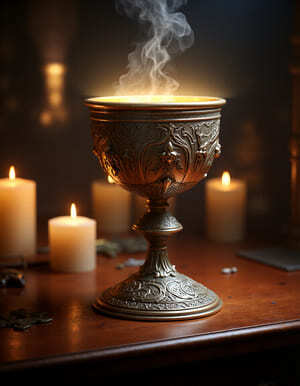
Where vision tools reveal, offering tools seal. These implements mediate the exchange between human and spirit, symbolizing covenant, devotion, and reciprocity.
They are the vessels of pact-making, consecration, and sacrifice, moments when the magician moves from command to communion.
The ChaliceThe chalice is one of the most universal tools in ritual practice. From Christian communion to pagan libations, it embodies the receptive principle and the vessel of transformation.
In ceremonial magick, the chalice is often filled with water, wine, or other liquids used as offerings. In some rites it symbolizes the element of water, complementing the wand (fire) or sword (air).
In Wiccan tradition, the union of athame and chalice symbolizes the sacred marriage of masculine and feminine principles.
Consecration typically involves cleansing the chalice with water and incense, then dedicating it with words of blessing. When used in ritual, the act of drinking or pouring libations is not mere consumption. It is a symbolic fusion of body, spirit, and divine power.
The Pentacle or DiscThe pentacle is a flat disc, often inscribed with protective symbols, divine names, or pentagrams. It represents the element of earth: grounding, stability, and material manifestation.
In Solomonic magick, pentacles (with a lowercase “p”) are talismanic seals drawn on metal, parchment, or wax, each connected to planetary forces. These were not simply protective but active, designed to summon angels or spirits aligned with their sphere.
In broader ceremonial use, the pentacle acts as a protective seal placed on the altar, grounding the energies of the ritual. It serves as a base for offerings or as a focal point for consecrating other tools.
Consecration involves engraving or painting the symbols, then exposing the disc to the four elements while reciting prayers.
A properly consecrated pentacle becomes a shield and anchor in ritual space, ensuring stability while the unseen forces are at work.
Sacrificial ImplementsSacrifice has always been at the heart of religion and magick. We can trace it back to the ancient world, when animals, food, and libations were regularly offered to gods and lesser spirits.
In modern ceremonial magick, literal blood sacrifice is rare and is often replaced by symbolic acts: burning herbs, cutting one’s own finger for a drop of blood, or offering wine, bread, or incense.
Nevertheless, sacrificial implements remain important as symbolic tools. These might include a ritual knife reserved for offerings, bowls for libations, or even small cauldrons for burning petitions.
Historically, grimoires like the Grimorium Verum or Grand Grimoire did reference animal offerings, while more modern systems discourage or reinterpret this into symbolic gestures.
What remains central is the principle: the magician gives something of value, creating a bond of reciprocity with the conjured spirit.
5. Tools of Record and Contact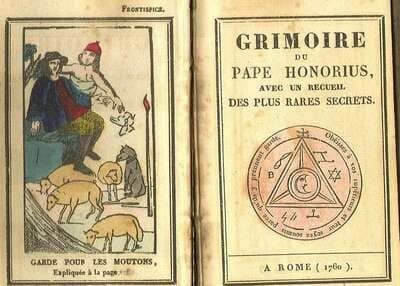
Communication with spirits isn’t always verbal or visual. Sometimes it requires recording, channeling, or inscribing messages in physical form.
Tools of record and contact are those that capture the fleeting presence of the spirit, allowing dialogue to be preserved, studied and hopefully replicated.
The Grimoire or Book of ShadowsThe magician’s book is more than a diary. It is part spellbook, part record, part talisman. In medieval Europe, grimoires contained seals of spirits, conjurations, and planetary tables, often copied by hand and passed secretly between adepts.
In modern practice, witches and ceremonialists alike keep a “Book of Shadows” or magical journal. This is where rituals are recorded, dreams are logged, and personal sigils are drawn. The act of writing itself has power and significance.
Consecrating a grimoire may involve dedicating it on the altar, tracing protective symbols on its cover, or writing an opening invocation on the first page. Over time, the book becomes charged with energy, as unique extension of its keeper.
Planchettes and Talking BoardsThe planchette is a heart-shaped pointer used with spirit boards. It became famous in the 19th century as the Ouija board spread through parlors and séance rooms. Though mocked by skeptics, these boards remain tools of spirit communication in occult circles.
The principle is simple: letters are inscribed on a surface, and the planchette moves to spell out messages under the combined touch of participants. Skeptics call it ideomotor movement (subconscious micro-movements of the muscles), while occultists see it as a genuine channel for spirits.
Traditional magicians use similar techniques, writing letters on parchment or creating “spirit alphabets” in circles. The idea is the same: a system of symbols that allows the summoned spirit to spell out words.
Consecration involves blessing the board, tracing protective circles around it, and sometimes restricting its use to particular spirits. As with all contact tools, the danger lies not in the object, but in the openness of the operator and the health/strength of their psyche.
Sigil Plates and SealsOne of the most enduring contact tools is the engraved seal. In grimoires, each spirit has a sigil, a unique design said to embody its essence. These were often inscribed on wax, clay, or metal discs known as lamens or pentacles.
The seal serves multiple purposes: it is a beacon to attract the spirit, a vessel to contain it and a physical proof of its presence. Magicians may place the seal in the triangle of manifestation, beneath a crystal ball, or on the altar itself. Offerings are often laid directly on top of the seal.
Consecrating a sigil plate involves engraving or drawing the design carefully, then exposing it to elemental consecrations through fire, water, incense, and earth. Once charged, it becomes a potent key, unlocking communication with the specific entity it represents.
6. Protective and Supportive Tools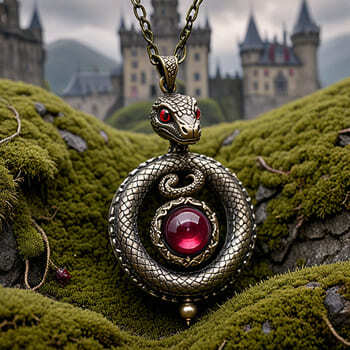
Not all occult tools are for commanding or contacting spirits. Some exist to shield the practitioner, stabilize their energy or to mark the ritual as sacred. These protective and supportive tools form the “armor” of the magician.
Amulets and TalismansAmulets and talismans are portable forms of magical protection and influence. The distinction is subtle but important:
An amulet protects the wearer, often through passive defensive energy.A talisman attracts or channels specific forces, usually inscribed with sigils, planetary seals, or divine names.In antiquity, Egyptians wore scarabs for rebirth, Greeks carried carved stones, while medieval magicians forged planetary talismans in metals aligned to the heavens. Each was consecrated through ritual, making the object a living link between the magician and cosmic forces.
Consecration often involves engraving the symbol during a planetary hour, charging it with incense and prayer, and wearing it close to the body. Over time, it becomes like a second skin of power and protection.
Robes and Ritual GarmentsThe magician’s robe is not a theatrical costume but a statement of separation from ordinary life. To don the robe is to step out of the mundane and into the sacred.
In grimoires like the Key of Solomon, robes were prescribed in white linen, symbolizing purity. In modern ceremonial traditions, black or colored robes are common, each hue linked to specific forces. Some practitioners (like yours truly) also wear hoods to enhance anonymity and focus.
Consecrating a robe typically involves washing it in clean water, fumigating it with incense, and blessing it with invocations of purity. When reserved only for ritual, the garment accumulates a charge of energy over time and acts as a protective mantle.
Ritual Rings and JewelryRings, pendants, and other jewelry are often worn as permanent links to spiritual power. In the Testament of Solomon, the king commands spirits with a ring engraved with a divine seal. Modern magicians may wear pentagrams, planetary sigils, or stones aligned to their personal guardian spirits.
These adornments serve three roles:
Protective — warding off hostile forces.Representative — linking the wearer to a specific spirit or current.Empowering — acting as a battery of charged energy.Consecration usually involves anointing the jewelry with oil, invoking divine or demonic names, and charging it during ritual. Unlike tools that are stored, ritual jewelry is often worn daily, blending magical practice with ordinary life.
To ConcludeOccult tools are more than artifacts or old relics. They are extensions of the magician’s Will and serve powerful ritual functions.
The altar and circle define sacred space, the wand and sword project authority, the mirror and crystal open gateways, the chalice and pentacle seal covenants, and the grimoire records the unfolding path. Amulets, robes, and rings remind the practitioner that every action in the unseen has a reflection in the seen.
For the beginner, these tools may appear optional and superfluous. And indeed, a highly skilled adept can summon forces with a minimalist setup. But for most practitioners, and especially when dealing with potent demons and angels, these tools contribute significantly to the success of an operation. I use many tools in my rituals, both for myself and my clients.
Lastly, to work with these items is to join a lineage stretching from the temple priests of Babylon to Renaissance magicians, spiritualist mediums, and us occultists of today. It is to engage in perhaps the most elevated, and certainly the most fascinating form of communication known to man – communication with the spirit realm.
The post Occult Tools Explained: From Scrying Mirrors to Spirit Trumpets appeared first on Occultist.