
Mel Cole: From Guadalcanal to Spokane
Mel Cole arrived at Spokane Indians spring training in early April 1946 unsure if he had a future in baseball. After all, it had been nearly five years since he had last played professionally. Like millions of Americans, Cole had spent the previous four years serving his country during World War II. With the war over, he joined thousands of other returning servicemen who attempted to resurrect their baseball dreams. Cole hoped to make Spokane’s roster that spring as a catcher. He could not have predicted that on the eve of opening day, he would be anointed manager.
“Can’t Miss” ProspectMelvin Chester “Mel” Cole, a native of Stockton, California, inherited a love of baseball from his father, Chester, a railroad conductor on the Southern Pacific Railroad. At age 16, Cole led the Sacramento American Legion team to the Little World Series in Gastonia, North Carolina. Two years later, legendary New York Yankees scout Joe Devine—the same West Coast talent hawk who signed Joe DiMaggio—inked Cole to a professional contract. Devine called Cole a “can’t miss” prospect.
The Yankees assigned Cole to a Class-D affiliate in El Paso, Texas, for the ’37 season. Playing primarily shortstop, he batted .315, made the circuit’s All-Star team, and set a league record by hitting safely in 26 consecutive games. Over the next four seasons, Cole inched up the Yankees’ minor-league ladder, spending time in Joplin, Lewiston, Wenatchee, Idaho Falls, and Tacoma. At each stop, he showed defensive versatility, logging time at shortstop, third base, outfield, and catcher.
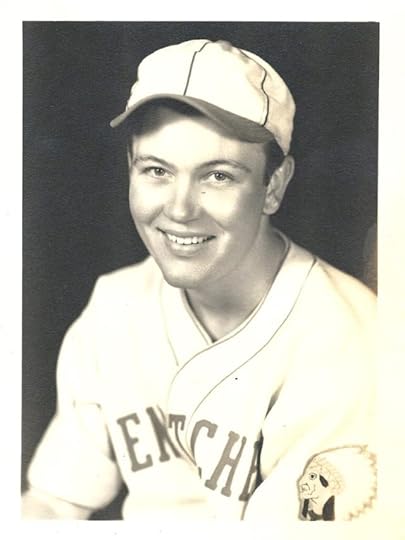 Cole played for the Wenatchee Chiefs in 1939 and ’40.Military Service
On May 8, 1942, Cole enlisted in the Navy. He reported to Sand Point Naval Training Center in Seattle, where he played ball on the base team alongside future Spokane Indians teammate Levi McCormack. In October 1943, Cole set sail for the South Pacific on the USS Hammondsport. He spent the next 18 months in the Pacific Theatre, including time in Guadalcanal, serving an Aviation Machinist Mate 1st Class. During his stint overseas, Cole played and managed a Navy ball team. He also filled out his frame. A fellow soldier told a reporter back home that Cole had become “husky young man in contrast to the anemic looking individual who used to play on high school team.”
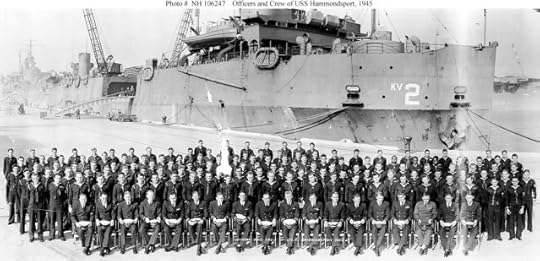 Crew of the USS Hammondsport in 1945.
 Upon returning stateside, Cole spent the winter working as a railroad switchman. But his desire to make a living playing baseball hadn’t wavered. On March 13, he signed a contract with the Spokane Indians, an independent Class-B club in the Western International League. At 27, Cole was old for a prospect, so he fudged his birthday on a publicity questionnaire he completed before the season. He indicated a birth year of 1920—two years after his actual birth date.
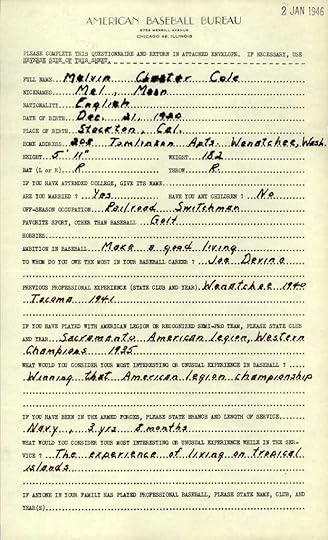 Mel Cole made himself two years young on this publicity survey from January 1946.Back to Baseball in ’46
In early April, Cole traveled to Marysville, California, for three weeks of spring training with the Indians. A hand injury hampered his play, but he still managed to win one of the team’s two catching jobs. When camp broke, Cole and his new teammates bussed from Marysville to Spokane. During the two-day trek, manager Glenn Wright—a former star shortstop with the Pirates and Dodgers—went on a bender. “Glenn was a terrific guy,” recalled pitcher Gus Hallbourg years later. “But he was drunk from the time we left Marysville to when we got back to Spokane.”
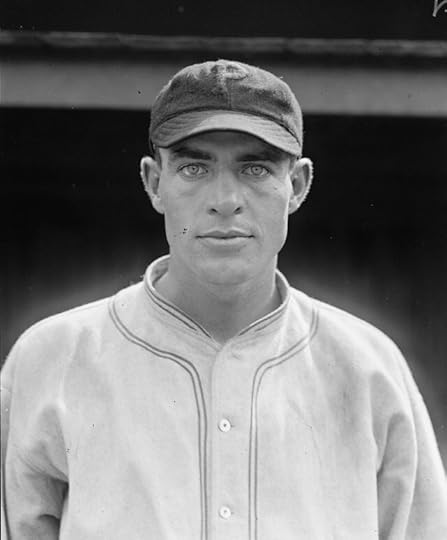 Former Pirates shortstop Glenn Wright was hired to managed the Spokane Indians in ’46 but lost his job before opening day.
 The team arrived in Spokane on April 23. Over the next two days, Wright disappeared. The night before the home opener, the team’s incensed owner, Sam Collins, fired him and named Cole player-manager.
Managing the Spokane Indians“I know I’m a lucky fellow to get this job, and I want the people to know I’ll do my best and so will the players,” Cole told reporters. “If I didn’t think I could handle the job, I wouldn’t have accepted it. The boys are going to hustle, and we’re going to win.”
After losing eight of their first 11 games, the talent-laden Indians caught fire. By mid-June, they stood firmly in the thick of the Western International League pennant race. Cole didn’t contribute much on the field, managing just seven hits in 41 at-bats for a .171 average. His dream of playing in the majors or Pacific Coast League looked bleak, but carving out a career as a manger remained a possibility. Over the first two months of the season, he proved himself a capable leader. He also showed a fiery temper. Umpires ejected Cole on three occasions for arguing. The third offense earned him a three-game suspension and $10 fine.
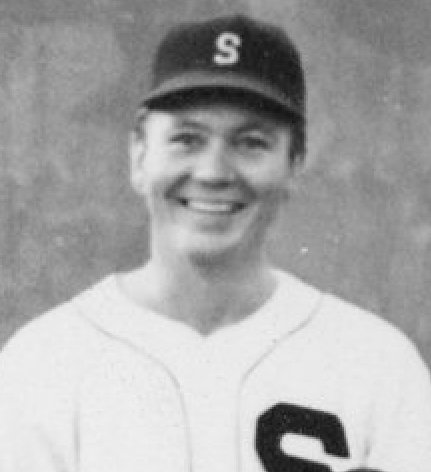 Mel Cole on June 22, 1946.
Former Brooklyn Dodger Ben Geraghty filled in while Cole served his suspension. A couple of days after his return, Cole piloted Spokane to a dramatic come-from-behind victory over the Salem Senators on June 23.
Tragedy StrikesThe next morning, the Indians boarded a coach bus and traveled west across Washington state for their next series in Bremerton. The bus reached Snoqualmie Pass in the early evening hours as a light rain fell from the dusk sky. Just over the pass, an oncoming vehicle forced the bus off the road. It tumbled down a steep ravine, catching fire as it rolled. The crumpled coach came to rest 300 feet below the road.
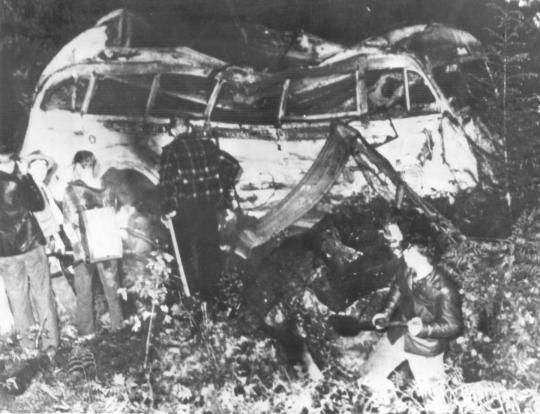 What remained of the Spokane Indians bus post-crash.
Mel Cole and eight of his teammates lost their lives. The twenty-seven-year-old skipper and World War II veteran was buried in East Lawn Memorial Park in Sacramento. He left behind a pregnant widow named Marian. She named her some Melvin Jr.
You can read more about the 1946 Spokane Indians in my book, Season of Shattered Dreams. I have also written several posts about other members of the team which can be found under the blog tab.
The post Mel Cole: From Guadalcanal to Spokane appeared first on Eric Vickrey.


