It's Flash! Ah-Ah!
A Brief History of G.I. Joe
Welcome! I look at action figures, mainly from the G.I. Joe line (because I love them so), as a touchpoint to discuss their character tropes in speculative fiction and TRPG game design.
Today, we explore a certain laser rifle trooper from Lodi, CA…
The rebirth of G.I. Joe in its Real American Hero line of figures (1982-1994) came in part as a response to the success of Kenner’s Star Wars line (1978-1985). And the 3 3/4” scaling for that line came in part as a response to the oil crises of the 1970s and the rising cost of plastic. Smaller figures, less plastic, smaller cost.
For G.I. Joe, the last time we saw their figures before this came in 1976, with the final wave of the 12” Action Team line. By then, the brand had moved away from their military identity due to the unpopularity of the Vietnam War, but returned to their roots (with a vengeance) in the first wave of a Real American Hero.
Those 1982 figures were very much grounded in real-world military language and aesthetics, helped in large part by the participation of Larry Hama, a Vietnam War veteran himself and comic book writer. Larry retooled a pitch for a Nick Fury spinoff involving the adventures of a military special forces unit, and used it to create Marvel’s G.I. Joe comic series instead (as well as character backgrounds for the figures themselves).
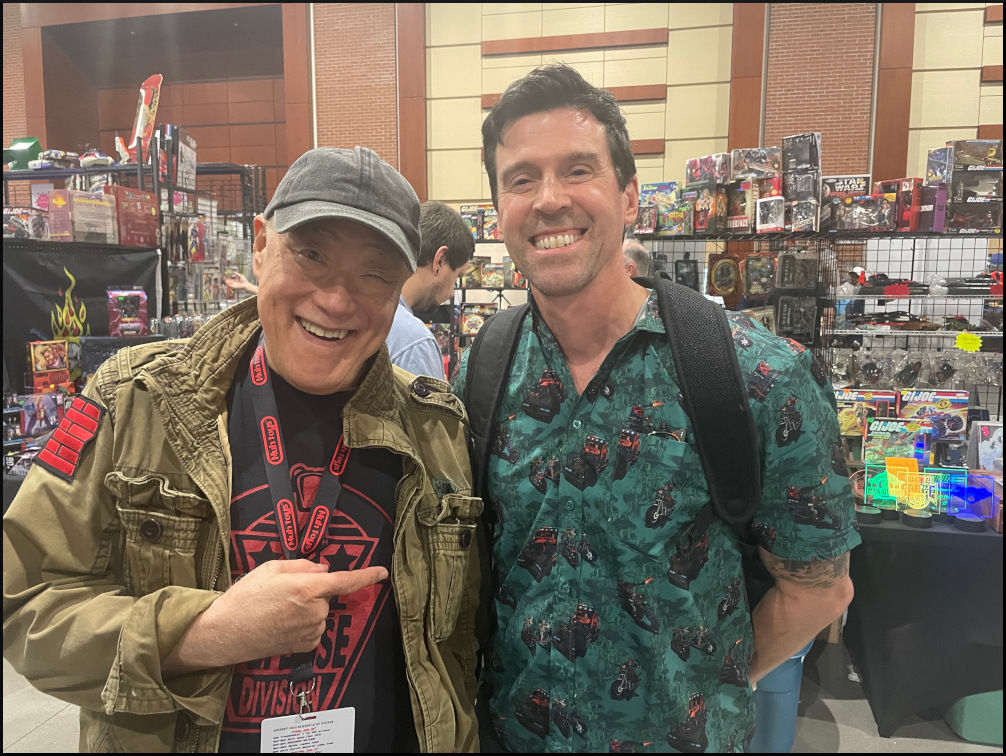 Any chance to use this picture, I will!Bring in the Genre Blending!
What helped set the A Real American Hero line apart was its willingness to weave in genre elements outside of a strictly real-world military universe. Largely, science-fiction and martial arts. Granted, these elements became increasingly pronounced in later waves, and arguably too far by the end when seemingly every figure was either a ninja or a member of some Eco Warrior/Star Brigade/Monster Hunter unit, often wearing the most garish colors and/or carrying the most ridiculously oversized weapons possible.1
(Including whatever the hell this guy is supposed to be.)
In much the same way, I’ve also written before (for an earlier version of the Dungeons & Dragons website now lost to the ages) about how the 1e Monster Manual helped expand the D&D universe by pulling in creatures not just from its own game world (the beholder, bulette, rust monster, etc.) but also from Hammer horror and martial arts films, medieval bestiaries, world folklore and legend—and really, any fertile garden of monsters bearing strange, desirable fruit.
In the 1982 wave, however, we have a more reasonable introduction of sci-fi elements with Flash.
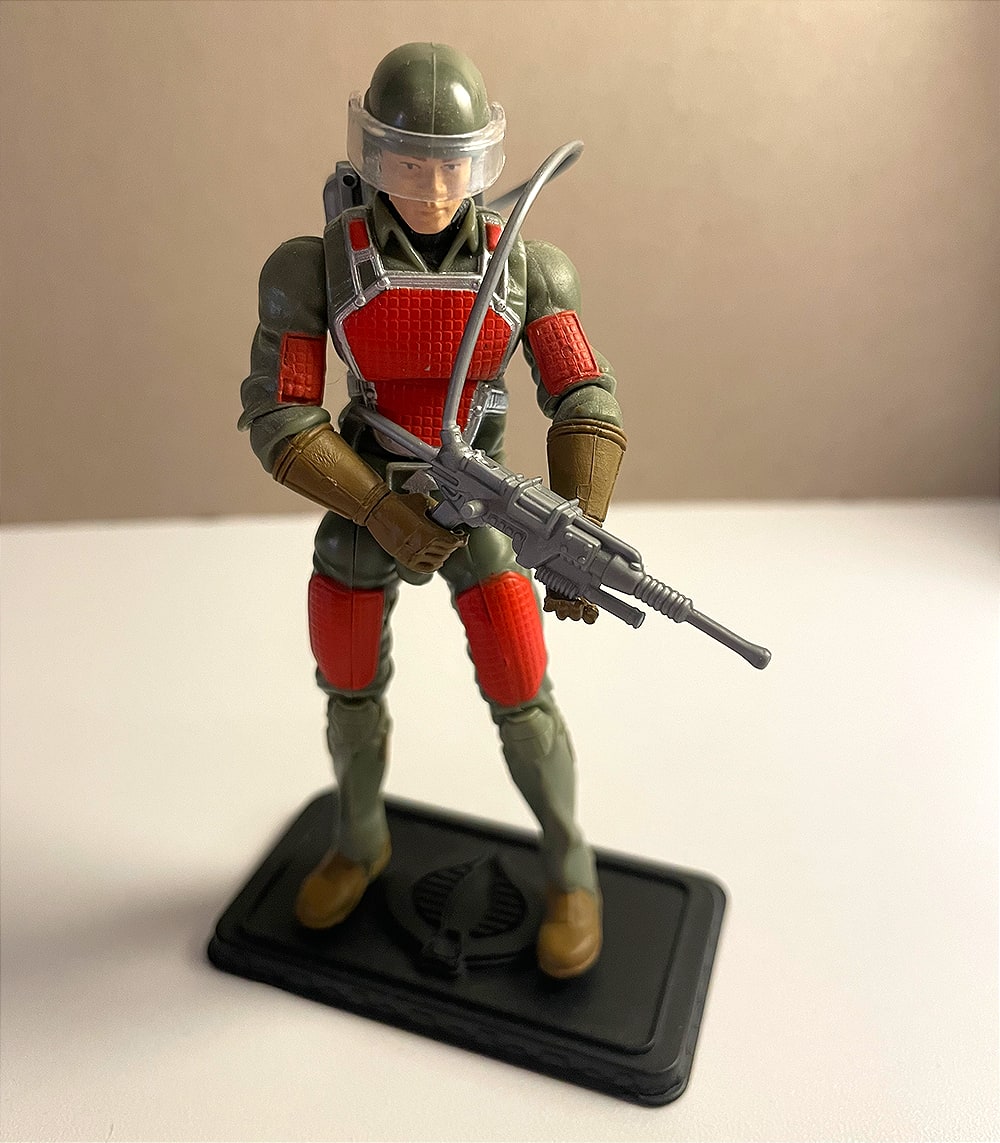 Insert the Queen soundtrack! Insert the Queen soundtrack!!!!Flash! Ah-ah! Savior of the (G.I. Joe) Universe
Identified as the team’s “laser rifle trooper,” Flash came equipped with the XMLR-1a and had a background in Electronics CBR…
Wait, what?
In considering Flash, I realize that another reason I have for creating this Substack is not just for the nostalgic love and appreciation of these figures. It is. But it’s also to gain a better understanding of these figures as well.
Despite being an Army brat myself, I didn’t have a solid enough knowledge of the military terminology being used. I couldn’t even identify Snake Eyes’ satchel charge for what it was, until I saw one used in the greatest film this (or any other) country has ever produced, 1987’s Predator.
OK, so what exactly is Flash’s rifle? What’s with his padded armor? And was he named after Flash Gordon?
The last one, probably… at least to some extent. And while a solid codename for a sci-fi laser trooper, it did also cause copyright problems running up against DC’s Flash. A situation repeated with G.I. Joe’s 1988 Ghostrider figure, where the brand somehow managed to run afoul of its own comics parent company!2
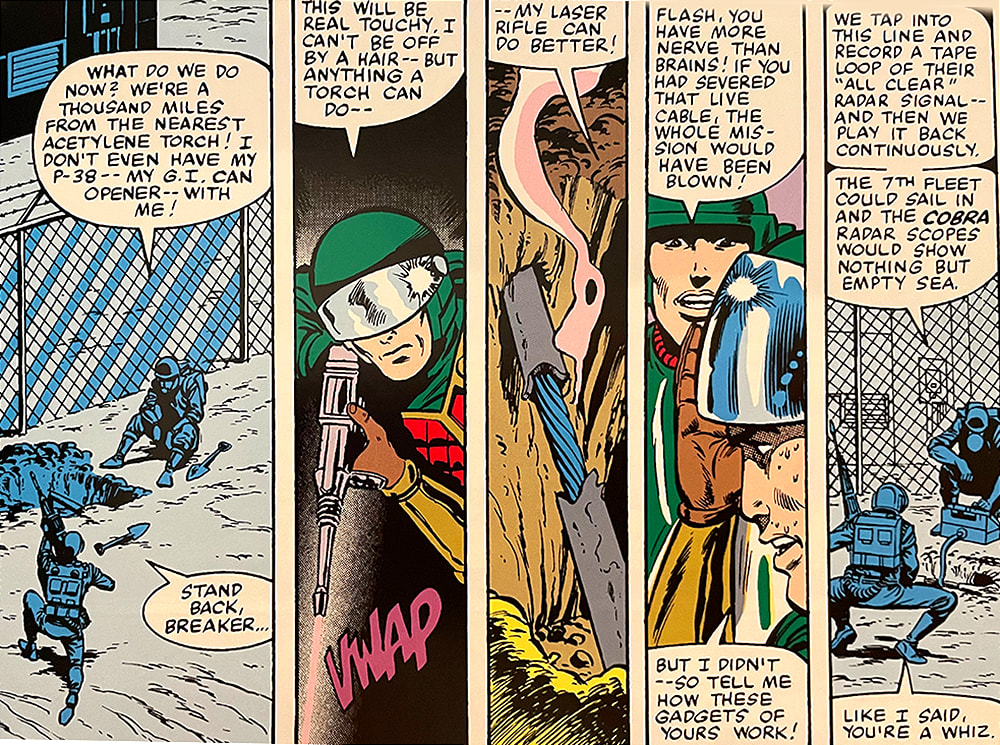 Marvel’s G.I. Joe: A Real American Hero Issue #1Fire the Pew! Pew! Gun
The XMLR-1a thus follows the conventions of other military weapon designations. For example, there’s the M-16 (I always thought the “M” stood for “Machine Gun,” but it actually just stands for “Model”), or the AK-47 (for Avtomat Kalashnikova, or Automatic Kalashnikova, after it’s designer, Mikhail Kalashnikov3, created in 1947).
For Flash, “XMLR-1a” is the designation for “Experimental Laser Rifle”. A damn shame that his successor, the absurdly color-schemed Sci-Fi, is not armed with a 2a evolution of the rifle, but an “XH86 LLOM beam” rifle instead, whose code does not seem to stand for anything (except the “X” as “Experimental”).
From Dan Klingensmith’s outstanding book series, Creating G,I. Joe, Flash’s character concept originated with an aesthetic far more similar to Sci-Fi’s with a more inflatable space suit-style uniform designed to be filled with oxygen and powered by a larger backpack (all to protect him from the heat of his rifle).
The laser rifle itself drew its stated inspiration directly from Star Wars; yet, unlike blasters, Flash’s rifle fired a steady cutting beam. For example as shown in the comics, when the team is trapped in their headquarters, Flash must balance the output of his rifle to cut through the door lock without using up the remaining oxygen in the room.
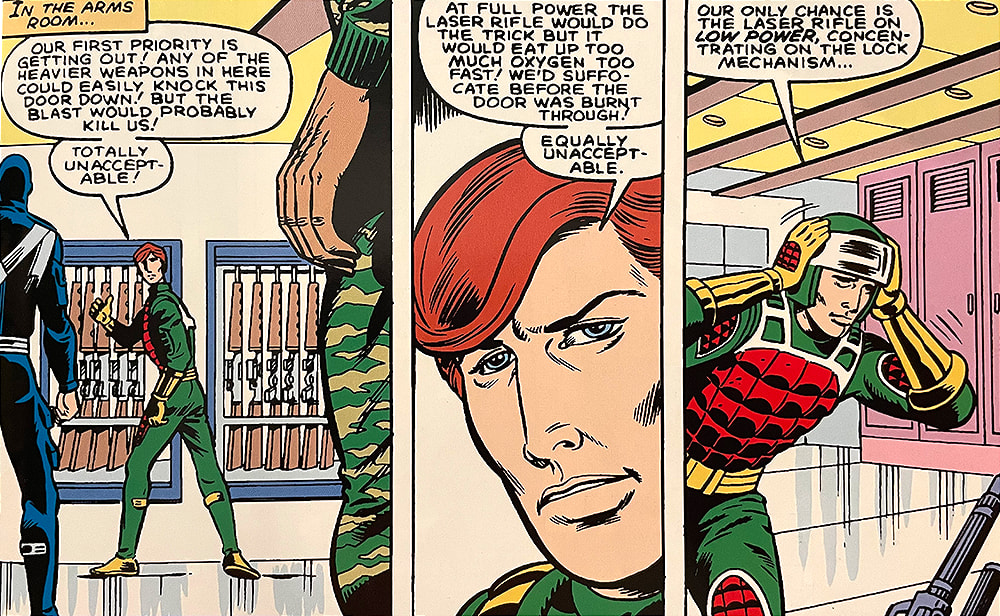 Marvel’s G.I. Joe: A Real American Hero Issue #3
This was exactly the same calculus I had to make when I drove my old Honda Accord. Drive slow enough to minimize it overheating, balanced against a high enough speed to at least get close enough to home before it invariably did.
That’s One Super SuitAll this jargony detail may bore the pants off most people, but I can’t help it! I find it needlessly fascinating...
And so… Flash’s Secondary Military Specialty is Electronics CBR, which (I now know) refers to gear designed to be operable in Chemical, Biological, and/or Radiological-contaminated environments.
Flash is thus trained and equipped to head into contaminated areas as well as to survive such conditions and effects. Which, if I’d have known as a kid, certainly expands the imaginative play for this guy. He’s not just another infantry soldier but with a laser rifle. Now he’s a special forces unit unto himself, specifically able to operate in the absolute worst of wartime conditions, in areas where chemical or even nuclear weapons have been deployed:
Chernobyl at the height of disaster and under enemy fire.
Meanwhile, Flash’s red-padded uniform, as a vestige of his original suit design, seems designed to protect him more from enemy laser fire than his own. Which would indicate that enemy (Cobra or other forces) troops might be similarly armed.
So now I picture a scenario of a post-war city, rendered uninhabitable. A dirty bomb has been set off by Cobra to clear it out. Flash is deployed to go in and recover material of some significance (a scientific formula, a code, a list of secret agents) knowing that Cobra forces will be attempting the same.
I still have questions:
What’s the range of Flash’s laser rifle? Long enough and he may wage a sniper’s duel with enemy troops from across the city.
Can it melt as well as cut? The two sides may cut open doors and through steel beams to maneuver, as well as melt vehicles and obstacles they train their lasers on.
How long is its power source? Running low, Flash may need to find a suitable city generator to tap into.
And finally, can these lasers be redirected by mirrors? The more powerful the laser, the more reflective the mirror would need to be (or else it absorbs the remaining energy); but if so, I can imagine a final twist, wherein Flash, out of power and cornered, manages to turn the enemy’s lasers back onto themselves.
After all, as the t-shirts have long stated, knowing is only half the battle. The other half is lasers.
This is right about where I usually add this little, blue button. Please consider becoming a regular subscriber!
Next time: Exploring the chocolate in your peanut butter of science-fiction in your fantasy.
Thanks for reading Curious Figures! This post is public so feel free to share it.
1Golems alone make as good a case study as anything. The 1e Monster Manual list four types, flesh (derived from Frankenstein’s monster), clay (from Jewish legend of the original golem), stone (fantasy tropes of living/animated statues), and iron (Talos from Greek mythology as seen in 1963’s film, Jason and the Argonauts).
2This led to the one of the dumbest running gags in the G.I. Joe comic series, where every time the character appeared, no one could “remember” his name, since it couldn’t actually be used in the comic.
3And how the .45 Colt refers to its founder Samuel Colt (and its .45 caliber ammunition size), while Colt 45 refers to #45 Jerry Hill of the Baltimore Colts. Allegedly.