Re-imagine your Scrum (from The Scrum Caretaker Courier 14)
In 2003 my life of Scrum didn’t actually start with Scrum but with eXtreme Programming that we subsequently wrapped in Scrum. As my professional life in 2025 still revolves around Scrum, can I safely say that I have a ‘career’ of more than two decades of Scrum?
There are a few important milestones that I passed in all those years, although I didn’t plan for them:
Virtually moving to the Netherlands in 2011 and working with large organizations,Creating my book “Scrum – A Pocket Guide” in 2013,Partnering with Ken Schwaber and Scrum.org in 2013,Continuing my professional life as an “independent Scrum Caretaker” in 2016,Collecting and curating the views of experts around the world in the book “97 Things Every Scrum Practitioner Should Know” in 2020.Today, in 2025, it feels like I am passing an important milestone again. Over the past two decades of Scrum I seem to have been gathering many, many pieces without being able to see the puzzle, the overall picture. Over the past 4-5 years however, those pieces did start to fit and form one holistic vision.
In 2019 I described my observations regarding “The illusion of agility” in a paper. But, the plan to write a follow-up paper called “Re-imagine your Scrum” never worked out. That is strange because I had created small recordings on both topics in 2019. After all, they are related in the sense that inspection and adaptation are. Today, I am happy to share that I have-finally-written that follow-up paper.
Still, I feel that I couldn’t have expressed my follow-up views and advice in writing sooner than now. Although it is not the complete story of how I look at the future state of Scrum (that will be the topic of my next book), I strongly believe it is already more than enough to get many people, teams, and leaders to start thinking beyond their (current instances of) Scrum.
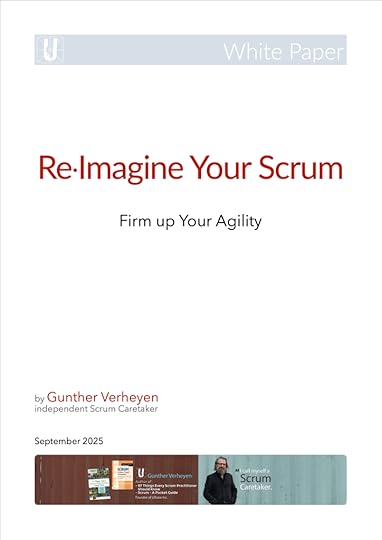
I hope you will enjoy watching and reading my views and ideas on how to “Re-imagine your Scrum (Firm up your agility)” through the recording & (NEW) WHITEPAPER.
If you want the full history, do read what follows…
Warm regards
Gunther
independent Scrum Caretaker
In September 2003, exactly 22 years ago, two software architects convinced me to apply eXtreme Programming for the development of a system we needed to deliver to a large telecom company in Belgium. My life of Scrum thus actually started with eXtreme Programming that we subsequently wrapped in Scrum. In May 2004, having practiced Scrum for a while, I attended the first CSM class (“Certified ScrumMaster”) in the lowlands (Belgium and the Netherlands). It was taught by Ken Schwaber, whose first two books I had read before attending the class. Over the years that followed, I applied Scrum in various environments, for different organizations, and with different teams mastering different technology stacks.
When did your life of Scrum begin? Do you remember starting with Scrum? What was it like? What was the impact on your professional life?
By the end of 2010 my life of Scrum got seriously boosted…
2010-2013: Scrum in the largeThat boost was not caused by attending a PSM class (“Professional Scrum Master”) taught by Ken Schwaber in Zurich (Switzerland) in December 2010. I attended that class as part of my desire to become a PST (“Professional Scrum Trainer”) for Ken’s organization, Scrum.org. I had been following up closely on the work of Ken with Scrum.org since he had established it in the fall of 2009. By the way, the materials taught in that first version of the PSM class were very, very similar to the materials of the CSM class that I attended in 2004.
No, what boosted my life of Scrum was virtually moving to the Netherlands.
I had joined Capgemini Belgium in March 2010. But by the end of 2010, around the time that I attended the PSM class, the Dutch Capgemini organization asked for my help. They were getting many requests from customers to help them with Scrum. As they had nobody with expertise in Scrum in the large organization that Capgemini Netherlands was (7 000 employees at the time) they requested my help, as someone from Capgemini Belgium (700 employees at the time). In January 2011 I facilitated several internal workshops at the Capgemini NL HQ in Utrecht. It allowed us to start answering the demand affirmatively. As we did, the response was such that I immediately found myself working in the Netherlands full-time. In no time, I was coaching aspiring Scrum coaches at Capgemini, facilitating various internal and external workshops, working with customers’ teams and leadership, guiding the Capgemini account teams, and working with people from Capgemini around the world. I called myself “Global Scrum Leader” within Capgemini.
The words that best describe the biggest change occurring in my life of Scrum are “size” or “scale”. I suddenly was a very visible person within a very large organization-globally-and I was suddenly working with very, very large customer organizations. Many of those clients, although not all, were financial organizations (banks and insurance companies). I was working with their executive leadership teams as well as with managers and Scrum teams. Having practiced Scrum for 7+ years did prove crucial to stand my ground.
In the spring of 2011 I became a Professional Scrum Trainer licensed to teach the PSM and the PSPO class (“Professional Scrum Master” and “Professional Product Owner”). Soon I became the first (external) steward to manage the courseware of those classes on behalf of Scrum.org. At the same time I was facilitating many, many Professional Scrum classes via Capgemini’s Academy. Due to the fairly open process, we were able to quickly ramp up and license more local people as PST without endangering quality. Answering the demand created more demand. In no time, the Netherlands became a near-exclusive “Professional Scrum” market.
And so, by accident, I found myself at the heart of the Scrum storm that was sweeping the Netherlands. Ken and I drove forward the first Scrum Day Europe event that happened in July 2012 in Amsterdam. I was working with large organisations on the adoption of Scrum and on their enterprise ambitions for doing so. So, at that event I already tried to paint a picture of the broader impact that introducing Scrum should have on an organization and its structures. The title of my presentation was: “Emergence of the Customer-Oriented Enterprise”).
It is also why I traveled to the Scrum.org office in Burlington (MA, USA) for the first time in 2012. With a small group of people we worked for two days largely upon models and Excels I had been creating and using at Capgemini. As the focus of my work had been much on Scrum teams, we expanded the scope to the enterprise level, elaborating on a playbook of Ken. We were envisioning a “Scrum qua Scrum” approach: using Scrum to adopt Scrum deeply.
By the end of 2012, I was accumulating a few jobs too much at the same time. I was working 7 days a week (literally). To be clear: not a healthy situation.
2013-2016: While at Scrum.orgIn March 2013, Ken and I agreed on the many mutual benefits of a full-time partnership. While preparing my transition I accidentally created the first edition of my book, “Scrum – A Pocket Guide” (published in November 2013). As from June 2013 Ken and I continued the work on our enterprise adoption framework, naming it “Agility Path” . We included an instrument called “Agility Index”, on which I even co-hold a patent—pointless and useless given the total lack of success and because it’s plainly ludicrous anyhow. We traveled the world, promoted our framework at events and organizations, and trained people in it (licensing them as “Engagement Manager”). Given the complete and total lack of success, Agility Path was abandoned but EBM (Evidence-based Management) was split off from it as a separate product.
In the mean time we had missed the market and the demand for implementing Scrum in the large, so in 2014 we started the work that resulted in the Nexus framework for Scaled Professional Scrum. Next to maintaining the Professional Scrum courseware and assessments (including the creation of the PSM II assessment) I represented us at events around the world and shepherded our global community of PSTs. That all consumed my time until I ended my exclusive work for Scrum.org in March 2016. That was around the time that I started gathering ideas around the “Scrum Studio” and the “SDK” concept of the “Scrum Development Kit”, ideas that thus never materialized.
2016-now: independent Scrum CaretakerI continued my professional life as a self-employed consultant calling myself “independent Scrum Caretaker”. It allowed me to get my boots on the ground again and visit and work with several organizations and their leadership teams. They were all trying to adopt and apply Scrum, at scales ranging from small to medium to large. I was reminded of the ideas I had been trying to formulate already in 2012, the ideas I had been trying to include in Agility Path and in Nexus, and the many ideas that never materialized. I was mostly, and painfully, reminded of how people were NOT acting upon those ideas and principles. I observed how the techniques and tactics that organizations used to adopt Scrum deliver no more than an illusion of agility.
So, in early 2019 I launched a recording with my main observations on what I called the illusion of agility and further described it in a whitepaper. However, pointing out the problem without offering a potential way out is hardly helpful. I live by the principle that inspection without adaptation makes no sense in a world of Scrum (which I also described in a blog post with a recording around the same time, early 2019). That is why I also recorded my advice to “Re-imagine your Scrum” to avoid the illusion of agility or get unstuck. I just didn’t get around to writing the envisioned paper. Until now…
Over the past 4-5 years I have finally pieced together a lot of ideas into a cohesive vision on the future state of Scrum. Many of those ideas had been lingering somewhere in my head for a long time, if not for the past 1-2 decades. I have shared those ideas, views, and vision-in whole or in part-at various events, meetups, and gatherings since 2020. It helped me enormously to better formulate them and improve how they were received and understood. Ultimately, I couldn’t have written down my views on re-imagining your Scrum any sooner then until recently.
Read my new whitepaper “Re-imagine Your Scrum (Firm up Your Agility)“.
It is now available for free, next to my other whitepapers.
Although it is not the complete story of how I look at the future state of Scrum (that will be the topic of my next book), I strongly believe it is more than enough to get many people, teams, and leaders to start thinking beyond their (current instances of) Scrum.