STAIRWAY TO HEAVEN IN JOSHUA TREE 2025
There are retreats that deliver content, and there are retreats that deliver a change of weather inside the soul.
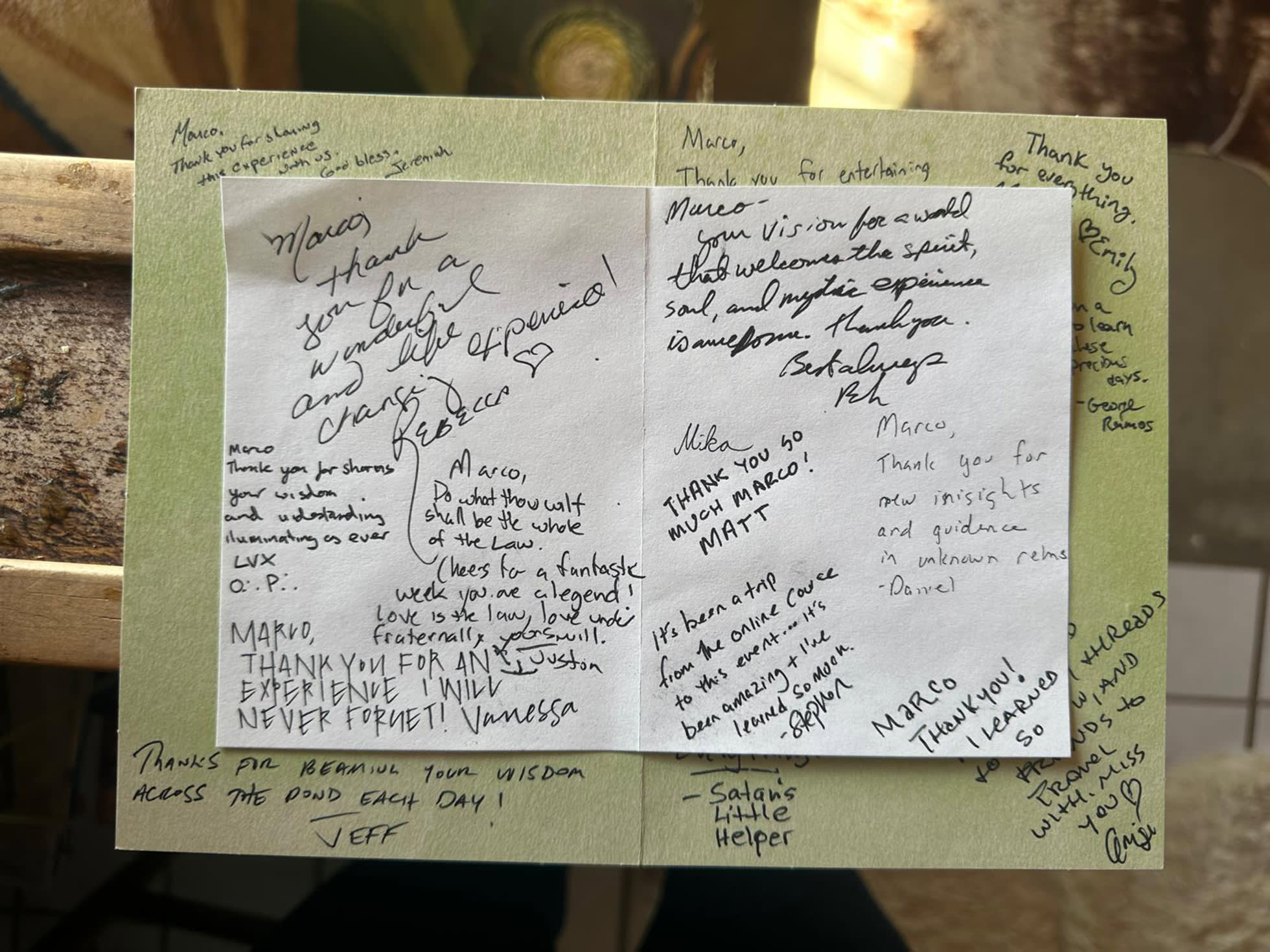
Stairway To Heaven in Joshua Tree set out to do both, and in the end, it did something rarer. People came for lectures and left saying they had found a genuine community of friends and seekers. More than one attendee told us, without prompting, that it was the best retreat or conference they had ever attended.
That sentence alone might be all the report you need, but the path that led there deserves to be told: step by step, under a sky bright enough to ring.
Magick Without Tears with Marco Visconti thrives on reader support. By choosing a paid subscription, you help keep new posts coming and fund ongoing research and writing. Thank you for considering a paid subscription to support this publication.
What nearly Stopped us, and What did notThis gathering was originally planned for February 2025. Too many issues piled up to detail publicly, the sort of logistical weather front that makes even the best-laid routes blur. The only way forward was to move the dates to October 2025. As the new timeline drew closer, it became clear I would not be able to be physically present. That decision felt like a painful heartbreak, the kind that leaves a clean crack down the middle of a good cup, since this work has lived in my notebooks, classes, and dreams for years.
I accepted it knowing that everyone would be in the capable hands of my friend , whose scholarship and clarity are a compass in turbulent waters, and supported on the ground by our logistics co-host, Tonelise, whose steadiness and care are the kind of infrastructure no programme can do without. I continued to teach, guide, and synthesise from London, while Peter and Tonelise held the circle in the desert. The signal carried. The work arrived.
What followed was a week where academic rigour and mystical practice met in the wild light of the high desert. Peter offered historical frameworks, lineages, and context. I brought the operant work, the inner methods, and the living language of practice. The two modes braided together so that participants were not forced to choose between learning and doing. They could hold a book in one hand and breathe the night sky with the other.
Day One: Setting the Tone, Meeting the LandWe began with the basics that are never basic in Joshua Tree. Introductions. A clear safety briefing about the high desert. Hydration, footwear, respect for closures during the government shutdown, and a reminder that this is sacred native land. We are guests here. (Wind whispering through cholla. The dry click of gravel under boots. Blue sky like a struck bell.)
Then the first move inward. Tonelise led a centring meditation, the kind that clears the dust from the mind and leaves a gentle stillness behind the eyes. From there, I set the arc for the week. Connect with the spirit of place. Let silence become a reagent that begins to develop a body of light. Keep a record of what finds you when you stop reaching for it.
We sketched a bird’s-eye map of celestial ascent across cultures. The sublunary realm, the planetary spheres, the many ladders that have tried to describe a climb that is always finally wordless. We contrasted Gnosticism’s harsh diagnosis of the world with the Hermetic sense of a cosmos that is holy from the inside out. We held Thelema as a living synthesis, with the Knowledge and Conversation of the Holy Guardian Angel as a horizon, not a slogan. We named the Hermetic Brotherhood of Luxor and the current that flows through Pascal Beverly Randolph into later Western work with eros and will. Sex magick was approached not for talismanic utility—although it has that—but for the flash of ontological truth it can open, the brief instant where self and cosmos cancel into a lucid nothing. We touched origins and transmissions, my long-standing thesis that many of these technologies of ascent flowered first in the Indian subcontinent and moved, slowly and strangely, into the West.
Then we sent people into the landscape with a simple exercise. Find a rock or a tree. Walk a quiet circle. Listen. (Silence like heat. A crow scissoring the air. The slow drum of your own pulse.)
Day Two: From Theory to EmbodimentThe morning began with a few technical hiccups. Then the room remembered it was a room of human beings in a shared field. In-person matters. It changes the conductivity.
We talked about learning that happens through the senses. You can read about the astral plane, but when you lean against a warm boulder and feel your breathing find the rhythm of the sun, something else switches on. We traced the modern language for the subtle body as it arrived through Theosophy, and how the Hermetic Order of the Golden Dawn operationalised this into practical magick. We compared those frameworks with Thelema’s insistence on experience and with neo-shamanic models of the lower, middle, and upper worlds that overlap with our own.
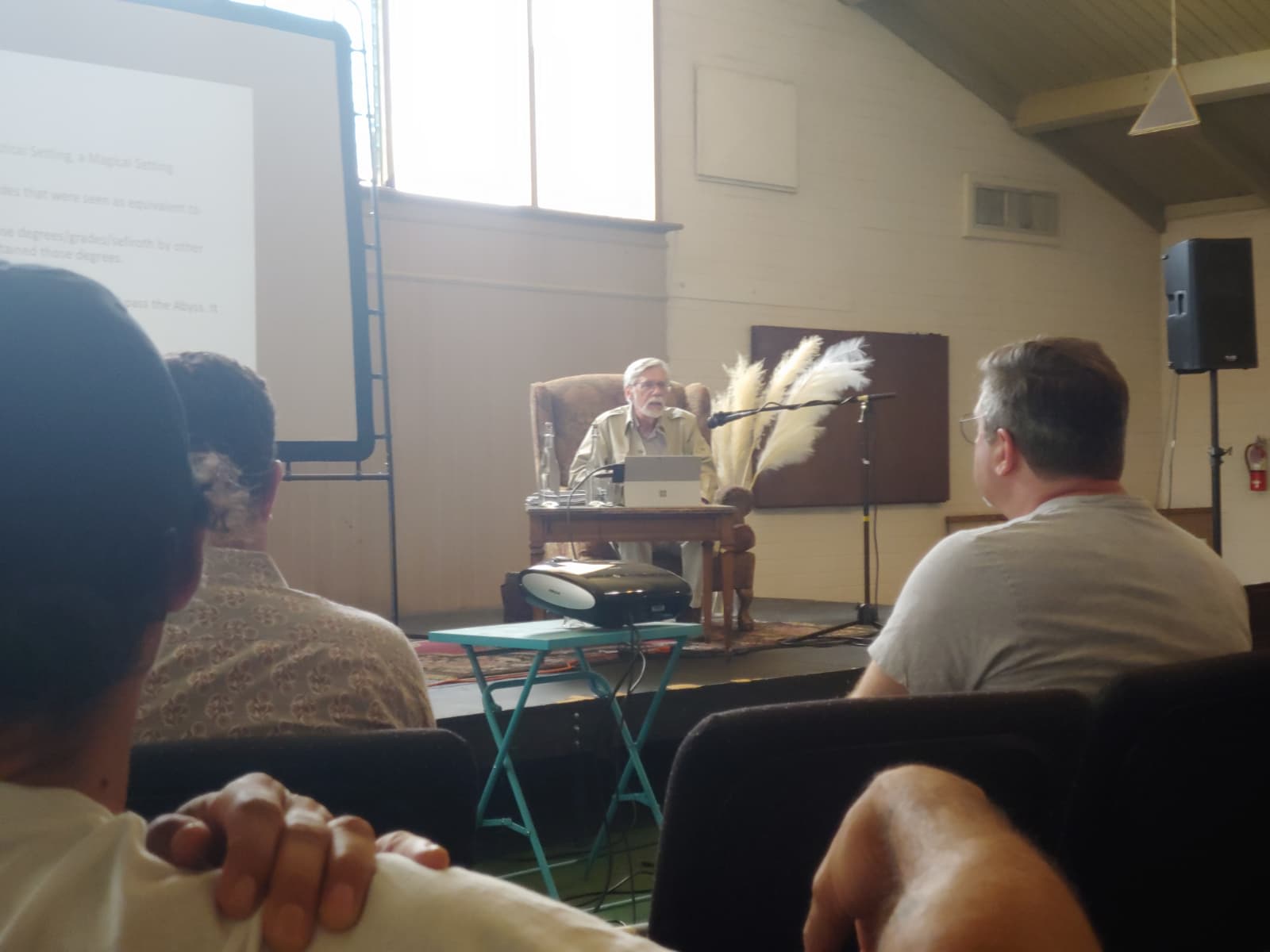
Then we practiced. The break included three questions to carry outside: How do you tell imagination from intuition from perception? Where in your body does skepticism tighten when practice begins? If you send a clear message to the landscape, does anything answer?
We returned for the first Godform assumption, working with Tahuti. Breathe, build a luminous shell, step into the ibis-headed current of wisdom and speech, and test the texture of consciousness when you shift your centre of gravity into an archetypal form. The discussion that followed was practical. Rituals are scaffolding for interior processes. Embodiment is not an optional flourish. There are resonances between African diaspora traditions of spirit possession and the Western technique of assumption, though language and aims differ. The point is not theatrics. The point is training a nervous system to hold more of the real.
Day Three: Lineages of Ascent, Breath as AlchemyWe opened with a story from the land itself. Tonelise spoke of creosote, how desert plants share resources through hidden networks, and the metaphor did what good metaphors do. It quietly rewired the room. (A resin-sweet note passes hand to hand. The mind hums like a buried root.)
This was the day we threaded the long arc. Tantric sacraments of the body. The Eucharist of ascent. Naples in the eighteenth century and the Arcana Arcanorum as a European custodian of interior alchemy. Raimondo di Sangro and the Egyptian imaginal that later blooms again in the nineteenth century. Cagliostro and then Pascal Beverly Randolph, and finally Giuliano Kremmerz, and how breath, visualisation, and polarity become not only doctrine but practice. We contrasted Indian authority structures and transmission with the Neapolitan approach. We spoke of sulfur and mercury, of the divine feminine, of energy as something refined by attention rather than hoarded by fear.
Practicalities were never far. Safety for any night work. Ground first. Keep your wits. Simpler rites done well are better than grand rites done poorly. Breath as an alchemical key. The body as both crucible and elixir. Some asked about aphantasia. You can work without vivid inner images, and you can train new faculties. Others asked about the spine, about amrita, about whether injury blocks ascent. The honest answer is that the variables are many and the testimony is mixed, which is why humility remains a friend.
We closed with a clear statement of aim. My private practice at present is a daily meditation on the void. Babalon, in my vocabulary, is the Void rather than a personality cult, and the crossing of the Abyss is the surrender of every mask. This is not a path for adrenaline chasers. It asks for maturity, consent, and guidance.
Day Four: Crowleymas and the Sumerian CurrentWe kept the feast for life. Crowleymas has become a tradition in my circles, a day to honour Aleister Crowley’s birth and to remember that practice must stay alive if it is to mean anything. The morning opened inside the Integratron, a space that amplifies sound, a small architectural wonder that turned breathwork into a kind of bell. Gratitude, intention, and a quiet rehearsal of what we had learned so far. (A tone hangs in the rafters; lungs answer with light.)
Then the lecture that many had asked for. The Sumerian tradition and its reception inside modern occultism. How lines from the ancient Near East surfaced in the twentieth-century imagination, and how The Simon Necronomicon functioned as a talisman in late twentieth-century occulture.
We used it not as a fetish but as a training ground for surrender. What does it mean to meet fear without theatrics, to lean into unknown names and remain balanced? We linked this to the wider Thelemic project, to the ethical work that any talk of the Abyss should entail, and to the small experiment everyone could try that afternoon. Find a polarity in your own life, love and hate are strong examples, and sit in the exact middle until the poles begin to inform each other rather than tear you apart.
Final Day: Synthesis, Skywatch, and the Unknown AboveWe had covered a lot of ground. The task now was to tie threads. We looked at mythmaking in the present tense. In a secular world, UFO narratives have become one of the ways we talk about transcendence in public without admitting that we are doing so. That is a gift and also a trap. Outsourcing spiritual responsibility to a rescue fantasy will always starve the soul.
We explored models. Interpenetrating dimensions rather than distant planets. Overlapping states of consciousness rather than simple visitors from elsewhere. We compared human-initiated contact protocols with ceremonial methods that also compress attention in order to open conversation with the more-than-human. Then we adopted Michael Bertiaux’s very practical distinction. A bad UFO experience drains vitality and contracts awareness. A good one nourishes clarity and leaves you stronger. Love and attention are not sentimental here. They are shields. Fear and obsession are invitations that you do not want to send.
That night, the conversation ceased to be theoretical. With the skywatchers team, under a vault of cold stars, an attendee witnessed an extraordinary UFO sighting.
No one jumped to conclusions, and no one needed to. The collective gasp, the unmistakable shift in the night, the way attention seemed to bend around a presence that did not behave like aircraft or satellite—all of it landed with the quiet weight of reality. People laughed. People stood in silence. (Stars sharp as salt. The desert holding its breath.) It was the right ending for a week that had asked us to hold complexity without panic.
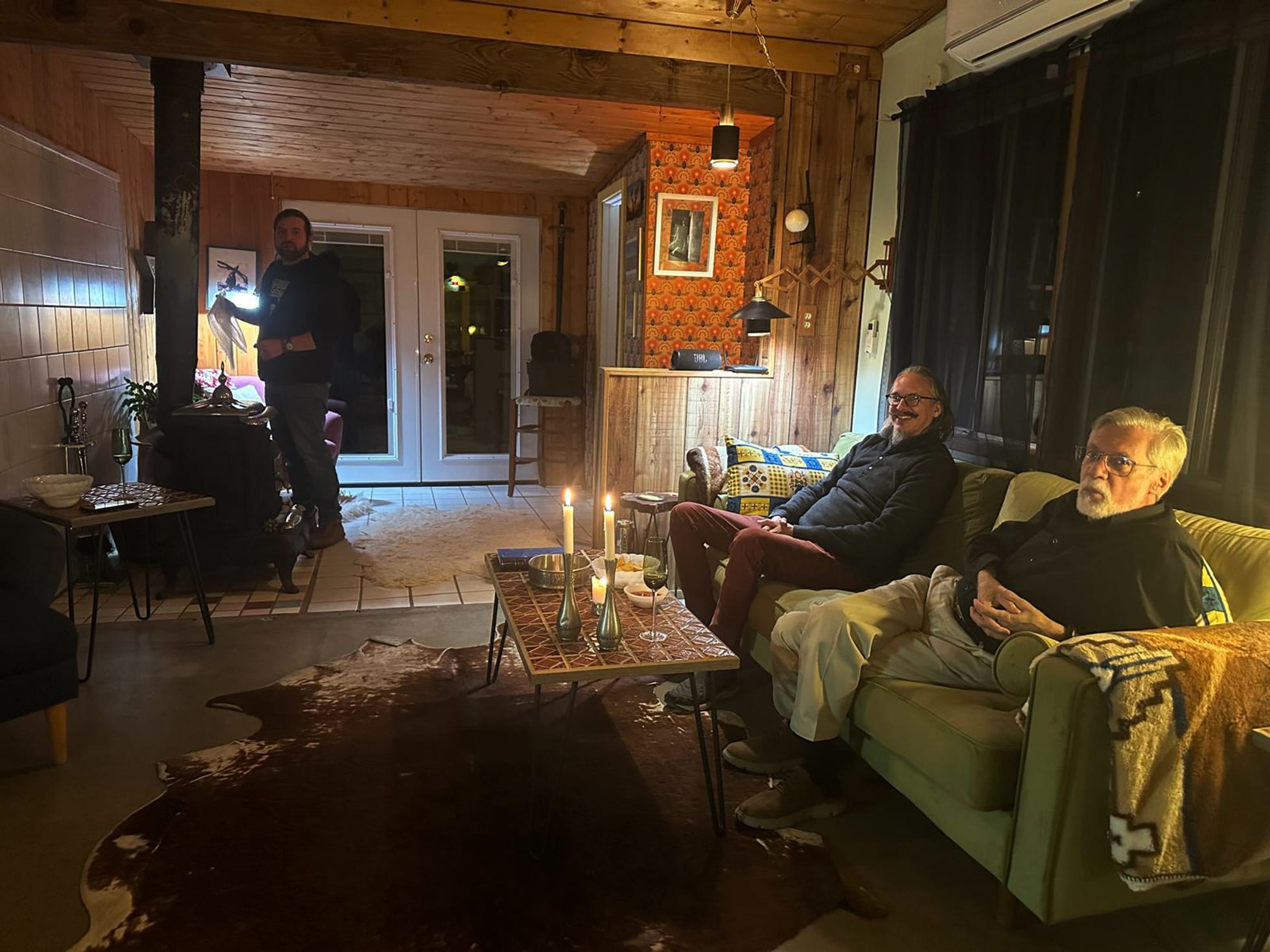
What People Took HomeBy the final circle, the theme had repeated enough that we began to trust it. Those who arrived for lectures found a community. Those who came for a break from ordinary life found practices that do not end when you close a workbook. Peter’s archive-precision grounded us. My magical and mystical sessions opened the door to direct experience. Tonelise’s care and presence kept the field humane and safe. The land did the rest.
The takeaways were simple and earned.
Silence is not passive. It is a technology.
Etymology and history matter because words are doors, and you should know where they lead.
Embodiment is the difference between thinking about ascent and starting to climb.
Build a body of light before you go looking for whatever looks back.
Treat every encounter, terrestrial or otherwise, as a test of nourishment. If it feeds clarity, proceed. If it feeds fear, withdraw.
Keep your humour. It is a kind of protection.
Remember that community is not an accident. It is a practice of attention to each other.
I am grateful to everyone who trusted this experiment through postponement and uncertainty. I am grateful to Peter for the spine of scholarship that let all of us stand taller. I am grateful to Tonelise for the thousands of invisible actions that make a retreat work. I am grateful to the desert for reminding us that the world is very old and very alive.
KEEP IN TOUCH WITH TONELISE FOR FUTURE MAGICAL RETREATS www.magical-retreats.com
For those who were there, keep the practices gentle and regular. For those who could not be, there will be more work ahead. We will continue to braid the academic and the magical so that your understanding has both roots and wings. There are future intensives in the works, including a focused exploration of the first rung of the Michael Bertiaux system, the Lucky Hoodoo, where we will take the principle of nourishment-versus-depletion and make it even more concrete in daily practice.
Most of all, keep walking. If the week taught anything, it is that heaven is not a place that waits at the top of something.
It is a way of moving through the world with the sky inside you.
Thanks for reading Magick Without Tears with Marco Visconti! This post is public so feel free to share it.