Marco Visconti's Blog
November 15, 2025
REDEEMING 666: THE ANTICHRIST THROUGH THELEMIC EYES
In Christian mythology, the term Antichrist refers to the ultimate adversary of Christ in the last days, a figure of deception and desecration who opposes God’s plan. The concept evolved from New Testament sources: the First Epistle of John speaks of “many antichrists” referring to any deceivers denying Christ, but later Christian imagination crystallised this into a single apocalyptic villain.
In the Book of Revelation, authored by “John” on Patmos in the 1st century, this evil takes the form of the Beast, a monstrous tyrant empowered by Satan. John describes a Beast rising from the sea, demanding worship and warring against the saints. Crucially, he cryptically notes in Revelation 13:18:
Let him that hath understanding count the number of the Beast… it is the number of a man; and his number is Six hundred threescore and six.
Thus, 666 entered lore as “the number of the Beast”, forever marking the Antichrist’s name.
Magick Without Tears with Marco Visconti thrives on reader support. By choosing a paid subscription, you help keep new posts coming and fund ongoing research and writing. Thank you for considering a paid subscription to support this publication.
Early Christians often interpreted this coded 666 as a reference to Nero Caesar, the infamous Roman emperor who savagely persecuted Christians. Indeed, in Hebrew gematria, “Nero Caesar” can total 666, and numerous scholars agree that John’s Beast symbolised Nero or the spectre of Nero’s return.
In later theology, the Beast of Revelation became synonymous with the Antichrist, a “man of lawlessness” or “son of perdition” prophesied in Scripture. Church fathers from the 3rd–4th centuries, like John Chrysostom, explicitly taught that Nero was a “type of Antichrist”, pointing to his cruel hubris and self-deification as foreshadowing the ultimate enemy of Christ. Over the centuries, this archetype of the Antichrist as a tyrannical false messiah – branded by the number 666 – became deeply ingrained in Christian eschatology and popular imagination.
Scholar of the Bible (and all-around hero) Dan McClellan produced many videos to deconstruct the Antichrist myth, but I want to share one here:
Symbolically, Christian tradition cast 666 as a polluted or imperfect number, falling short of the sacred 7. Where 777 might symbolise holy perfection or the Trinity, 666 was seen as a dark parody, “an imperfect knockoff brand of God”, a triad of sixes evoking unholiness or incomplete power.
In medieval and modern Christianity, the Antichrist/Beast is often depicted as a single future dictator or demonic entity who will briefly rule the world, demand worship (bearing the “mark of the Beast” 666), and be defeated by Christ at the Second Coming. He is the “dark twin” of Christ, a counterfeit saviour bringing a reign of terror and thus, in Christian eschatology, the Beast with the number 666 is a malignant figure, embodying all that is anti-divine: tyranny, blasphemy, and deception.
Aleister Crowley and “The Beast 666” : Reclaiming a BlasphemyAgainst this backdrop of dread, the English occultist Aleister Crowley shocked his contemporaries by openly styling himself “The Beast 666.”
Crowley, always the irreverent mystic and magician, adopted the very epithet meant to terrify Christians. It was not a whimsical choice. Raised in a strict fundamentalist household, young Crowley was well aware of Revelation’s Beast. In fact, his devout mother, dismayed by his rebellious behaviour, had nicknamed him “the Beast” in his youth, an insult he “revelled in.” Crowley later quipped that he was born to that role. As an adult occultist, he fully embraced the persona of To Mega Therion (Greek: “The Great Beast”), even making it one of his official mystical titles.
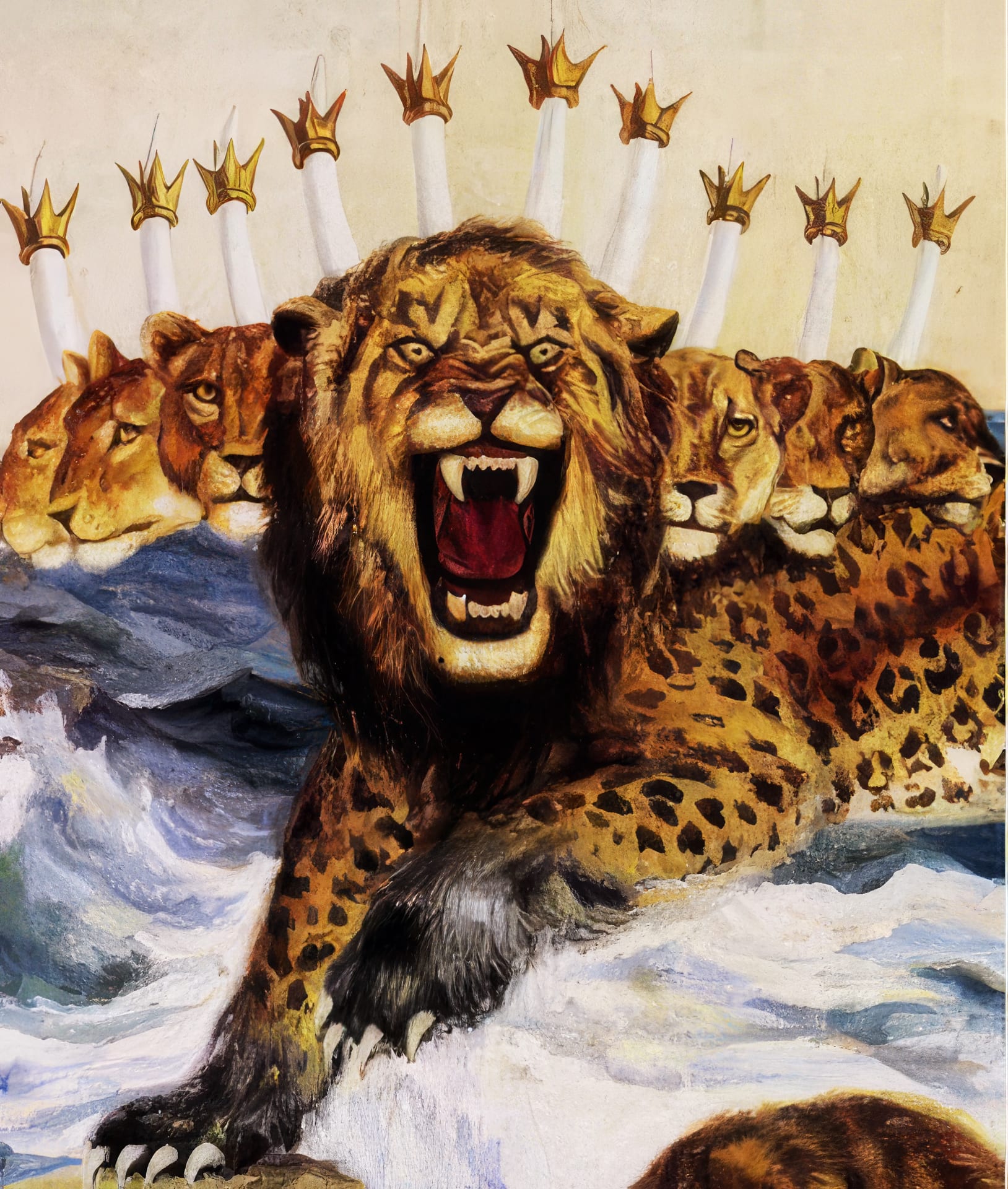
Crowley’s identification with “the Beast” was not an empty provocation but a deliberate redefinition of the symbol. In Thelema, Crowley recast the Beast from Revelation into a positive, initiatory archetype. In The Book of the Law, the Being who dictated the text, Aiwass, proclaims Crowley the prophet: “the prince-priest the Beast” to whom “all power is given” along with his consort “the Scarlet Woman”. Far from denouncing this Beast, the holy book exalts him as the chosen emissary of the new age. Crowley believed he was the Beast prophesied, but not as Antichrist in the Christian sense of an evil impostor. Rather, he saw himself as the inaugurator of a new Aeon, heralding a spiritual revolution that the old Christian world had demonised.
In Crowley’s eyes, nearly every term of Christian blasphemy was ripe for redemption. He delighted in pointing out that 666, far from being a satanic omen, is in fact the number of the Sun in Qabalistic symbolism – the life-giving star. In one of his essays, Crowley notes that the Sun’s magic square (6×6) produces the number 111 in each row and 666 in total: “The Sun being 6… each line adds to 111; the total of all is 666.” He then wryly reminds us that 666 is “the number of a man”, echoing Revelation but with a twist of meaning.
To Crowley, 666 symbolised not a fall from God but the ascent of human divinity. It stood for the solar force of life and the creative will within humankind.
Thus, Crowley boldly reversed the valence of the Beast symbol. What Christianity had vilified as demonic, he hailed as holy. Thelema taught that the so-called Devil was misunderstood: “The Devil does not exist,” Crowley writes provocatively; “‘The Devil’ is, historically, the God of any people that one personally dislikes.” In Liber ABA: Magick in Theory and Practice, he explains that the figure Christians call Satan – the serpent, the tempter – is actually a divine force.
This serpent, SATAN, is not the enemy of Man, but He who made Gods of our race, knowing Good and Evil; He bade ‘Know Thyself!’ and taught Initiation.
In other words, the serpent that brought knowledge to Eden (and by extension the Beast/Antichrist) represents the inner spark that spurs humanity toward enlightenment.
By calling himself the Beast 666, Crowley was aligning with this liberating current of knowledge and revolt. He intended to personify what the old Aeon (the Christian era) most feared: the overthrow of obsolete dogmas.
In The Book of Thoth, Crowley directly links the Beast symbol to the new epoch. The seers of the past (in the “Aeon of Osiris,” the age of the Dying God) foresaw a coming age of freedom and illumination – and “regarded it with intense horror.” He writes that this is “the real interpretation of the diatribes against the Beast and the Scarlet Woman in the Apocalypse”. John’s furious vision of the Beast 666 and the “Whore of Babylon” was, in Crowley’s view, a frightened prophecy: a distorted warning about the incoming Aeon of Horus, which would unseat Christian values. Crowley took it as a badge of honour to be cast in that Revelatory role.
Scandal and Misunderstanding: Crowley as the “Antichrist”Unsurprisingly, Crowley’s embrace of the Beast archetype created enormous confusion and scandal, both in his own time and long after.
To a public raised on Christian symbolism, proclaiming oneself The Beast 666 sounded like literally claiming to be the Antichrist – Satan incarnate. Many could not discern the nuance of Crowley’s reclamation. The British press in the early 20th century seized upon his self-designation and lurid occult activities to paint him as a monster.
Crowley was dubbed “the wickedest man in the world,” accused of devil-worship and every depravity under the sun. Tabloids described him as a black magician, a diabolist sacrificing humans in dark rituals. Even some occultists who didn’t understand his symbolism thought he might be truly in league with evil forces. The nickname “The Great Beast” stuck to Crowley in tabloids and popular culture, shorn of its Thelemic context. He became, in the public imagination, virtually interchangeable with the Biblical Beast, a living Antichrist figure to be feared or derided.
Magick Without Tears with Marco Visconti is a reader-supported publication. You have read only 1/3 of the entire article so far. To read it in its entirety, become a paid subscriber now.


November 11, 2025
IS THERE A FAR-LEFT PROBLEM IN OCCULTURE?
For years, I have written at length about the dangers of far-right entryism in occulture and how reactionary and even fascistic elements creep into spiritual communities under the guise of esoteric lore.
But lately, another question has emerged from the shadows: is there also a far-left problem in occulture? Recent events suggest to me that yes, something is amiss on that end of the spectrum as well. In the past few months, I’ve observed vocal denouncements of “woke cults” within the occult community, coming from people who once occupied very different positions. These cases aren’t about isolated cranks; they reflect a broader trend of backlash against progressive activism in metaphysical circles.
Before anyone panics, let me clarify: this isn’t a “both sides” equivocation claiming the far-left is just as bad as the far-right.
The threats are different in nature. Far-right infiltration often entails organised hate, bigotry, and authoritarian ideology sneaking into our spiritual spaces – a phenomenon I’ve extensively documented and fought against. The far-left issue, on the other hand, is more insidious in a softer way: a kind of purity policing and aggressive orthodoxy that can alienate and fracture communities from within.
Let’s explore two recent examples (with names withheld, as this is about trends, not individuals) that illustrate this emerging problem, and then consider what truth they hold, and how we might move forward constructively.
Magick Without Tears with Marco Visconti thrives on reader support. By choosing a paid subscription, you help keep new posts coming and fund ongoing research and writing. Thank you for considering a paid subscription to support this publication.
Occultists vs. “Woke” : Two Recent RebellionsThe first case that grabbed my attention was a male ceremonial magician from Australia, a relatively obscure YouTuber with a modest following until very recently. His fortunes changed overnight when a well-known UFO/UAP whistleblower in mainstream media quoted him or referenced his work. Suddenly, this magician’s audience ballooned, granting him a platform many occult content creators dream of.
What did he do with this newfound megaphone? Almost immediately, he launched into a tirade about how he “finally understood” the world: according to him, the far-left was a cult in thrall to literal demons.
In his telling, progressive social movements were not just misguided – they were actively evil, a malicious force compelling society (and especially cis-het men like himself) to “submit” to dark supernatural powers. This individual claimed that, as a result of seeing the left as a demon-worshipping cult, he realised that the demons he once casually worked with in ceremonial magick are, in fact, objectively malevolent entities. It’s a dramatic heel-turn for someone steeped in occult practice, effectively mixing Infowars-style culture war rhetoric with Goetic demonology. The irony is palpable: after being boosted by a UFO whistleblower’s credence, he pivoted to whistleblowing about an alleged leftist-demon conspiracy.
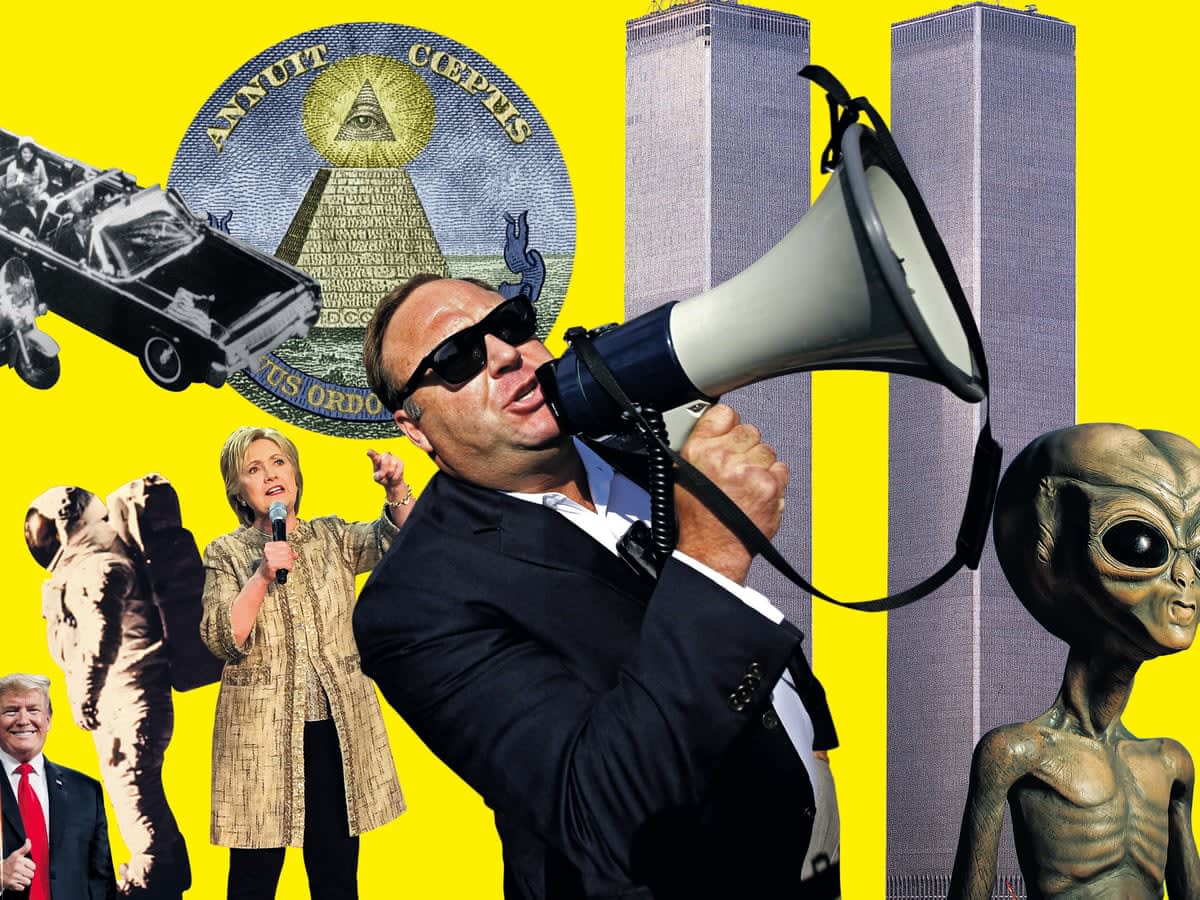
Around the same time, another familiar figure from the occult Instagram sphere resurfaced in my feed, someone I hadn’t heard from since 2020. She was one of the original “boss babe” witches, known for glossy self-help occultism and hashtag empowerment.
Back then, her content was all positivity and entrepreneur-friendly witchcraft branding. Now, she has dramatically rebranded herself as a champion of conservatism, loudly proclaiming that she was “canceled” for defying the tyranny of wokeness. She insists that because she dared to question certain progressive talking points, the “woke mob” ruined her reputation, and thus she’s bravely become a right-wing sorceress, so to speak.
However, the facts behind her narrative tell a less flattering tale. In truth, her fall from grace had a lot to do with her own words: she went on public tirades claiming, for example, that “Palestine supported Hitler,” among other historically ignorant and inflammatory remarks. She liberally slanders social justice movements and conflates any support for Palestinian human rights with Nazism. Such gross mischaracterisations understandably drew ire from her peers. Yet in her mind, she is the victim – a lone witch persecuted by a hyper-liberal orthodoxy. By recasting herself as a martyr who “stood against woke culture,” she has found a new audience in reactionary circles eager to embrace an ex-woke witch.
These two cases – an occultist man equating leftists with demons, and an influencer witch recasting bigotry as brave dissent – are extreme, almost cartoonish, examples of occult figures swinging hard against the left. I wish I could say they were isolated anomalies, but they tap into a larger sentiment I’ve observed brewing over the last couple of years.
There is a backlash mentality taking root in some corners of occulture, where any progressive or inclusivist effort is painted as oppressive brainwashing, and those espousing such views portray themselves as renegades for “seeing through the illusion.” It’s the conspirituality horseshoe theory in action: where new-agers or magicians meet culture warriors, sharing a common enemy in “the woke.”
Far-Right Entryism vs. Far-Left IntoleranceTo understand the full picture, we need to step back and distinguish between two problems that are often falsely conflated.
On one side is the ongoing menace of far-right entryism in occult and pagan circles. This is something I have been militant about calling out, often to my own personal cost. Reactionary groups – from neo-fascists to ethnonationalists – have repeatedly tried (and sometimes managed) to infiltrate occult communities, orders, and publishing houses. They exploit the subcultural nature of occulture, hoping to blend in with the edgy, the esoteric, the outsider ethos, all the while introducing racist or authoritarian ideas under an arcane cover.
I’ve written elsewhere about how I noticed ultra-reactionary and outright fascistic elements creeping into my own corner of occulture, and I sounded the alarm despite backlash. Indeed, calling out these tendencies earned me years of anonymous defamation, slander, and libel from their defenders, a badge of honour I’ll gladly wear if it means exposing fascist sympathies. There is no question in my mind (or in documented reality) that the far-right has continually attempted to use occult subcultures as a recruitment pool or at least a propaganda outlet. From supposedly spiritual authors spouting transphobic or Islamophobic screeds, to occult publishers suddenly churning out ultra-Zionist, anti-immigrant rants, we’ve seen this happen. And we know the consequences: communities fractured, vulnerable seekers preyed upon, hate cloaked in the language of hermetic truth.
So what about the far-left? Unlike the far-right, we’re not usually talking about organised groups trying to infiltrate occult circles, and despite what some might believe, there’s no Antifa coven trying to covertly run the local tarot meetup.
The “far-left problem” is more about internal dynamics: call it dogmatic intolerance, purity tests, cancel culture, or simply bad behaviour wearing a halo of righteousness. These are the tendencies of some left-leaning occultists to police every word and thought, ever ready to pounce on those who don’t articulate the correct ideology with perfect precision.
I’ve seen progressive occult forums descend into flame wars over minor semantic disagreements, with people who are ostensibly on the same side viciously attacking each other for not being “woke enough.” In pagan and witch communities, there have been witch hunts (pun intended) for perceived heretics of inclusivity, sometimes based on genuine issues like calling out racism or sexism (which is valid), but other times based on extremely niche points of contention where no amount of apology or clarification will satisfy the self-appointed ideologues.
To be clear, I consider myself on the left. I value social justice, inclusion, and equality; these principles are, in fact, deeply compatible with an occult worldview that recognises the divine spark in all individuals. But I’ve also personally experienced the far left’s capacity for cannibalising its own. There’s a subset of leftist occultists (again, radical types, not the majority) who will not hesitate to brand someone like me as an enemy for the smallest deviation in speech or thought.
I have literally been called a “misogynist” by certain detractors on the left, not because I espoused anything remotely anti-women, but because I did not perform my allyship in the exact expected manner. Perhaps I failed some obscure litmus test – a particular turn of phrase, or not immediately condemning a person they dislike, and suddenly, in their mind, I’m a covert woman-hater.
The first time it happened, I was stunned. Here I was, someone who has vehemently supported feminist and queer causes in our community, being vilified as if I were a MAGA-touting incel. It would be almost comical if it weren’t so damaging.
What I have been noticing is that in occult and pagan circles, some on the far left can exhibit the same unforgiving zeal as the far right when someone offends their orthodoxy. If you say something a radical leftist doesn’t like, they can be “just as bad as the white supremacists” in how swiftly they ostracise you. I’ve felt that sting myself. In these cases, the content of the creed is opposite (inclusivity vs. exclusivity), but the method of enforcement is eerily similar: conform or be cast out.
Another issue is how some far-left rhetoric in occulture starts to mirror the very things we all claim to hate. For example, a strain of thought has emerged that certain spiritual practices or symbols are off-limits to people of particular backgrounds – a kind of rigid cultural gatekeeping. While cultural sensitivity is important (nobody should be appropriating sacred traditions irresponsibly), the extreme arguments sometimes veer into race essentialism. The idea that, say, dreadlocks or runes belong to one race and are sacrilegious for another to touch: this is not a progressive idea when taken to that extreme; it’s a rehashed segregationist idea in trendy new clothes. And indeed, it wasn’t the far-right promoting that notion; it was the far-left. This is what I mean when I talk about leftist intolerance harming our occulture: it can become so militant in its pursuit of purity or justice that it ends up reinforcing the paradigms of hate and separation that we were trying to transcend.
Moreover, all this infighting and policing carries a very practical cost: it bogs down our spiritual work in incessant politics. When one faction of occultists is Sieg-Heiling to the Kabbalah and another faction is cancelling people for forgetting the correct use of pronouns, who is left actually exploring the Mysteries? Who is building the community of seekers? I have felt this frustration keenly. It seems we can’t hold a Thelemic gathering or a witchy meetup these days without some political litmus test creeping in. Don’t get me wrong here. Values do matter, and I am not advocating for some false neutrality that tolerates hate. But I am lamenting how even well-meaning political vigilance sometimes devolves into a circular firing squad. In the end, the far-right threat remains ever-present, and now the far-left’s overzealous responses are splintering our ranks from within. It’s a double whammy that leaves our occultural community weakened and disheartened.
When the Left “Eats Its Own”: Is the Outrage Justified?Given the above, is there any truth to the narrative pushed by those ex-occultists now decrying the “woke cult”?
The uncomfortable answer is: Yes, there is a kernel of truth, but it’s often exaggerated and exploited. My own experience confirms that some on the left can be dogmatic to a fault. They can indeed create a hostile, almost cult-like atmosphere where you’re constantly afraid of misspeaking.
This climate of fear and performative virtue can drive sane people away. It can even drive them straight into the arms of the right-wing, who are eagerly waiting to say, “See? The left are insane, come join us where you can speak freely.” I believe this is exactly what happened to the two individuals I described earlier. They felt (rightly or wrongly) persecuted or stifled in left-leaning occult circles, and thus swung to the opposite pole, finding validation among conservatives who welcomed their testimonies as proof of “woke tyranny.”
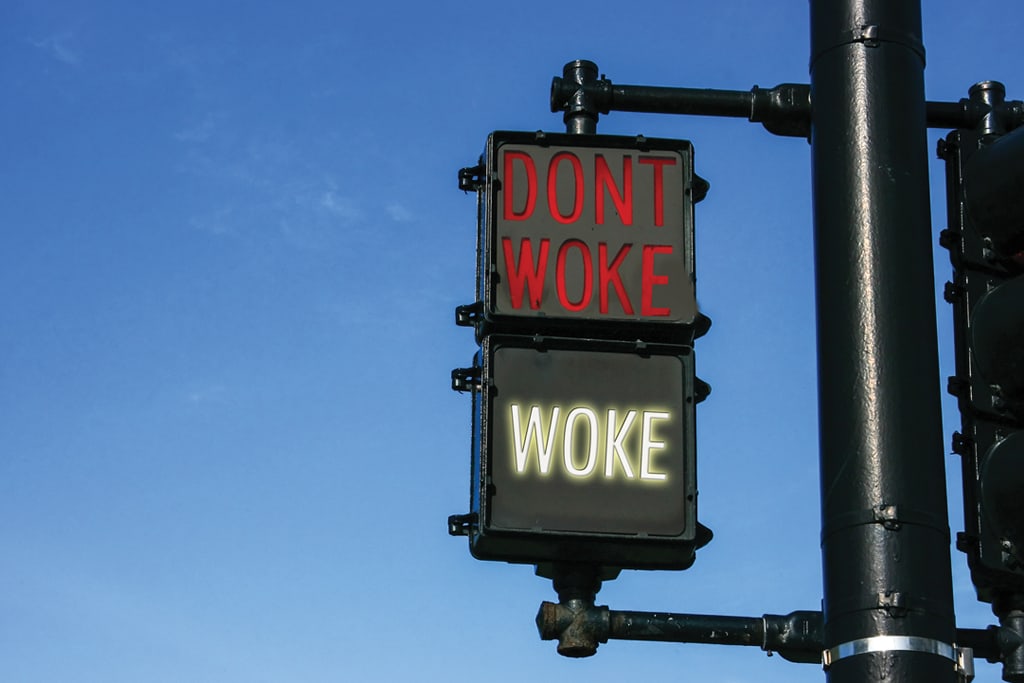
However, acknowledging the left’s overreach does not mean buying into the backlash narrative wholesale. It’s important to distinguish honest critique from self-serving revisionism. Many who cry “I was canceled by the woke mob!” conveniently omit why they were called out in the first place. In the case of our rebranded conservative witch, her complaints about being ostracised leave out the reality that she was spouting abhorrent rhetoric (equating pro-Palestinian sentiment with Nazism, etc.). Criticism and consequences in such cases are not persecution; they are the community’s natural immune response to bigotry. Likewise, the Australian magician who now claims the left is demonically evil was not exactly an innocent victim either; he chose to escalate a culture-war narrative to boost his profile.
From where I stand, the far-left problem in occulture is real in the sense that it creates unnecessary division and bitterness. It turns potential allies into enemies over matters of ideological purity or style. It sometimes prioritises symbolic gestures over substance and demands absolute conformity on complex social issues, even when reasonable people might have nuanced differences. This rigid mindset does resemble a kind of cultishness, albeit without a central leader; it’s more of a decentralised dogma. And yes, it can be toxic.
Yet, I will die on the hill that this problem, as real as it is, pales in comparison to the damage the far-right has done and will do if left unchecked. Far-left zealotry might hurt feelings, ruin reputations, or drive people away from movements; far-right infiltration can destroy lives and undermine the very foundations of inclusive community. We should keep some perspective: being mobbed on Twitter for using the wrong term is painful, but it is not the same as, say, a neo-fascist order using an occult bookstore as a recruitment ground for violent extremism.
In other words, both deserve our attention, but one is an existential threat to occulture (fascism), while the other is an internal dysfunction that hinders our unity.
I suspect the truth is that many of the loudest “anti-woke” occult figures are engaging in a form of opportunism. They take legitimate criticisms of left-wing overreach and blow them up into a grand conspiracy, all to justify their own slide into reactionary ideology. It’s a classic playbook: “I didn’t leave the left, the left left me!” Sometimes that’s how it genuinely feels; other times it’s a convenient excuse to abandon progressive values that were never deeply held to begin with. Our boss-babe-turned-conservative might genuinely feel wronged, but she’s also clearly revelling in the attention (and likely financial support) that comes from pandering to the right. Similarly, the magician railing about demonic leftists likely enjoys his new audience and the drama of playing prophet against the “cult.”
So yes, there’s truth that the left side of occulture has issues, and I’ve lived through them. But the narrative that it’s an all-powerful cult controlling everything is hyperbole. It’s a narrative conveniently used by those who have axes to grind or money to make by switching sides. As an insider who has been critical of both the far right and the far left in these circles, I feel sadness above all. Sad that progressive ideals, which should make our community better – like respect for all genders, sexualities, and cultures – sometimes devolve into rigid codes of conduct and public shamings. Sad that instead of resolving these issues internally with compassion, we drive people to such frustration that they’ll join forces with bigots out of spite. Sad, but not hopeless.
The Fraying Edge of OccultureAfter years of wading through these toxic swamps, what’s left of a path forward? How do we face down the increasingly explicit far-right infiltration and the brittle righteousness of the far-left without forfeiting what first drew us to the occult in the first place – the mystery, the sovereignty, the flame?

If there is still a way out, it must begin with remembering why any of us walked into the dark woods of the esoteric at all. We came for truth beyond consensus, for meaning that could not be handed down by institutions or algorithms. We came to listen to spirits, not algorithms. That impulse, fragile and half-forgotten, is still alive. It’s what makes the current disillusionment all the more painful – because so many of us truly believed these spiritual spaces could be something better than the hollow culture wars outside.
And yet here we are, mirroring the very systems we sought to escape: purges, in-groups, doctrinal compliance, passive-aggressive social rituals masquerading as moral awakening. Our would-be liberatory movements now whisper the language of control. And while we sharpen our ideological knives against each other, the actual fascists are laughing and walking straight through the door, unchallenged, often even invited by those burnt out on the left’s perceived sanctimony.
I used to believe we could fight back by staying rooted in shared values, and that compassion, nuance, and accountability could coexist. I wanted to believe that by refusing to give in to either side’s authoritarianism, we could stake out a middle space where integrity and spirit could thrive. I still want to believe it. But I can’t pretend I’m not weary. I’ve seen too many good people devoured by both sides. I’ve watched friends abandon the spiritual path not because they lost faith in the gods or their practice, but because the communities around them became unbearable battlegrounds of status and shame.
And yes, I know that even writing this will land me in someone’s crosshairs. Again. I can already hear the inevitable accusations forming: that I’m centrist, that I’m enabling fascism by critiquing the left, that I’m secretly conservative, or worse, that I’m just bitter. I’ve heard it all before. I’ll hear it again. There is no immunity, no perfect stance that makes you untouchable. Every time I try to speak clearly, to carve out room for critical thought, I feel the jaws tightening on both sides.
But I say it anyway. Because maybe, just maybe, someone out there still cares. Maybe someone else is quietly struggling, watching this all unfold, wondering if they’re the only one feeling the rot. You’re not. The rot is real. The dream is slipping.
Whether it’s already too late, I don’t know. What I do know is this: if we cannot learn to hold contradiction, to make space for difference without annihilation, then the occult revival we’ve all cherished will end not with a bang, but with a bitter, petty sigh. And whatever we once hoped to build in the ashes of the old world will be indistinguishable from the ruins we claimed to transcend.
Thanks for reading Magick Without Tears with Marco Visconti! This post is public, so feel free to share it.
November 3, 2025
WALKING THE CITY OF THE BEAST with JOHN ROGERS
I have to begin with an admission. I am a massive fan of John Rogers. Not a casual fan who dips in once in a while, but the sort of dedicated viewer who lets his walks play in the background while answering emails, who pauses the video to look up an OS map, who buys the books, and who then spends an afternoon retracing the route in real life.
Magick Without Tears with Marco Visconti thrives on reader support. By choosing a paid subscription, you help keep new posts coming and fund ongoing research and writing. Thank you for considering a paid subscription to support this publication.
I discovered his work in 2018, which, looking back, feels like very good timing. London was already shifting again after the Olympic euphoria and the Brexit hangover, and I was in the middle of writing the material that would become The Aleister Crowley Manual, thinking very hard about how place shapes magic and not only the other way around. Then here comes this filmmaker, writer, and walker whose YouTube channel is basically a love letter to London in motion, and whose books This Other London and Welcome to New London insist that the city is never finished and that the overlooked corner is very often the key to the whole plan.
I liked him so much that I thanked him in the acknowledgements of both my books, the one already out and the one arriving later this year, because his way of moving through the city informed how I wanted to move through occult material. I wanted to show that the Western Esoteric Tradition is not all rarefied temples and remote abbeys. It is also pavements, bus routes, pubs where people argued about ritual grades, tenements where a poet and a Beast once lived above a shop. Watching John made me remember this.
So when he wrote to ask whether I would join him for an esoteric London walk devoted to Aleister Crowley, the answer was immediate. Of course. It was a no-brainer.
The video that went up on his channel is exactly what it says on the tin. John does what he always does. He takes a part of the city that most people hurry through, and he drifts into it, letting the camera serve as a second pair of eyes. Only this time, he invites me to be the magical tour guide, so the walk becomes a conversation rather than a monologue. We are not only walking through central London. We are walking through the wake of a person whose presence still clings to certain buildings and street corners. Crowley called London “dear, vile London.” He always came back. We get to show why.
Our route picked up a thread that I had already explored in my own Crowley Crawl events, but filtered through John’s psychogeographic lens.
You look up at the windows and you imagine Allan Bennett giving Crowley meditation instructions above the roar of traffic. You imagine how close the Golden Dawn temple at Mark Masons’ Hall was, and how perfectly that fits the narrative of a city teaching a magician how to be a magician.
We began at Cleopatra’s Needle, which felt perfect. Here you have a 3,500 year old obelisk carved for Thutmose III, hauled from Heliopolis to Alexandria, gifted to Britain in 1819, nearly lost at sea on the way over, and finally raised on the Victoria Embankment in 1878 with full Victorian pomp and a certain Masonic flavour to the ceremony. It already vibrates with that curious London feeling where imperial pride, Egyptomania and river magic are stacked on top of one another. So John and I met there, under the two bronze sphinxes, looking out over the river, and I remember thinking that if you want to tell the story of magick in London, you could do a lot worse than to start at an imported sun pillar that should by rights be in the desert but is instead watching the buses go by.
No occult walk through London can ignore the Atlantis Bookshop, so of course, we stopped to talk about it. Atlantis is one of those living reliquaries. Since the 1920s, it has seen everyone from Gerald Gardner to Dion Fortune to Crowley himself pass through, and it has managed to survive wave after wave of London redevelopment. I always tell students that if they want to understand occult London, they need to go into Atlantis, buy a book, and listen to the stories the shelves are telling. John understands this instinctively. His camera lingers on storefronts and doorways as if they were faces. We spoke about how Atlantis later published the illuminated edition of The Book of the Law and how it remains a crossroads for magicians, pagans and the simply curious.
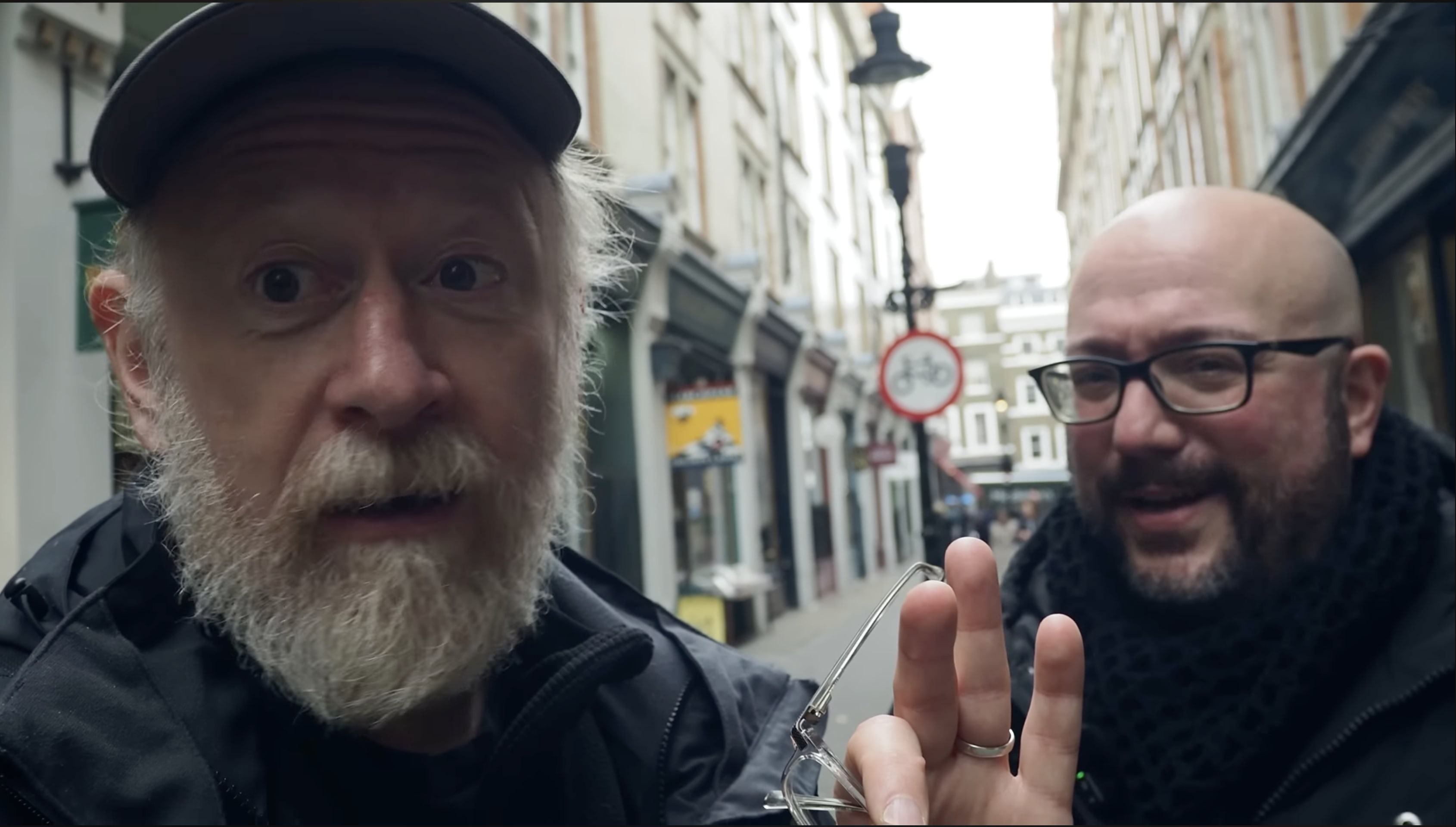
At some point, I remember saying to John that what he does with London is very close to what I try to do with Crowley. He does not tell you only the official, authorised, respectable narrative. He notices the desire lines people have worn into the city. He notices the ghosts. He likes what the Situationists used to call the dérive, the purposeful drift, and he has made a whole body of work about how a drift through the modern city can become a form of secular pilgrimage. That is exactly how I think about following Crowley through London, or Dion Fortune, or Austin Osman Spare. It is a pilgrimage without piety. It is a hunt for the places where spirit and brick once touched. John’s love for London is so generous and so stubborn that you cannot help catching it.
What struck me, watching him work that day, was how careful and patient he is. He does not just point the camera and walk. He frames. He listens to the street. He lets the buses pass so that their red bodies become part of the shot. He lets the voiceover breathe. When we talked about 93 Jermyn Street, where Crowley lived toward the end of his life and where he could look across to the garden of St James’s Church, John immediately started looking for the angle that would allow the viewer to see both the residence and the square. That is what a good psychogeographer does. They choreograph your attention. They make sure you see what the place wants you to see.
I have written before that John is an urban shaman of sorts. He would probably laugh it off, but I stand by it. He has this rare ability to stitch together folklore, municipal history, topography, film, and the odd bit of Forteana into a single narrative of place, and he does it without losing his sense of humour. He can spend five minutes telling you about the lost rivers of the Fleet or the Tyburn and then pivot into talking about psychogeography, hauntology and the way certain corners of London feel thicker in time than others. If you watch his channel, you know what I mean. He can start in a park and finish in the 1970s without ever leaving the footpath.
That is also why his work has had an impact on my own. When I was working on The Aleister Crowley Manual, I wanted the book to do something similar, to show students that magick lives in the present tense and in the streets they walk every day, not only in remote mountain ashramas or retreats. When I finished the manuscript for Aleister Crowley’s Mysticism: A Practical Guide, I thanked him again, because his videos had kept me company through the long nights of drafting and redrafting. If you watched London disappear and reappear on his channel during the lockdowns, you know the kind of company I mean. It is the reassurance that the city is still there, that the river is still flowing, that the stories are still worth telling, even if you cannot step outside yet.
Filming the walk with him was also a lesson in how form influences perception. On my own Crowley Crawls, I speak to a group. I look at faces. I modulate the energy in the moment. With John, I had to speak to a lens, trust that the viewers would hear every nuance, trust that some editor magic would later weave together the map, the voiceover and the walk into a single spell.
It reminded me of how Thelema itself was born. Crowley walked through Cairo; he visited the museum; he listened to a voice, and then he wrote a book. The book became a current. A century later, I am walking through London with a friend, listening to the murmur of buses and the rush of the West End, and the current is still alive.
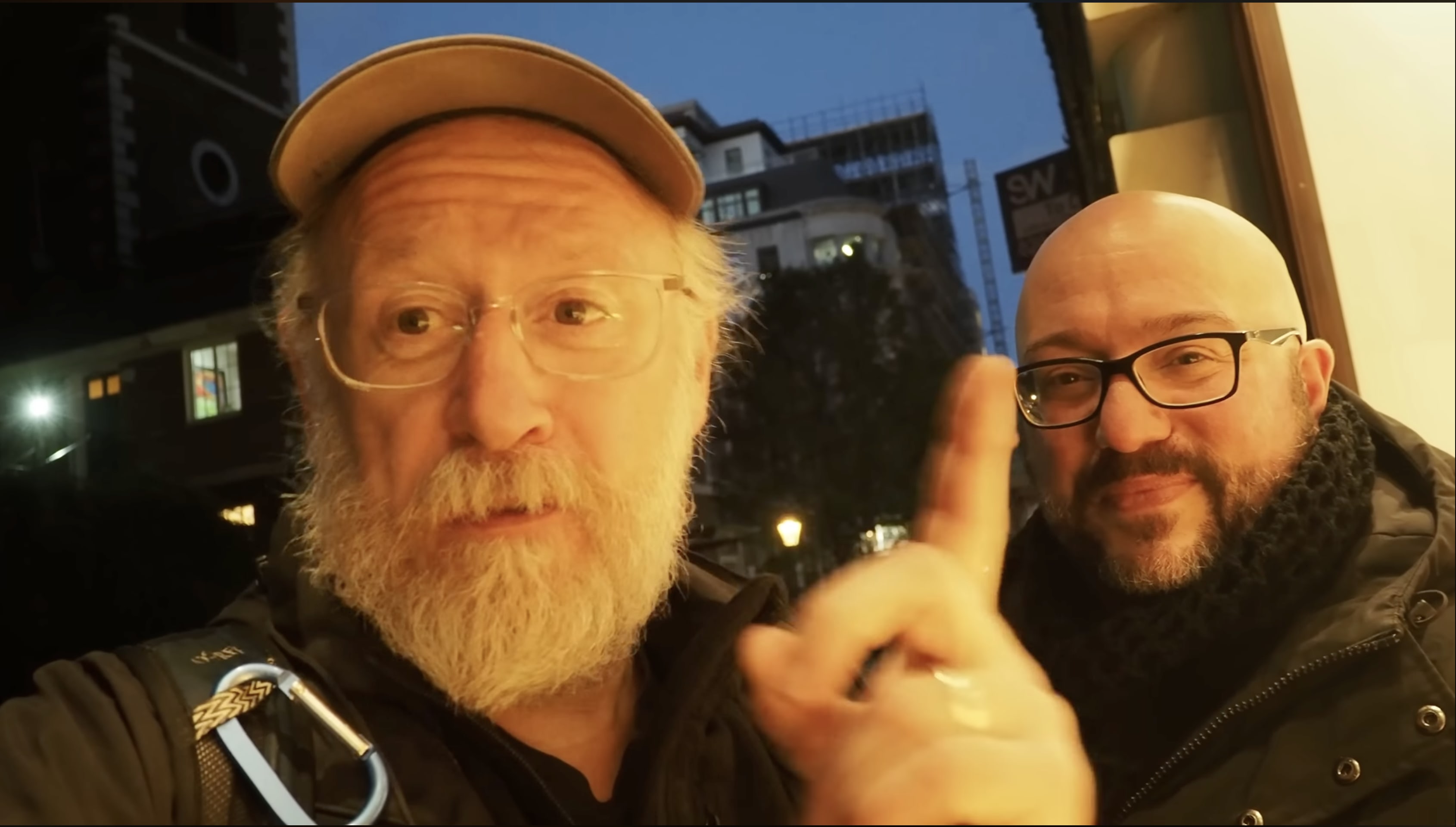
What I liked most about the finished video is that it shows what I have been repeating for years. Occult London is not an abstract idea. It is a lived, walkable archive. You can begin at an ancient obelisk by the bank of the Thames, trace a line to an old bookseller near the British Museum, then down toward Regent Street to stand before the building where the Great Beast chanted in the language of the Angels, and you will have in your body the memory of a magician’s career. You will have performed a sort of rite yourself. And if you do it with a guide who loves the city as much as John does, you will also have proof that psychogeography and practical magic are not separate disciplines. There are two names for the same longing to see through the surface of things.
So yes. This was a fantastic experience. It felt like two long-standing obsessions of mine finally shaking hands.
On one side, my insistence that Aleister Crowley is a London writer and magician as much as he is a world traveller. On the other side, John’s long project of revealing that every street in this city contains stories if you are willing to slow down. There are few things better, on a clear London afternoon, than walking with someone who pays attention to the same things you do.
If you enjoyed the video, watch it again with a map open. Mark the sites. Then come walk them with me on the next Crowley Crawl, or walk them on your own on a quiet weekday evening. Bring along John’s books, because they are the perfect companions, and because it feels right to keep this conversation between walkers, magicians and city lovers going.
The city is generous. It likes to be walked. And every time you walk it with intent, it will give you another secret.
Thanks for reading Magick Without Tears with Marco Visconti! This post is public so feel free to share it.
November 1, 2025
TAROT OF THE MONTH
November is the hinge of the year. In the Wheel of the Year we have just stepped through Samhain, the threshold where the old harvest is counted and the lights go out in the fields.
The living tend their dead, the dead tend our memory, and everything leans inward. It is the time of reckoning and keeping. It is also the month when the cold clarifies our priorities.
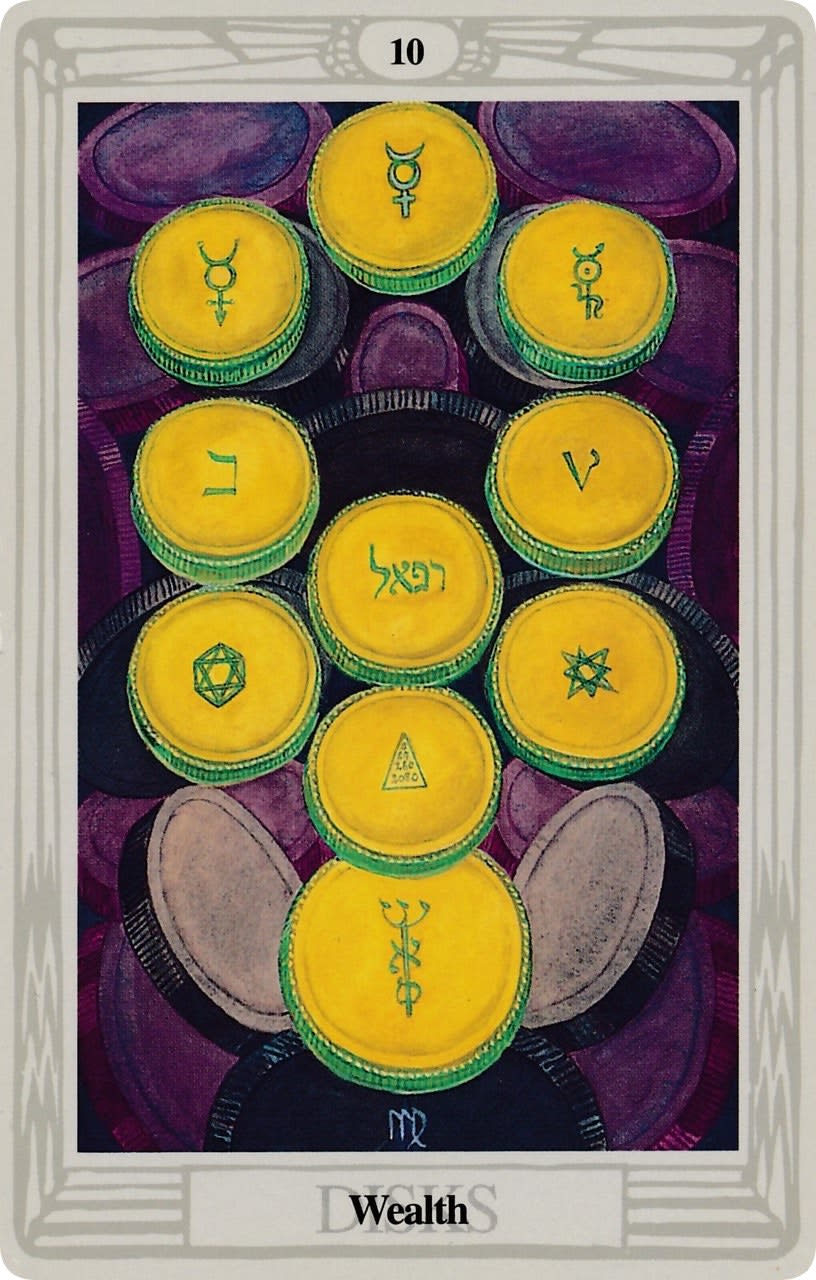
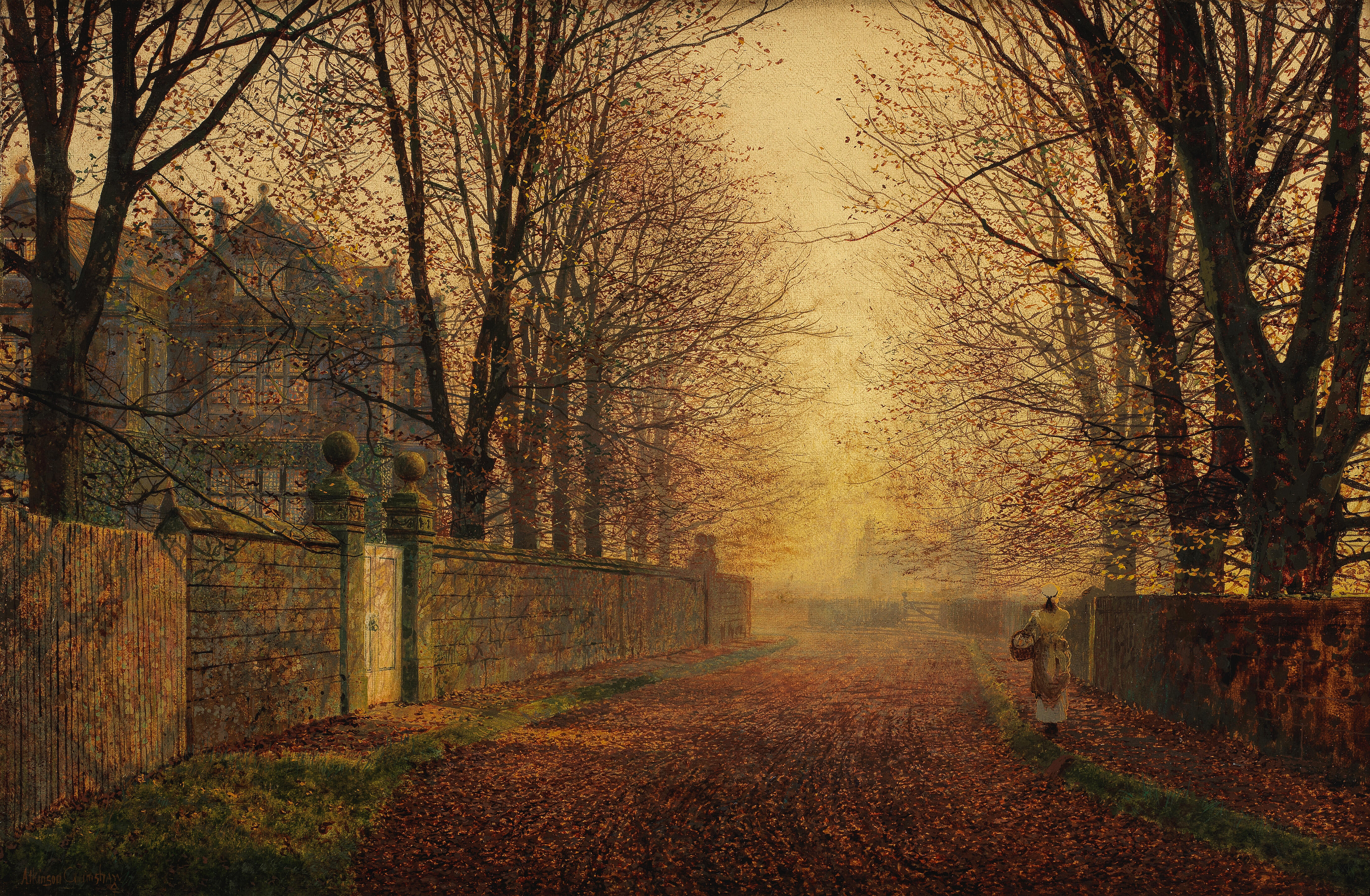 John Atkinson GrimshawWhat we keep, what we store, what we invest, all begin to matter in a very concrete way, as the month is governed by the Ten of Disks, Wealth
Magick Without Tears with Marco Visconti thrives on reader support. By choosing a paid subscription, you help keep new posts coming and fund ongoing research and writing. Thank you for considering a paid subscription to support this publication.
The Ten of Disks is a bright shock of gold arranged as the Tree of Life, the coins stamped with Mercurial emblems, except at Hod where the solar cipher interrupts the chorus and promises a way through. Crowley is blunt about what this card signifies at the end of a cycle: “great and final solidification,” the energy of a suit fully spent in matter. Yet he immediately points to the remedy inside the image itself. Mercury in Virgo appears not as mere commerce but as the Logos and intelligent will that can wake solidified wealth into usefulness. He even calls the card “a hieroglyph of the cycle of regeneration.”
On a practical level, this is the card of endowments and legacies, the moment when success must be stewarded, or it stagnates. In his commentary, Crowley notes that when wealth accumulates beyond a certain point, it either becomes inert or must “call in the aid of intelligence to use it rightly.” In other words, this month is not only about having resources. It is about arranging them so that they live again.
Harris’s painting amplifies the lesson. Every sephirah bears a mark of Mercury, save the place of Mercury itself, which bears the sign of the Sun. That single departure is the escape hatch, the spark of purpose that can reanimate the whole structure. The card, therefore, behaves like a teaching diagram. It says: collect, count, consolidate, then illumine with intention.
Astrologically, it is Mercury in Virgo, a meticulous, serviceable intelligence applied to material reality. Geometrically, it resonates with Conjunctio, the figure of the sacred joining. Behind the counting-house mood is a devotional question: what will you join your wealth to so that it breathes?
How We Got HereLast month’s Ace of Cups poured the raw, luminous potential of Water into our hands. In The Book of Thoth he said that Ace is the essential Grail, “the root of the powers of water,” the feminine vessel that receives the descending dove and can become water, wine, or blood according to need. It is the matrix. It gives feeling its holy form.
If the Ace was inspiration, the Ten of Disks is incarnation. It is what happens when the wave becomes grain and the grain becomes bread. The move from Ace of Cups to Ten of Disks reminds us that desire and devotion only become durable when they are given structure. The Ace opened the heart. The Ten now asks for account books, schedules, estate plans, studio calendars, and ritual containers that actually hold a life. The grail was the pattern. The coins are the proof.
October 20, 2025
RECENSIONE: VAN HELSING INVESTIGAZIONI
Prima di tutto, dichiaro la mia parzialità.
In questa recensione parlerò molto di Dagon, uno dei personaggi più magnetici del romanzo, perché era un nome che non sentivo ormai da tempo e che, francamente, mi mancava.
Dagon è stato il mio alter ego letterario creato dall’amico di lunga data Francesco Dimitri per i suoi romanzi, il più bello dei quali (secondo me!), Pan, sta finalmente per essere pubblicato anche in lingua inglese.
Questa risonanza personale non toglie nulla al giudizio critico, anzi, mi permette di cogliere con precisione una serie di dettagli che rendono il romanzo che sto per presentarvi ancora più avvincente.
Magick Without Tears con Marco Visconti è una pubblicazione sostenuta dai lettori. Per ricevere nuovi post e supportare il mio lavoro, considerate di diventare abbonati gratuiti o a pagamento.
Van Helsing Investigazioni di Marcello Pistolini è un noir soprannaturale in cui il fantastico non fa rumore, ma struttura. Roma non è sfondo, è un corpo con nervi e memoria. Elia Van Helsing attraversa librerie esoteriche, pub, botteghe, conventi e ogni luogo risponde come un tessuto vivo. La prosa è pulita, i dialoghi sono asciutti, l’attenzione al dettaglio è da cronista. Pistolini conosce la materia e la tratta con sobrietà, lasciando che il mistero agisca senza effetti speciali.
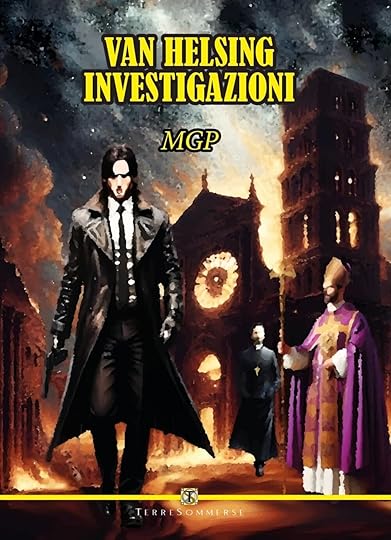
In questo ecosistema torna Dagon, prima come sussurro, poi come presenza che curva la temperatura della stanza, infine come forza capace di ristabilire confini violati. La sua etica non è quella del salvatore, è la legge non scritta del territorio. Rispetto, patti, limiti. Dagon parla poco, appare solo quando serve e ogni ingresso sposta gli equilibri già precari. Pistolini evita la caricatura del mago da romanzetto e costruisce un guardiano liminale dotato di regole e protocolli, persino di una quotidianità concreta, che lo rende più vero della sua leggenda.
Il confronto con il Dagon di Francesco Dimitri dà profondità al personaggio. Il Dagon di Dimitri è l’amico “darkettone”, il mediatore tra vita ordinaria e incanto, ed è una versione molto vicina alla mia controparte giovanile, stessa attitudine operativa, stessa ironia secca, stessi giri tra librerie e locali. In Pistolini, questa matrice diventa archetipo. Il consulente si fa custode, il fratello maggiore diventa forza di sistema, la bonaria ironia si condensa in un principio di territorialità che suona come una norma. Dimitri racconta il ponte tra i mondi; Pistolini racconta chi difende quel ponte quando qualcuno prova a minarlo.
Funzionano bene i contrasti che Pistolini orchestra con maestria. La luce fredda di una TV in un appartamento borghese contro il gelo improvviso di un’ombra che entra senza bussare. Il profumo di resina contro il tanfo di una cappella dove l’umano imita gli dèi nel modo peggiore. Le risposte dure di Dagon davanti alla gratitudine goffa di chi crede di dovergli la vita. Nessun sentimentalismo, poca metafisica proclamata, molta etica delle conseguenze. E sullo sfondo la realpolitik dell’invisibile, con i suoi obblighi di ospitalità e i patti che tengono insieme una città minata da alleanze fragilissime.
Se cercate un urban fantasy pirotecnico, qui resterete spiazzati. Se invece volete un racconto in cui il soprannaturale è estremamente simile alle esperienze del “mondo reale”, Van Helsing Investigazioni è il romanzo che fa per voi. Elia è un buon compagno di viaggio. Dagon è il baricentro implicito, ma non ruba la scena, la misura.
In sintesi, un romanzo solido e elegante, capace di tenere insieme ritmo, atmosfera e una visione coerente dei mondi sottili. Per me è stato anche un incontro con un personaggio che porto nel cuore, qui reinventato con intelligenza.
Consigliatissimo a chi ama il noir e a chi sa che la magia, quella vera, si manifesta come Incanto e come Sogno.
Grazie per aver letto Magick Without Tears con Marco Visconti! Questo post è pubblico, quindi siate liberi di condividerlo.
October 16, 2025
STAIRWAY TO HEAVEN IN JOSHUA TREE 2025
There are retreats that deliver content, and there are retreats that deliver a change of weather inside the soul.
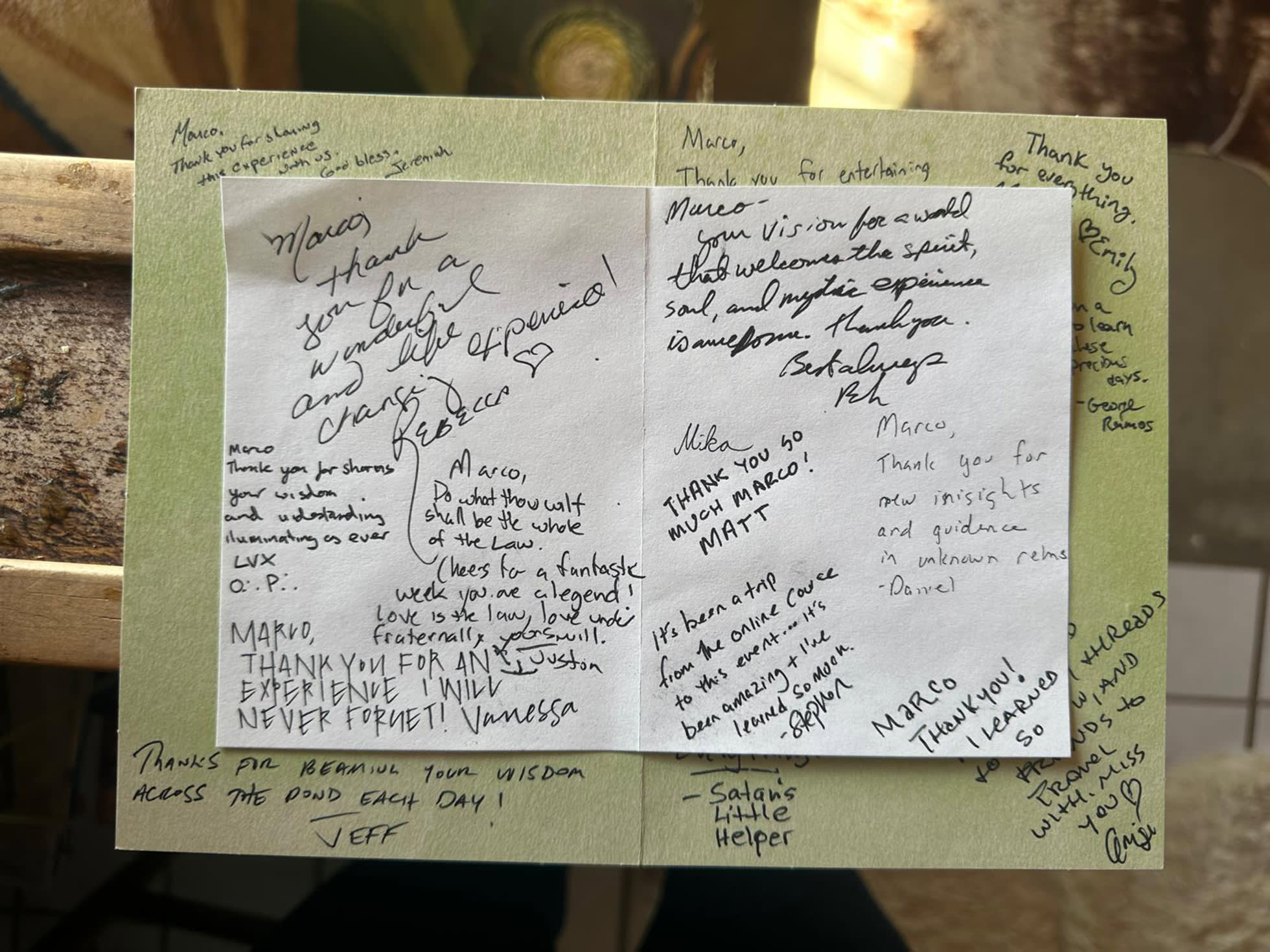
Stairway To Heaven in Joshua Tree set out to do both, and in the end, it did something rarer. People came for lectures and left saying they had found a genuine community of friends and seekers. More than one attendee told us, without prompting, that it was the best retreat or conference they had ever attended.
That sentence alone might be all the report you need, but the path that led there deserves to be told: step by step, under a sky bright enough to ring.
Magick Without Tears with Marco Visconti thrives on reader support. By choosing a paid subscription, you help keep new posts coming and fund ongoing research and writing. Thank you for considering a paid subscription to support this publication.
What nearly Stopped us, and What did notThis gathering was originally planned for February 2025. Too many issues piled up to detail publicly, the sort of logistical weather front that makes even the best-laid routes blur. The only way forward was to move the dates to October 2025. As the new timeline drew closer, it became clear I would not be able to be physically present. That decision felt like a painful heartbreak, the kind that leaves a clean crack down the middle of a good cup, since this work has lived in my notebooks, classes, and dreams for years.
I accepted it knowing that everyone would be in the capable hands of my friend , whose scholarship and clarity are a compass in turbulent waters, and supported on the ground by our logistics co-host, Tonelise, whose steadiness and care are the kind of infrastructure no programme can do without. I continued to teach, guide, and synthesise from London, while Peter and Tonelise held the circle in the desert. The signal carried. The work arrived.
What followed was a week where academic rigour and mystical practice met in the wild light of the high desert. Peter offered historical frameworks, lineages, and context. I brought the operant work, the inner methods, and the living language of practice. The two modes braided together so that participants were not forced to choose between learning and doing. They could hold a book in one hand and breathe the night sky with the other.
Day One: Setting the Tone, Meeting the LandWe began with the basics that are never basic in Joshua Tree. Introductions. A clear safety briefing about the high desert. Hydration, footwear, respect for closures during the government shutdown, and a reminder that this is sacred native land. We are guests here. (Wind whispering through cholla. The dry click of gravel under boots. Blue sky like a struck bell.)
Then the first move inward. Tonelise led a centring meditation, the kind that clears the dust from the mind and leaves a gentle stillness behind the eyes. From there, I set the arc for the week. Connect with the spirit of place. Let silence become a reagent that begins to develop a body of light. Keep a record of what finds you when you stop reaching for it.
We sketched a bird’s-eye map of celestial ascent across cultures. The sublunary realm, the planetary spheres, the many ladders that have tried to describe a climb that is always finally wordless. We contrasted Gnosticism’s harsh diagnosis of the world with the Hermetic sense of a cosmos that is holy from the inside out. We held Thelema as a living synthesis, with the Knowledge and Conversation of the Holy Guardian Angel as a horizon, not a slogan. We named the Hermetic Brotherhood of Luxor and the current that flows through Pascal Beverly Randolph into later Western work with eros and will. Sex magick was approached not for talismanic utility—although it has that—but for the flash of ontological truth it can open, the brief instant where self and cosmos cancel into a lucid nothing. We touched origins and transmissions, my long-standing thesis that many of these technologies of ascent flowered first in the Indian subcontinent and moved, slowly and strangely, into the West.
Then we sent people into the landscape with a simple exercise. Find a rock or a tree. Walk a quiet circle. Listen. (Silence like heat. A crow scissoring the air. The slow drum of your own pulse.)
Day Two: From Theory to EmbodimentThe morning began with a few technical hiccups. Then the room remembered it was a room of human beings in a shared field. In-person matters. It changes the conductivity.
We talked about learning that happens through the senses. You can read about the astral plane, but when you lean against a warm boulder and feel your breathing find the rhythm of the sun, something else switches on. We traced the modern language for the subtle body as it arrived through Theosophy, and how the Hermetic Order of the Golden Dawn operationalised this into practical magick. We compared those frameworks with Thelema’s insistence on experience and with neo-shamanic models of the lower, middle, and upper worlds that overlap with our own.
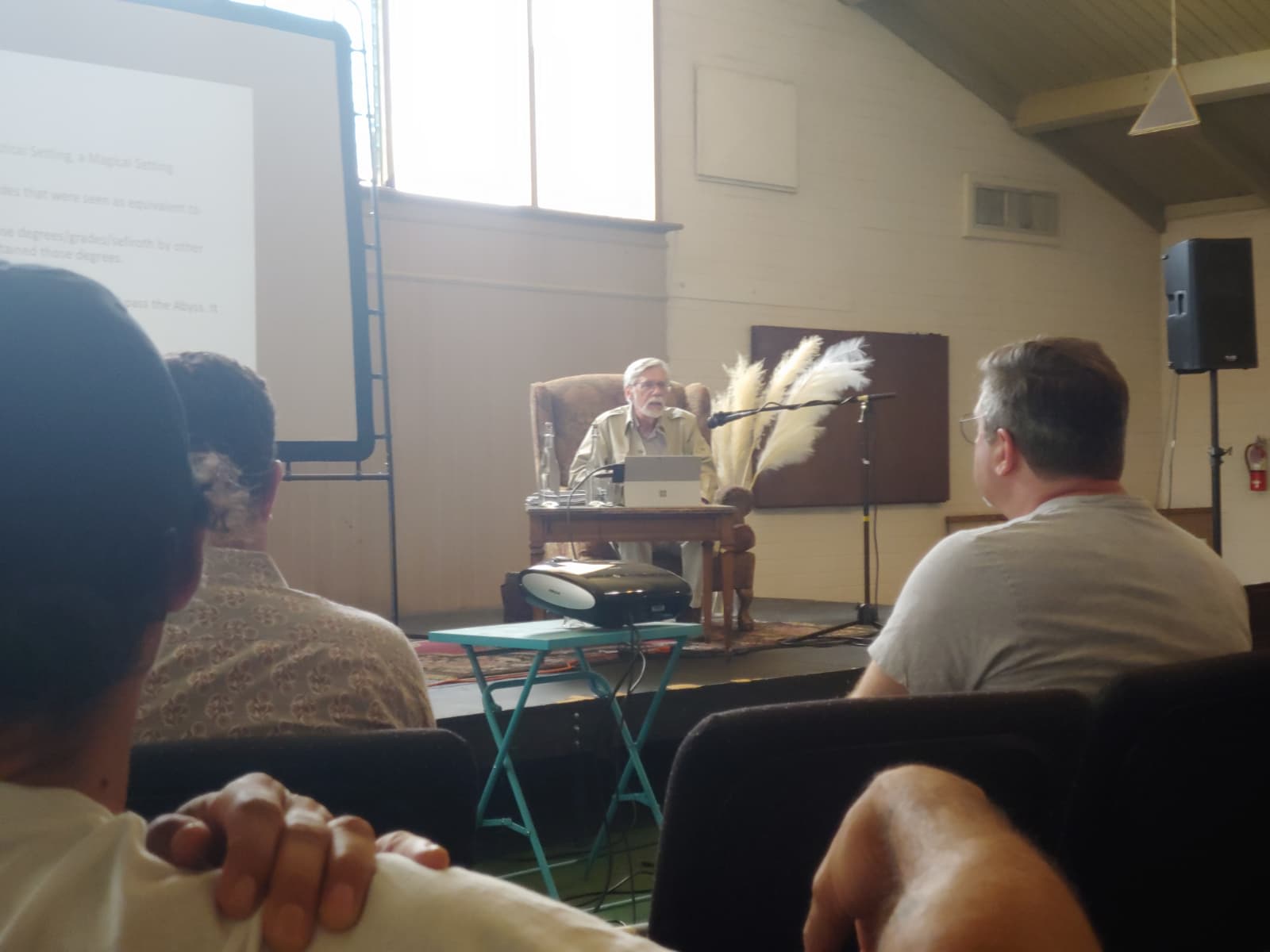
Then we practiced. The break included three questions to carry outside: How do you tell imagination from intuition from perception? Where in your body does skepticism tighten when practice begins? If you send a clear message to the landscape, does anything answer?
We returned for the first Godform assumption, working with Tahuti. Breathe, build a luminous shell, step into the ibis-headed current of wisdom and speech, and test the texture of consciousness when you shift your centre of gravity into an archetypal form. The discussion that followed was practical. Rituals are scaffolding for interior processes. Embodiment is not an optional flourish. There are resonances between African diaspora traditions of spirit possession and the Western technique of assumption, though language and aims differ. The point is not theatrics. The point is training a nervous system to hold more of the real.
Day Three: Lineages of Ascent, Breath as AlchemyWe opened with a story from the land itself. Tonelise spoke of creosote, how desert plants share resources through hidden networks, and the metaphor did what good metaphors do. It quietly rewired the room. (A resin-sweet note passes hand to hand. The mind hums like a buried root.)
This was the day we threaded the long arc. Tantric sacraments of the body. The Eucharist of ascent. Naples in the eighteenth century and the Arcana Arcanorum as a European custodian of interior alchemy. Raimondo di Sangro and the Egyptian imaginal that later blooms again in the nineteenth century. Cagliostro and then Pascal Beverly Randolph, and finally Giuliano Kremmerz, and how breath, visualisation, and polarity become not only doctrine but practice. We contrasted Indian authority structures and transmission with the Neapolitan approach. We spoke of sulfur and mercury, of the divine feminine, of energy as something refined by attention rather than hoarded by fear.
Practicalities were never far. Safety for any night work. Ground first. Keep your wits. Simpler rites done well are better than grand rites done poorly. Breath as an alchemical key. The body as both crucible and elixir. Some asked about aphantasia. You can work without vivid inner images, and you can train new faculties. Others asked about the spine, about amrita, about whether injury blocks ascent. The honest answer is that the variables are many and the testimony is mixed, which is why humility remains a friend.
We closed with a clear statement of aim. My private practice at present is a daily meditation on the void. Babalon, in my vocabulary, is the Void rather than a personality cult, and the crossing of the Abyss is the surrender of every mask. This is not a path for adrenaline chasers. It asks for maturity, consent, and guidance.
Day Four: Crowleymas and the Sumerian CurrentWe kept the feast for life. Crowleymas has become a tradition in my circles, a day to honour Aleister Crowley’s birth and to remember that practice must stay alive if it is to mean anything. The morning opened inside the Integratron, a space that amplifies sound, a small architectural wonder that turned breathwork into a kind of bell. Gratitude, intention, and a quiet rehearsal of what we had learned so far. (A tone hangs in the rafters; lungs answer with light.)
Then the lecture that many had asked for. The Sumerian tradition and its reception inside modern occultism. How lines from the ancient Near East surfaced in the twentieth-century imagination, and how The Simon Necronomicon functioned as a talisman in late twentieth-century occulture.
We used it not as a fetish but as a training ground for surrender. What does it mean to meet fear without theatrics, to lean into unknown names and remain balanced? We linked this to the wider Thelemic project, to the ethical work that any talk of the Abyss should entail, and to the small experiment everyone could try that afternoon. Find a polarity in your own life, love and hate are strong examples, and sit in the exact middle until the poles begin to inform each other rather than tear you apart.
Final Day: Synthesis, Skywatch, and the Unknown AboveWe had covered a lot of ground. The task now was to tie threads. We looked at mythmaking in the present tense. In a secular world, UFO narratives have become one of the ways we talk about transcendence in public without admitting that we are doing so. That is a gift and also a trap. Outsourcing spiritual responsibility to a rescue fantasy will always starve the soul.
We explored models. Interpenetrating dimensions rather than distant planets. Overlapping states of consciousness rather than simple visitors from elsewhere. We compared human-initiated contact protocols with ceremonial methods that also compress attention in order to open conversation with the more-than-human. Then we adopted Michael Bertiaux’s very practical distinction. A bad UFO experience drains vitality and contracts awareness. A good one nourishes clarity and leaves you stronger. Love and attention are not sentimental here. They are shields. Fear and obsession are invitations that you do not want to send.
That night, the conversation ceased to be theoretical. With the skywatchers team, under a vault of cold stars, an attendee witnessed an extraordinary UFO sighting.
No one jumped to conclusions, and no one needed to. The collective gasp, the unmistakable shift in the night, the way attention seemed to bend around a presence that did not behave like aircraft or satellite—all of it landed with the quiet weight of reality. People laughed. People stood in silence. (Stars sharp as salt. The desert holding its breath.) It was the right ending for a week that had asked us to hold complexity without panic.
What People Took HomeBy the final circle, the theme had repeated enough that we began to trust it. Those who arrived for lectures found a community. Those who came for a break from ordinary life found practices that do not end when you close a workbook. Peter’s archive-precision grounded us. My magical and mystical sessions opened the door to direct experience. Tonelise’s care and presence kept the field humane and safe. The land did the rest.
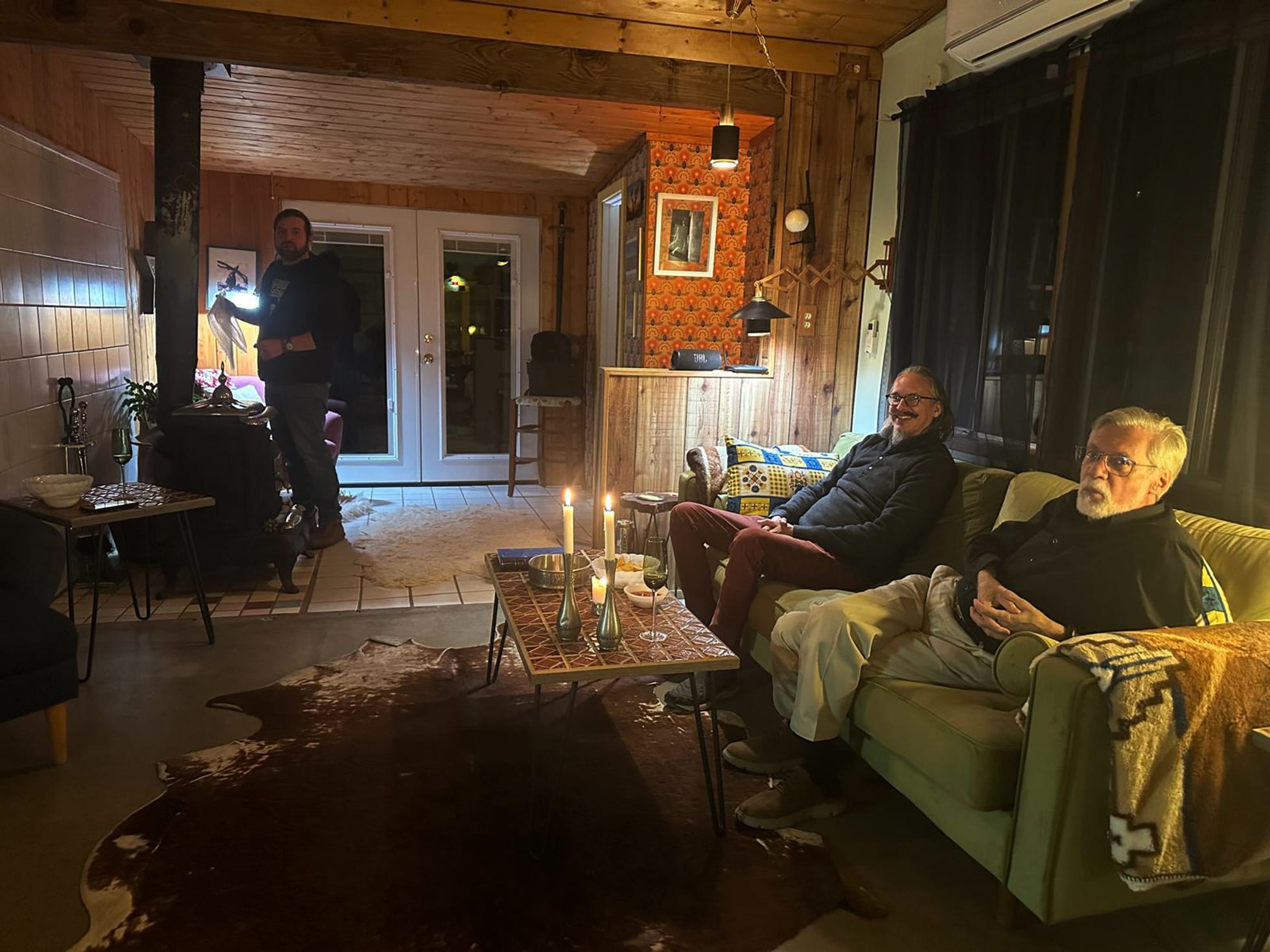
The takeaways were simple and earned.
Silence is not passive. It is a technology.
Etymology and history matter because words are doors, and you should know where they lead.
Embodiment is the difference between thinking about ascent and starting to climb.
Build a body of light before you go looking for whatever looks back.
Treat every encounter, terrestrial or otherwise, as a test of nourishment. If it feeds clarity, proceed. If it feeds fear, withdraw.
Keep your humour. It is a kind of protection.
Remember that community is not an accident. It is a practice of attention to each other.
I am grateful to everyone who trusted this experiment through postponement and uncertainty. I am grateful to Peter for the spine of scholarship that let all of us stand taller. I am grateful to Tonelise for the thousands of invisible actions that make a retreat work. I am grateful to the desert for reminding us that the world is very old and very alive.
KEEP IN TOUCH WITH TONELISE FOR FUTURE MAGICAL RETREATS www.magical-retreats.com
For those who were there, keep the practices gentle and regular. For those who could not be, there will be more work ahead. We will continue to braid the academic and the magical so that your understanding has both roots and wings. There are future intensives in the works, including a focused exploration of the first rung of the Michael Bertiaux system, the Lucky Hoodoo, where we will take the principle of nourishment-versus-depletion and make it even more concrete in daily practice.
Most of all, keep walking. If the week taught anything, it is that heaven is not a place that waits at the top of something.
It is a way of moving through the world with the sky inside you.
Thanks for reading Magick Without Tears with Marco Visconti! This post is public so feel free to share it.
October 12, 2025
CROWLEYMAS AT 150
From every report I am getting from those with the boots on the ground, out there in Joshua Tree the air is thin and electric, and the rocks keep their own counsel.
I am facilitating the Stairway to Heaven retreat with , and today we have dedicated every lecture to Crowleymas, the Feast for Life that marks Aleister Crowley’s birth.
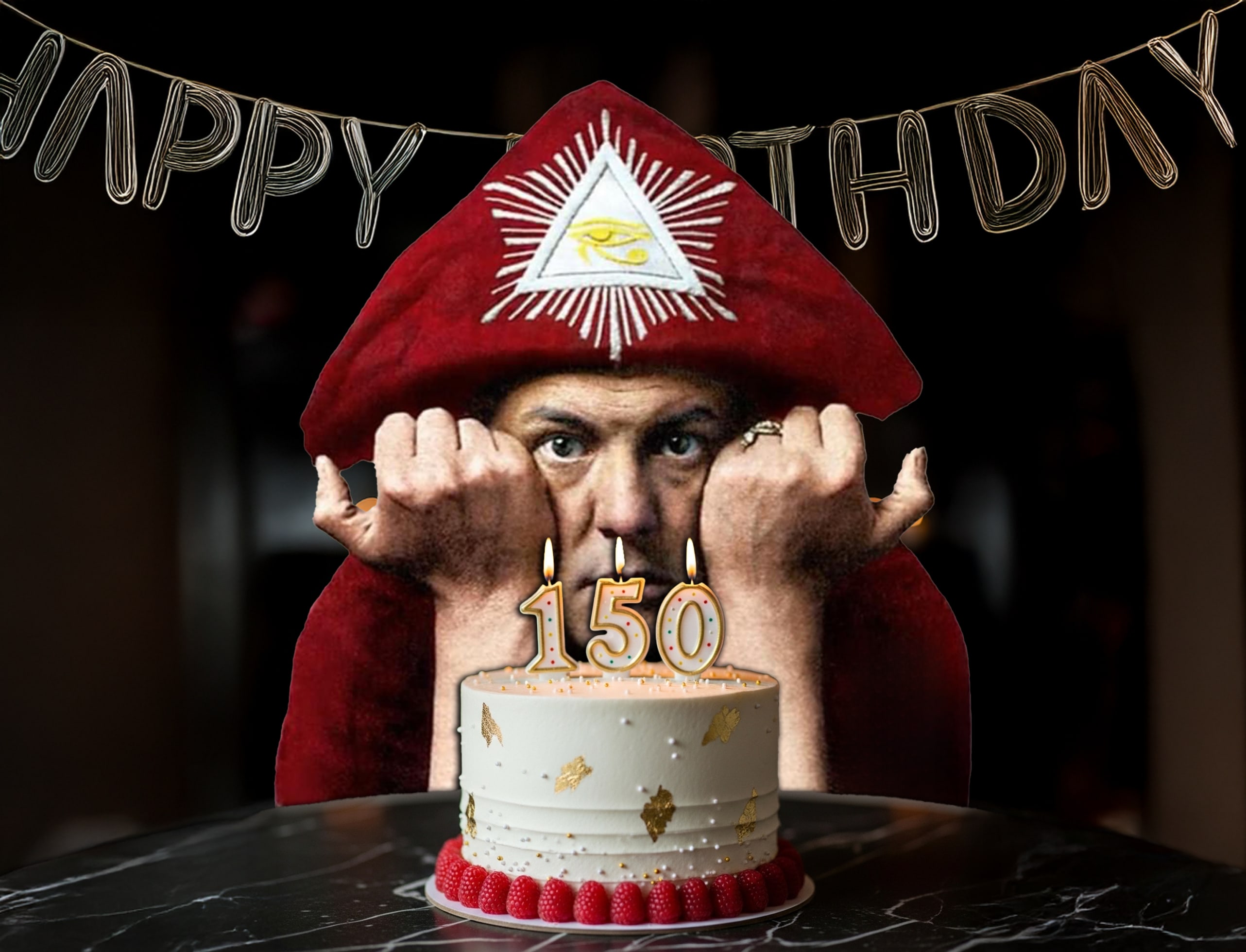
One hundred and fifty years have passed since 12 October 1875, yet the signal of his Work still cuts through the static.
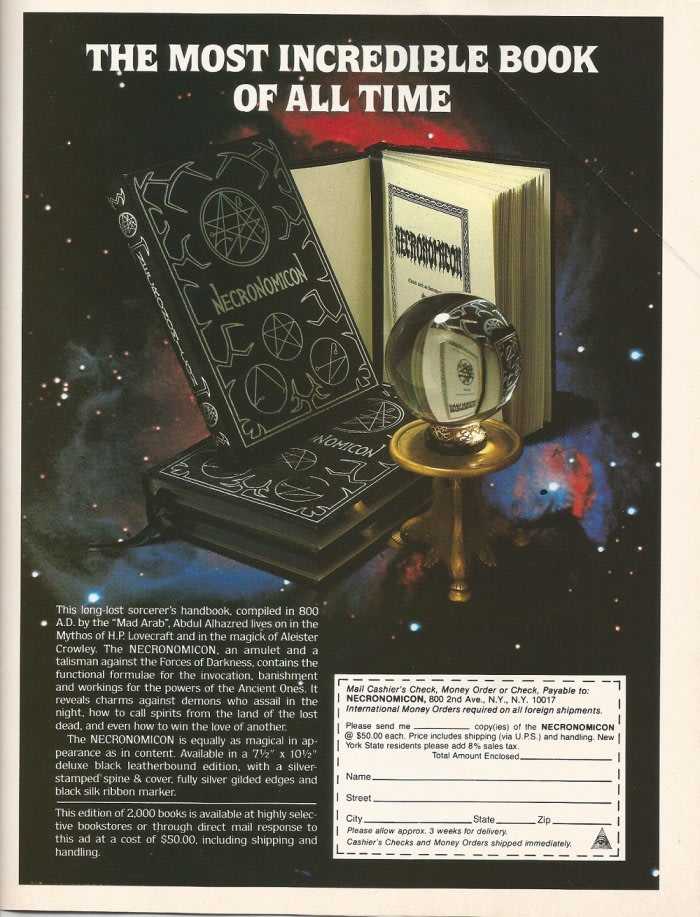
This year also brings a milestone for another strange book that shaped late-twentieth-century occulture. The “Simon” Necronomicon enters its half-century shadow, a reminder of how myth, mischief, and magic feed one another. Whether you regard it as talismanic bricolage or modern grimoire, its presence has been formative for conversations around the Nameless Current.
Magick Without Tears with Marco Visconti thrives on reader support. By choosing a paid subscription, you help keep new posts coming and fund ongoing research and writing. Thank you for considering a paid subscription to support this publication.
Because I am teaching all day, I will keep this brief and leave you with a small reading path from my Substack archive. These pieces sketch the contours of Thelema as a living practice and gesture toward that other current that hums beneath many names.
One last housekeeping note for friends following my current work. Today is the final day to access the Black Stars in Dim Carcosa course material. If you have been meaning to step in, this is your moment. After midnight, the gate closes, and the dreaming moves on.
Wherever you are, raise a glass for the Feast for Life of the Master Therion.
Out there in Joshua Tree, the desert is teaching us again that the sacred does not shout. It gathers, and then it changes everything.
Happy Crowleymas.
Thanks for reading Magick Without Tears with Marco Visconti! This post is public so feel free to share it.
October 1, 2025
TAROT OF THE MONTH
October leans toward Samhain like a pilgrim approaching a threshold.
The fields dim, hearth-smoke sweetens the air, and the world seems to tilt toward the West, where memory ripens and the Gate of the Dead opens a finger’s width. This is the season of lanterns and listening, when the living and the ancestral mingle in the same breath.
 This month, the current that moves beneath events is the Ace of Cups.
Magick Without Tears with Marco Visconti thrives on reader support. By choosing a paid subscription, you help keep new posts coming and fund ongoing research and writing. Thank you for considering a paid subscription to support this publication.
Within that ambience, the Ace of Cups arrives as the first sound of water in a cavern, a pulse from the unseen that tells you there is a river below the floor of things. The Egyptian myths lend a subterranean feel to this card. The underworld is imagined as a night sea journey, with the Sun as Khepra, travelling through darkness, reborn from the waters at midnight, while Anubis keeps the thresholds. These are not dry catacombs but moving depths, a Duat of currents, ferries, and passages. The Ace of Cups, then, is the Grail that catches the underworld’s first rain, the proof that the dark is not empty but gestational.
In Thelema, this ATU is no simple promise of romance. It is the root of Water itself, the primordial Grail, the feminine complement to the Ace of Wands, derived from the lunar yoni just as its fiery sibling is from the solar lingam. Crowley writes that upon the dark sea of Binah the Great Mother, there rise twin Lotuses that fill the Cup with Life-fluid, a current that may manifest as water, as wine, or as blood according to the work at hand. Above the cup descends the Dove of the Holy Spirit, consecrating the element. At the base gleams the Moon, for it is the virtue of this card to conceive and to bring forth the second form of its nature.
Frieda Harris paints the vessel as a living icon. The bowl receives scalloped radiations of light that meet the undulating horizon of the sea. On its face, she places the interlaced triple rings that Crowley elsewhere associates with the Aeons of Isis, Osiris, and Horus. Even if that emblem differs from the Mark of the Beast, the artistic choice reminds us that the Cup includes and reconciles epochs of consciousness. It is the matrix in which a new Aeon’s wine ferments.
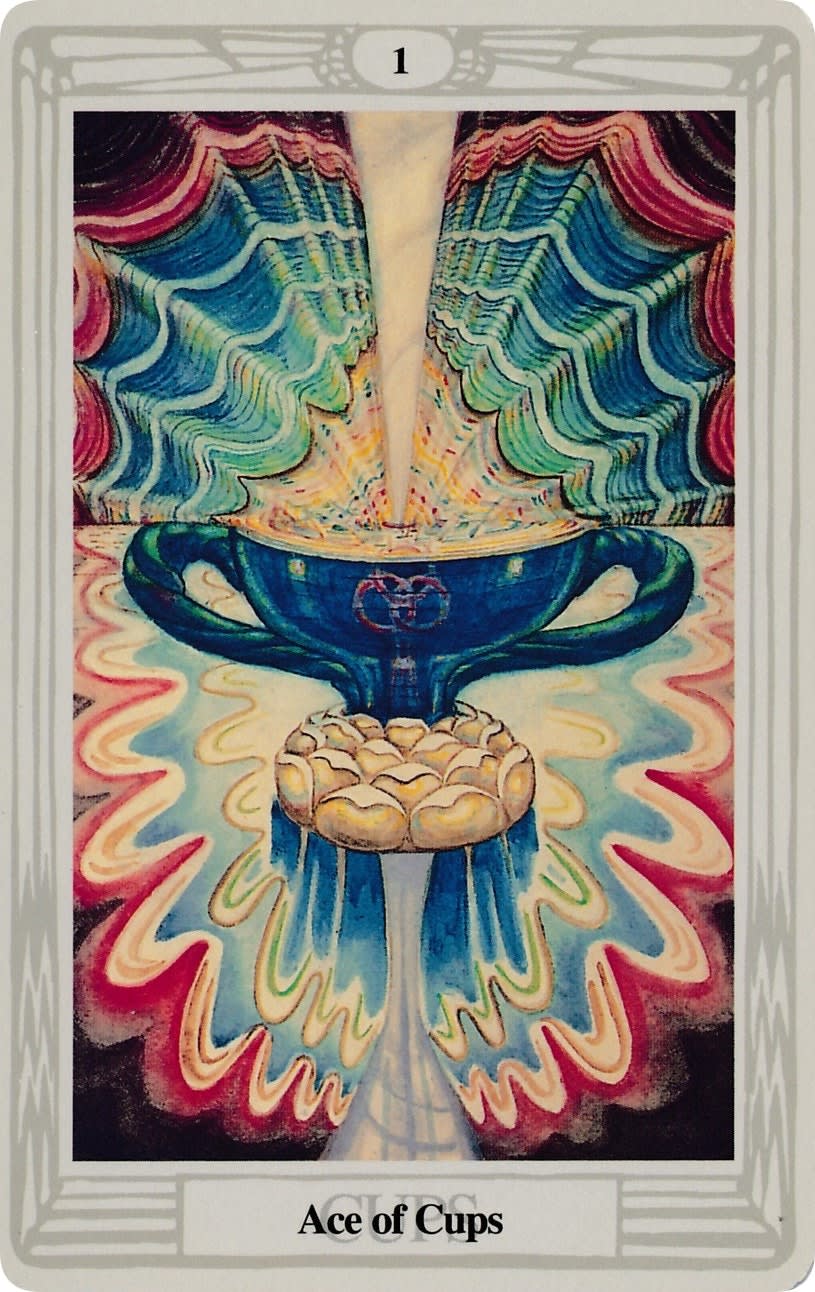
Seen from a Qabalistic perspective, the Ace of Cups is a font in the supernal triad. It is the boundless possibility of creation, the field where every feeling is a seed and every seed is already wet with becoming. It is the Graal at its essential, receptive, lunar virtue, the place where spirit and substance first agree to meet. In this reading, the Ace carries not only the root of water but also an implicit trinity, already poised to manifest.
So what does that mean for October’s lived texture? Water at the root softens what has grown rigid. It irrigates exhausted soil and invites us to drink and be changed. Expect a month of openings in the heart, of reconciliations that do not require words, of inspirations that arrive not as arguments but as tides. The Cup descends before the story begins. It is the first yes.
September 30, 2025
TURNING THE WHEEL: THE THOTH TAROT AS AN ENGINE OF INITIATION
Thank you , , , , , , and many others for tuning into my live video with !
Join me for my next live video in the app.
Magick Without Tears with Marco Visconti thrives on reader support. By choosing a paid subscription, you help keep new posts coming and fund ongoing research and writing. Thank you for considering a paid subscription to support this publication.
The Secret of the Thoth Tarot is an exegesis of Crowley’s Book of Thoth rather than a spread-by-spread tutorial.
Paul Hughes-Barlow opens by showing you how to study Crowley’s text, then traces the deck’s Masonic and Golden Dawn DNA, setting readers up to read the Thoth as a philosophical and magical system. The structure makes that intent plain: an introductory section, a sustained commentary on Crowley’s Part I theory, Qabalah, and Universe chapters, a bridge into Liber AL, and then a suite of essays that wrestle with “initiatory” matters like the Black Brothers, the martial face of Adonai, and TARO as Tetragrammaton. It closes with conclusions, a timeline, and working appendices.
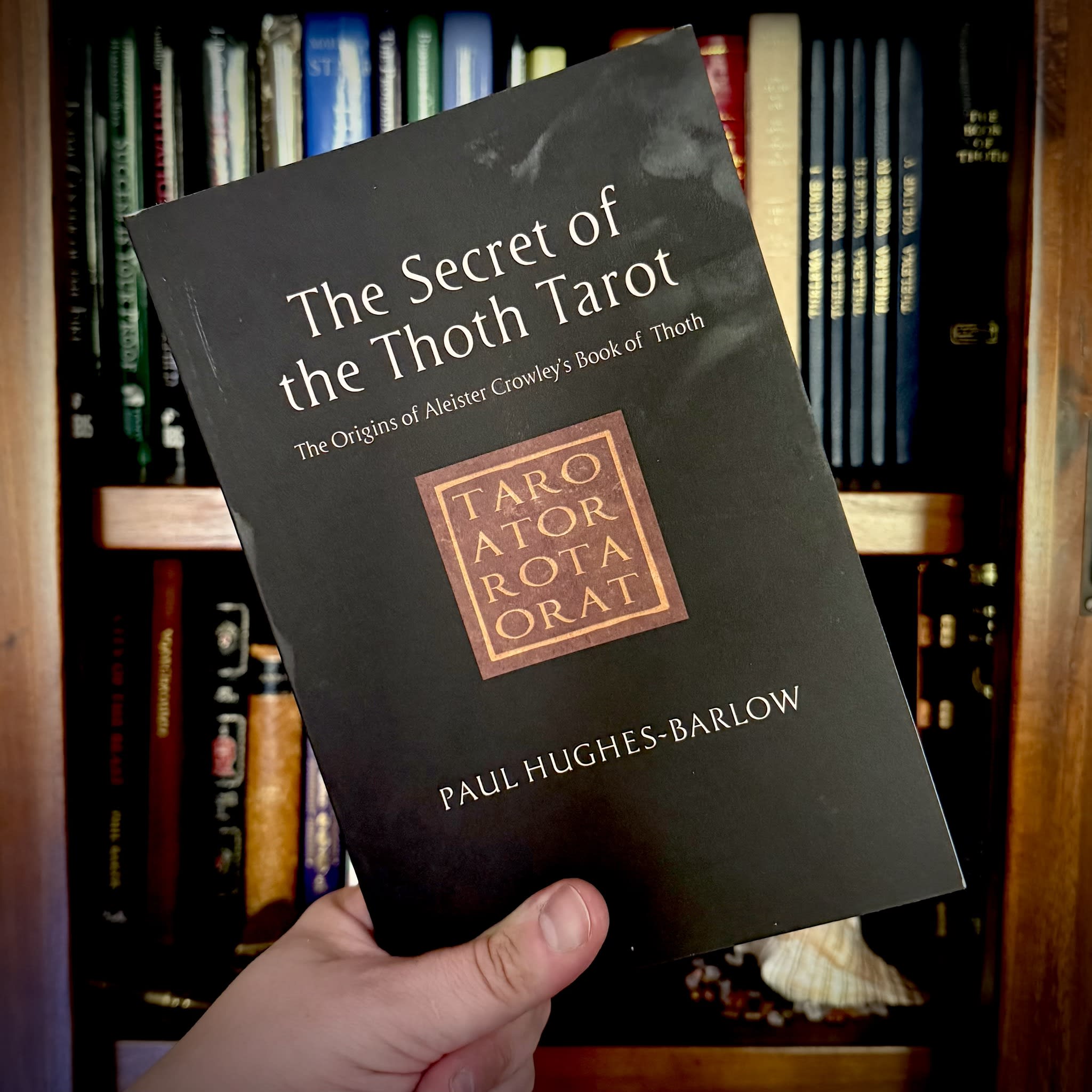
This emphasis lands. Crowley’s original Book of Thoth was already more a theurgic atlas than a fortune-telling guide, mapping the trumps into Qabalah, the Naples Arrangement, and the Great Work. Hughes-Barlow’s commentary stays in that current, helping readers actually work with those correspondences rather than admire them at arm’s length. If you want to understand why Crowley insists the Wheel of the TARO is the one wheel that “avails thee consciously,” and how that wheel becomes a ladder beyond the Abyss, this book gives you the scaffolding.
Where the book really shines is in its “Emergent Inspirations.” Essays on gematria, Kant in Crowley’s worldview, and “TARO as a Map of the Universe” push the discussion past rote correspondences into lived practice. A chapter on BABALON and ABRAHADABRA sits beside a study of Allan Bennett’s hidden influence, and the material on “the initiated view” reads like a seasoned practitioner helping you orient yourself in the storm.
Hughes-Barlow also treats the deck as a magical instrument, not just a text to decode. The foreword flags three new working patterns for invocation — ABRAHADABRA, Vision of 231, and 6°=5° — and the appendices include invocations and “Magick via the Princesses,” inviting readers to use the cards as keys, not just symbols. That practical, initiatory bent is the heartbeat of the book.
Verdict: readers hunting card meanings will be disappointed. Readers who recognise the Thoth as a ritual machine and a curriculum of consciousness will find real gems here, the kind you only uncover after years of turning the Wheel with intent. If Crowley’s Book of Thoth is the mountain, The Secret of the Thoth Tarot is a set of lines and holds that make the ascent possible without ever pretending it is easy.
Thanks for reading Magick Without Tears with Marco Visconti! This post is public so feel free to share it.
September 25, 2025
RAPTURE MYTHS vs LIVED AEONS
In my latest instalment of the New Aeon Agora YouTube series, I explored a subject that continually captures popular imagination: the Rapture. With each passing year, date-setters predict a secret evacuation of believers; yet another weekend comes and goes without a trumpet call. In the video, I sketched the history of this modern doctrine, contrasted it with the Thelemic understanding of time and spiritual evolution, and urged viewers to focus on real injustices rather than apocalyptic fantasies.
Because the response to that video has been so engaging, this article takes the conversation further. Here you’ll find additional historical detail about John Nelson Darby and the Plymouth Brethren, insight into how Aleister Crowley’s upbringing within that sect shaped his rebellion, and a deeper look at the Thelemic idea of the Succession of the Aeons.
If you haven’t watched the video yet, I encourage you to do so; it marks the beginning of a renewed commitment to my YouTube channel. For now, settle in for an exploration that weaves biography, theology, and social critique.
Magick Without Tears with Marco Visconti thrives on reader support. By choosing a paid subscription, you help keep new posts coming and fund ongoing research and writing. Thank you for considering a paid subscription to support this publication.
The Rapture is a Recent InventionMany Christians assume that the idea of a pre‑tribulation Rapture is ancient, but historical evidence shows that it emerged in the nineteenth century. Before that time, most American and European believers adhered to postmillennial or amillennial interpretations, believing the Church would persevere through tribulation to ultimately triumph.
In contrast, Dispensationalism, the system that introduced the very idea of the Rapture, divides sacred history into distinct administrations, draws a hard line between ethnic Israel and the Church, and inserts a secret removal of believers before a final period of turmoil.
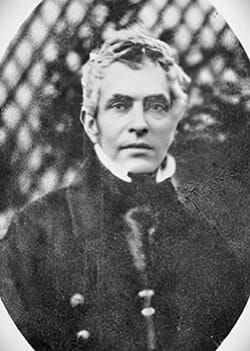
This framework originated not with the early Church or the Nicene Creed, but with John Nelson Darby, a nineteenth-century Anglo-Irish cleric and a founding figure of the Plymouth Brethren. Darby’s scheme identified six “dispensations” and argued that 1 Thessalonians 4:17 pointed to a future event in which Christ would snatch believers away before resuming his dealings with Israel.
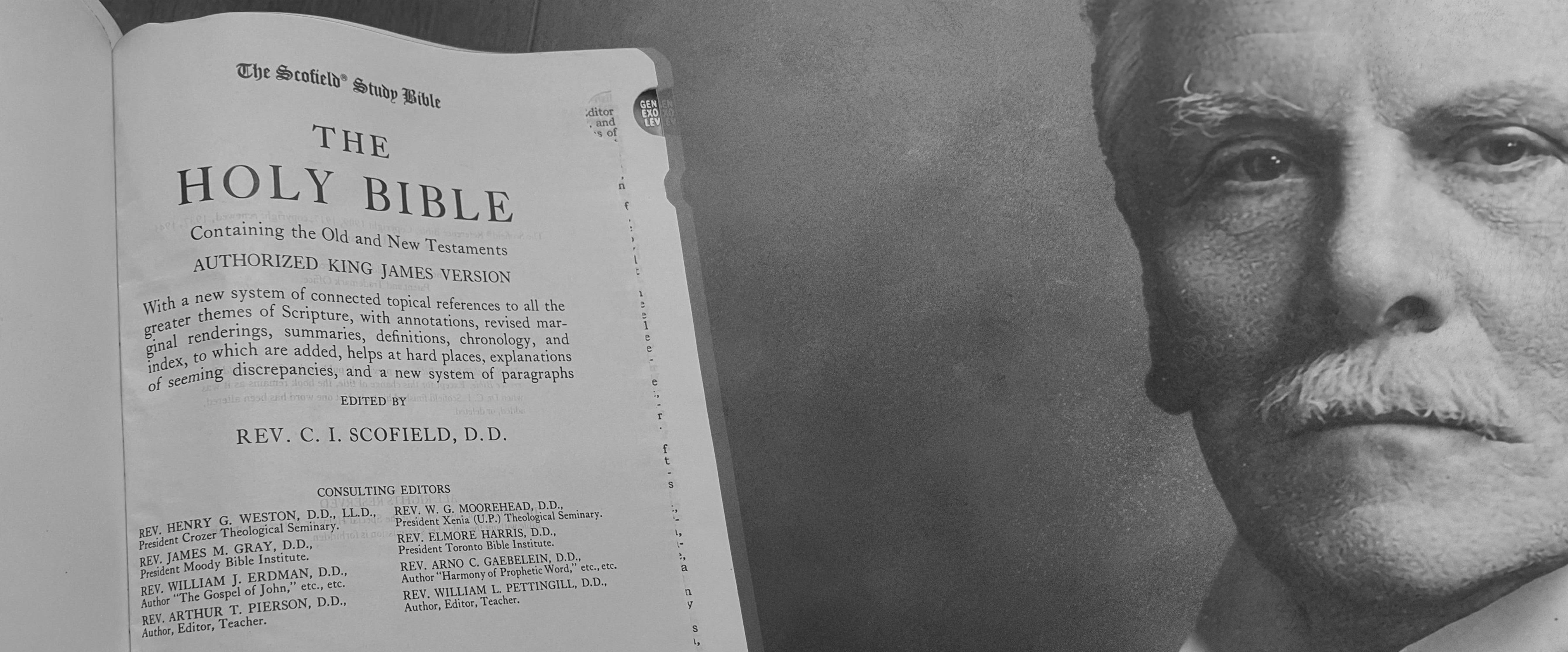
Dispensationalism’s novelty is not disputed by historians of theology. Darby formulated a new system of theology in the mid‑1800s. Its spread owed less to exegetical elegance than to persuasive marketing. American pastor Cyrus I. Scofield embedded Darby’s interpretations into the footnotes of his Scofield Study Bible, first published in 1909. This study Bible sold more than two million copies in its early years and convinced readers that its notes were the definitive exposition of the biblical text.
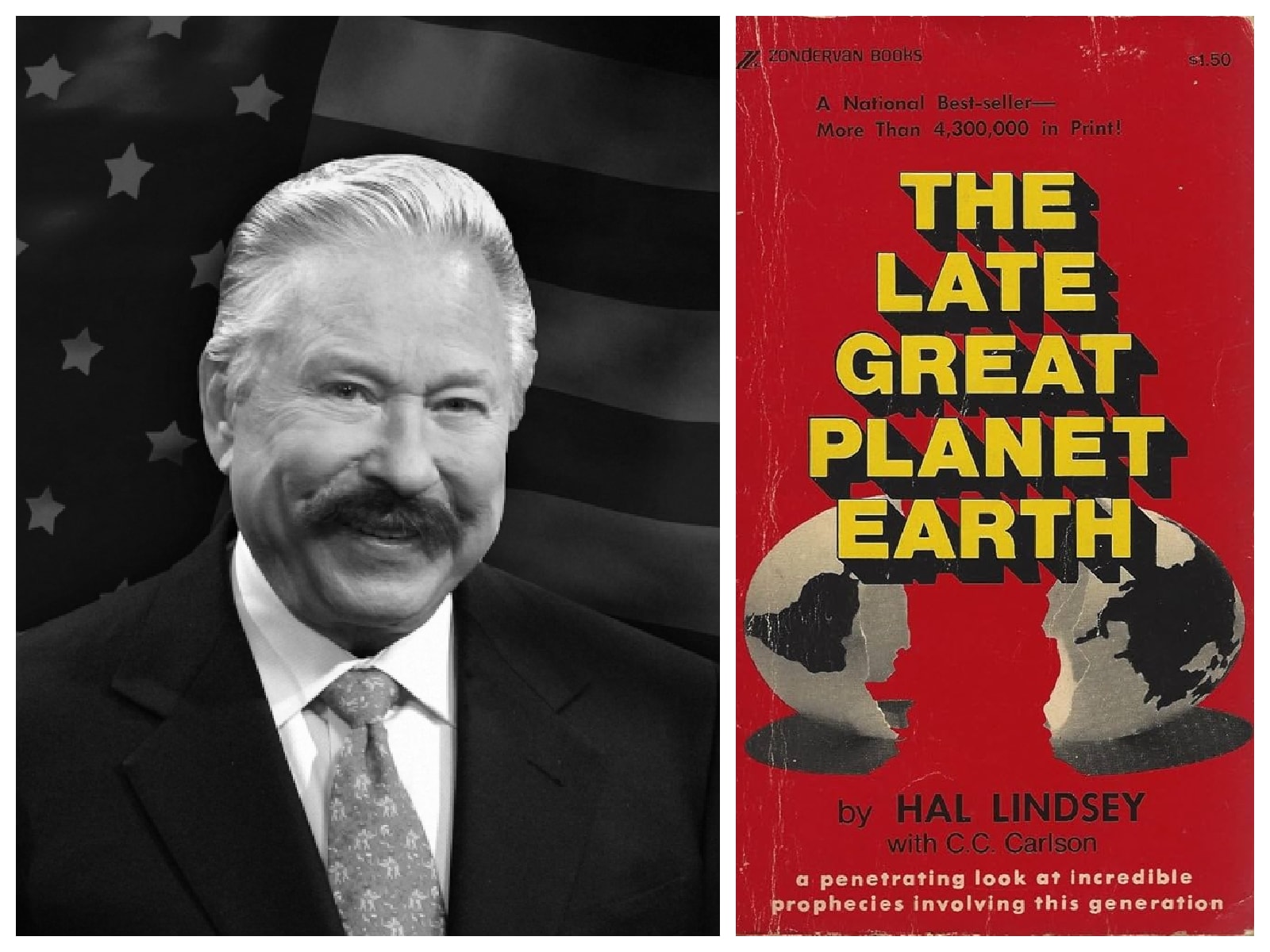
Popular authors followed. Hal Lindsey’s 1970 bestseller The Late Great Planet Earth repackaged Darby’s timetable for a Cold War audience, and the 1990s Left Behind novels by Tim LaHaye and Jerry B. Jenkins turned the same outline into thriller fiction.
The result has been a generation of believers for whom a pre‑tribulation Rapture feels like mere Christianity, even though it has a very specific pedigree.
Core Claims of DispensationalismDispensational theology rests on three primary assertions:
Historical divisions: History is divided into discrete eras in which God interacts with humanity in different ways.
Israel–Church distinction: A sharp distinction is drawn between ethnic Israel and the Christian Church; promises to Israel are not applied to the Church.
Secret Rapture: Believers will be “caught up” to meet Christ, halting the “Church age” and restarting Israel’s prophetic clock.
These claims provide the logic for the chart on so many prophecy conference brochures. Without the Rapture, the dispensational timetable falls apart. What is often presented as biblical inevitability is, in fact, a modern program devised by a particular preacher within a specific movement.
John Nelson Darby and the Plymouth BrethrenFrom Barrister to Sectarian LeaderDarby was born in London in 1800, the youngest son of an Anglo‑Irish merchant family. A gifted student, he graduated first in his class from Trinity College, Dublin. Although he had trained for the legal profession, he soon abandoned it for the Anglican ministry. Yet he found himself increasingly disenchanted with the established church. After a riding accident forced a period of convalescence, he embraced radical biblicism, believing truth could be found in Scripture alone and interpreted literally. He also articulated a conviction that the church was a spiritual priesthood of believers rather than a hierarchy of clerics.
By the late 1820s, Darby began meeting with a group of like‑minded evangelical malcontents in Dublin, individuals who sought to return to New Testament simplicity by gathering without official clergy and celebrating the Lord’s Supper together. These meetings laid the foundation for the Brethren movement, which soon spread to Bristol, Plymouth, and beyond. Darby wrote in his letters that finding brethren acting together in Plymouth “altered the face of Christianity to me”. Although the Brethren resisted denominational labels and preferred to be called simply “Christians,” outsiders began to refer to them as the Plymouth Brethren.
The Brethren’s Distinctive IdeasAmong the Plymouth Brethren, a cluster of practices and convictions developed that made their communities instantly recognisable, not because they embraced novelty for its own sake but because they believed they were returning to the primitive simplicity of the apostolic church. The most visible expression of this ideal was the weekly “breaking of bread,” a communion celebrated not in consecrated chancels and certainly not under the presidency of an ordained sacerdotal class, but in parlours, rented rooms, and modest halls where any baptised believer might rise to offer a prayer, read a passage of Scripture, or speak as the Spirit prompted. The rite was less a liturgical performance than a living conversation, and the absence of clerical mediation served as a continual reminder that authority resided in the gathered body and in the immediacy of the Holy Spirit rather than in ecclesiastical office.
This ecclesiology of immediacy cohered with an ethic of separation that Darby and his adherents raised to a principled program. Convinced that doctrinal error and moral compromise were not accidental blemishes but structural features of the visible churches, they treated fellowship as something to be guarded with jealous care, refusing communion with congregations or individuals they deemed contaminated by false teaching or lax discipline. The result was a community that prized purity over breadth and that accepted social isolation as the necessary cost of fidelity.
Undergirding these choices was an eschatological outlook marked by heightened expectancy. Christ’s return was not a remote hope to be filed under long-term theological concerns; it was imminent, always on the threshold, and it cast a stark light on the present. If the Church existed in a state of ruin, as Darby insisted, then reforming the historic denominations was a distraction from the obedience of the hour. Christians ought to meet, keep themselves unspotted, and await the Lord. Efforts to reconstruct Christendom were not only futile but theologically misguided, since they risked mistaking human architecture for divine order.
Darby’s system took on its full coherence during the prophetic conferences at Powerscourt House in County Wicklow, convened under the patronage of Lady Theodosia, Countess of Powerscourt. In that charged setting, he refined the scaffolding that would become dispensationalism: the division of sacred history into discrete economies, the notion of a parenthetic “Church age” in which God’s dealings with Israel are temporarily suspended, and the pivotal claim of a Rapture that would remove believers before the final tribulation. These constructions did not remain abstract; they generated friction within the movement itself, since the logic of separation pressed some assemblies toward a rigour that others found untenable.
The Crowley ConnectionA Childhood Under the BrethrenThe ensuing rupture produced Darby’s Exclusive Brethren on one side and the more open gatherings on the other, and the culture of strict separatism that crystallised around the Exclusive party foreshadowed the intense sectarianism that would frame the early life of Aleister Crowley.
Aleister Crowley, born Edward Alexander Crowley in 1875, entered the world of the Plymouth Brethren from the moment of his baptism. His parents, Edward and Emily Crowley, were Plymouth Brethren of the strictest kind. Edward Crowley had inherited wealth from the brewery trade but devoted himself to preaching; he was revered within the sect, and his son adored him. The household adhered to Brethren principles, which included daily family worship, a literal interpretation of Scripture, and abstention from worldly entertainments. Crowley later wrote that the Bible was the only book permitted in the home and that games, music, and novels were banned. This austere environment shaped his imagination in ways he would later both rebel against and reappropriate.
This is not abstract church history for our purposes, because Aleister Crowley was born into precisely that world. His father, Edward Crowley, left engineering to preach as an Exclusive Brother, flooding the streets and the post with tracts, buttonholing strangers with the unnerving catechetical question “and then?”, and becoming a minor but tireless evangelist of Darbyite rigour. Family life followed suit: daily Bible readings, a Spartan upbringing that disdained holidays and toys, a closed circle of “walking Bibles” whose disputes were settled with “It is written” and “Thus saith the Lord.” Crowley later remembered that atmosphere with a complicated mixture of admiration for his father’s strength and revulsion for the sect’s absolutism; the memories deepen after Edward’s premature death in 1887, when a fresh Brethren schism—this time the Raven Division—pushed his mother into still more stringent devotion and tore even the family’s social fabric. The boy who would become Perdurabo learned early how quickly one could fall from “chosen” to “damned” when a new doctrinal hair was split. The intensity of his break with Protestant literalism makes far more sense once you see the walls he grew up inside.
There is another detail—almost folkloric now but rooted in that household’s habits. For much of his infancy and adolescence, the Bible was his only reading, and his mother, exasperated by his wilfulness, called him “The Beast,” a stinging label that sent him prowling through Revelation and left him electrified by the book’s lurid figures. That imaginative seed matters; Crowley’s later symbolic world did not arrive from nowhere. It grew in soil tilled by Brethren severity and apocalyptic fascination, and it flowered into a thorough revolt against fear-dressed-as-faith.
The strict Brethren environment also imposed social isolation. Crowley attended Brethren schools, where dayboys were taught to fear the world outside their sect. He internalised the language of apocalypse and judgment but chafed against the hypocrisies he perceived among believers. When he later encountered the broader world at Malvern College and Tonbridge School, he experienced bullying and sexual repression, which further soured him on conventional Christianity. This combination of religious intensity and personal disillusionment provided fertile soil for his later attraction to occultism.
Flight to Cambridge and the OccultIn 1895, Crowley finally overcame family opposition and entered Trinity College, Cambridge. There, he immersed himself in literature, poetry, chess, and mountaineering. For the first time, he indulged in pleasures previously forbidden: sex (and bisexuality), smoking, and wine. Cambridge liberated him from the suffocating moralism of the Brethren and exposed him to new philosophical ideas, including the works of Richard Burton and French decadent literature. During this period, he also began reading widely on esotericism. He wrote to occultist A. E. Waite, asking for guidance in finding the “Secret Sanctuary” described in the 18th‑century classic, The Cloud upon the Sanctuary. Waite’s suggestion to read that text accompanied Crowley on a climbing holiday, and he resolved “to find and enter into communication with this mysterious brotherhood”.
Crowley’s initiation into the Hermetic Order of the Golden Dawn in 1898 provided the framework for his lifelong pursuit of magick. Yet the antagonistic relationship with his mother and the memory of his father’s strict Brethren preaching continued to haunt him. In his Confessions, he attributed his early turn to the occult to the shock of his father’s death and his sense that God had failed to protect them. His later disdain for Christian fundamentalism and his celebration of personal sovereignty can be read as an inversion of the Plymouth Brethren ethos. Crowley did not merely reject his upbringing; he transmuted it into the mythos of Thelema, making his childhood demons into symbols and tools.
The Thelemic Idea of the Succession of the AeonsAeons as Spiritual ParadigmsOne of Crowley’s most creative contributions to modern esotericism is the concept of Aeons. In Thelema, an Aeon is a vast epoch characterised by a particular spiritual formula. Crowley identified three major historical Aeons—Isis, Osiris, and Horus—each reflecting a distinct religious and cultural paradigm. According to Thelema, these shifts are not arbitrary but arise from the evolution of human consciousness.
Aeon of Isis: This earliest epoch was matriarchal and nature‑oriented. The Great Goddess—known as Isis to the Egyptians, Demeter to the Greeks, and Kali to the Hindus—represented fertility, motherhood, and the earth. Worship during this Aeon focused on mysticism, intuition, and the cycles of nature. We can think of it as the (perhaps mythical) “Age of the Great Goddess”, and its magical formula was based on humanity’s perception of spontaneous growth and continuous life.
Aeon of Osiris: In the classical and medieval periods, the matriarchal paradigm gave way to patriarchy. The Aeon of Osiris centred on the dying and resurrecting god, embodied by divine figures such as Osiris, Dionysus, and Christ, and emphasised sacrifice, moral dualism, and submission to a paternal deity. Religious institutions became hierarchical and dogmatic. Individuals were seen as fallen beings in need of redemption. Several Thelemic writers later elaborated that this era hid esoteric knowledge beneath layers of ritual and dogma.
Aeon of Horus: Crowley announced that a new Aeon began in 1904 when he received Liber AL vel Legis. The Aeon of Horus emphasises individual self‑realisation, sovereignty, and the pursuit of True Will. Horus, the child god, crowned and conquering, symbolises renewal and potential. In this era, spiritual authority shifts inward; each person is called to discover and fulfil their unique purpose. Crowley summarised this ethos in the famous maxim from Liber AL: “Every man and every woman is a star”.
Crowley warned against interpreting the Aeons as astrological ages or as excuses for escapism. In The Book of Thoth, he explained that the magical doctrine of the succession of the Aeons is connected with the precession of the zodiac. He associated the Aeon of Isis with Pisces and Virgo, the Aeon of Osiris with Aries and Libra, and the present Aeon of Horus with Aquarius and Leo. Yet he also noted that seers in the Osirian age feared the coming change because they misunderstood the precession of Aeons and equated every transition with catastrophe. For Thelemites, Aeonic shifts are not disasters but opportunities for conscious evolution.
Aeons versus DispensationsUnderstanding the Aeons provides a precise vantage point from which to set Thelema beside Darby’s dispensationalism. Both schemas describe history as articulated into distinct epochs, and both assign to each period a characteristic formula that shapes religion and conduct. Yet the likeness ends there, because the mechanisms that drive change are conceived in utterly different terms. Dispensationalism envisions a divine legislator issuing new administrative orders at regular intervals, so that the spiritual economy of humanity hinges on fresh decrees. The Aeonic model treats history as a drama of consciousness rather than an alternation of statutes; its turning points arrive as shifts in symbolic language, mythic pattern, and interior orientation, and what changes is not the letter of a law but the quality of awareness through which men and women apprehend themselves and the world.
These divergent premises naturally give rise to divergent postures toward human agency. In the dispensational chart, the drama reaches its fever pitch with a sudden extraction of the faithful, and agency becomes largely a matter of waiting rightly for rescue. Thelemic aeonics refuses that exit. The Aeon of Horus speaks to sovereignty and to the burdens that accompany it, asking each person to take responsibility for a life shaped in accordance with True Will and to meet the world as a field of work rather than as a catastrophe to be dodged. The energy is affirmative, not evasive; it encourages the practitioner to stand upright, to act, and to accept the consequences of their actions as part of maturation.
So too with suffering, which the popular Rapture narrative either avoids through timely evacuation or imagines as a chastisement visited upon others once the righteous have been removed from the stage. In Thelema, no timetable dissolves pain by decree. Suffering is not a clerical error in the cosmos. Still, one of the materials through which character is tempered and clarity is won, and the task is to confront and integrate it within the discovery of True Will. The passage forward is not the erasure of difficulty but its transmutation.
The ethos is set in a single sentence of Liber AL: “Every man and every woman is a star.” Each of us has a trajectory that is neither interchangeable nor negotiable, and no one is licensed to seize the helm of another’s course. In that sense, the Aeon of Horus democratises spiritual life, since the measure of authenticity is not conformity to an external program but fidelity to an interior law.
There is no cosmic escape hatch concealed behind the clouds. There is only the steady labour of becoming who you are meant to be and of ordering your orbit so that your light can be of use.
Why the Rapture Myth PersistsDarby’s timetable did not become dinner-table common sense through scholastic elegance alone, nor by the patient work of exegesis; it spread because the Scofield Reference Bible of 1909 stitched a vast apparatus of commentary directly to the sacred page, so that for millions of readers the marginal notes carried the gravitational pull of Scripture itself, and because late twentieth-century popularisers converted a technical scheme into cultural air. Hal Lindsey distilled the system into a brisk bestseller, the Left Behind franchise repackaged it as page-turning melodrama, and a once sectarian calculus migrated from prophecy conferences and Bible institutes into Sunday school charts, radio sermons, and televised pulpits, until a Victorian minority report had been naturalised as something like mere Christianity for a wide swath of American Protestants.
Its durability, despite a recent origin and a fragile scriptural foundation, rests on the incentives of an outrage economy. The narrative furnishes stock villains, confers insider status, and turns eschatology into a renewable product line; when a date fails, the goalposts slide, a fresh graphic appears, and the market obligingly resets.
By contrast, facing the prosaic emergencies that shape our lives offers no narcotic thrill of secret knowledge. It is less glamorous to reckon with wage stagnation, predatory housing markets, brittle public services, and the quiet capture of democratic institutions by concentrated wealth. Yet, these are the forces that make people anxious, isolated, and susceptible to stories that promise meaning, certainty, and someone to blame. As I argued in the video, fear narratives flourish where life is precarious; if families could rely on rising wages, dependable infrastructure, and a dignified retirement, there would be far less oxygen for moral panics and profit-driven prophecies.
Nor is the trade in fear confined to evangelical fundamentalism. The modern occult scene harbours its own hucksters, eager to sell a password to hidden wisdom if payment arrives before next Tuesday, and conspiracy-minded spirituality often recycles the same dramaturgy with a shifting cast of antagonists.
The roles change—demons, migrants, transgender people, musicians—yet the script remains constant: identify an enemy, declare an imminent catastrophe, monetise insider status. Thelema’s call to True Will stands at a principled distance from this economy of panic.
To do one’s Will is to act from clarity rather than anxiety, to accept responsibility in place of scapegoating, to build communities that practise mutual aid and sane spiritual discipline, and to measure progress not by the frenzy of headlines but by the steady work of becoming who you are meant to be.
Towards a Mature SpiritualityThe stories we tell about time do more than decorate our theologies; they script our habits, shape our expectations, and train our imaginations toward either responsibility or retreat. A theology of escapism teaches people to hold the world at arm’s length, treating injustice as a passing weather system rather than the consequence of choices and structures, and cultivating the passive vigilance of those who prefer rescue to reform.
A spirituality of Aeonic transformation points in the opposite direction, inviting us to become conscious participants in the unfolding of awareness, to notice how epochs change as people change, and to accept that the great work before us is double, within and without, a conversation between inner clarity and outer practice that remakes both the self and the polis.
Here are some ideas:
Engage in social justice: Recognise that much of the suffering in our world is not the work of unseen agencies but the predictable outcome of policies, incentives, and power imbalances. Acting under Will means directing energy where it can alter conditions, supporting movements that raise minimum wages, secure broad access to healthcare, stabilise housing, curb predatory practices, and resist the capture of democratic institutions by private wealth. This is not a flight from the spiritual to the political; it is the application of conscience to the arena where consequences are measurable, from local council meetings and union halls to courtrooms and clinics, with the understanding that every incremental gain in the commons widens the field in which human flourishing can occur.
Cultivate mutual aid: Build circles of reciprocity that treat care as a daily liturgy rather than a last-minute scramble for supplies in anticipation of a cosmic bailout. Feed those who are hungry, help secure shelter for the unhoused, organise rides, share tools, pool small grants, and keep an eye on the elders and the vulnerable on your street. Mutual aid differs from charity because it assumes equality, not hierarchy; it is a covenant among neighbours rather than a display of magnanimity. In Thelemic terms, it is the social expression of love under will, a practice that dignifies both the giver and the receiver, and turns community from a slogan into a durable infrastructure of trust.
Pursue inner work: The Aeon of Horus is not a permission slip to drift; it demands discipline sufficient to reveal what is yours to do. Meditation, journaling, ritual practice, breathwork, honest self-examination, and periods of silence are not luxuries, but rather instruments that bring the True Will into focus. Record your experiments as Crowley advised, compare intention with result, and refine the practice accordingly. Thelemic magick and mysticism are empirical, a long conversation between hypothesis and experience. As the record deepens, so does discernment, and with discernment comes the freedom to spend your life on what genuinely belongs to you.
Reject fear-based spirituality: Whether it appears in a pulpit or a temple, a livestream or a lodge, refuse programs that trade in terror, exclusivity, and the promise of insider status to those who pay or comply. Fear narrows attention, corrodes judgment, and makes people easy to manage; authentic spirituality does the reverse, widening the field of choice and strengthening the capacity to choose well. Seek teachers and communities that empower rather than intimidate, that welcome questions, and that measure authority by service rather than by spectacle. In practical terms, this translates to clearer boundaries with grifters, a reduced appetite for crisis theatre, and a renewed commitment to practices that make you calmer, kinder, and more effective in the world that is actually here.
I hope this expanded article deepens your understanding of both the historical origins of the Rapture and the transformative power of Thelema’s Aeonic vision.
If the conversation resonates with you, consider watching the New Aeon Agora video that inspired it, liking, sharing, and commenting with your own stories of apocalyptic predictions and spiritual awakenings.
Let’s replace fear with responsibility every time .
Thanks for reading Magick Without Tears with Marco Visconti. This post is public, so feel free to share it.