TURNING THE WHEEL: THE THOTH TAROT AS AN ENGINE OF INITIATION
Thank you , , , , , , and many others for tuning into my live video with !
Join me for my next live video in the app.
Magick Without Tears with Marco Visconti thrives on reader support. By choosing a paid subscription, you help keep new posts coming and fund ongoing research and writing. Thank you for considering a paid subscription to support this publication.
The Secret of the Thoth Tarot is an exegesis of Crowley’s Book of Thoth rather than a spread-by-spread tutorial.
Paul Hughes-Barlow opens by showing you how to study Crowley’s text, then traces the deck’s Masonic and Golden Dawn DNA, setting readers up to read the Thoth as a philosophical and magical system. The structure makes that intent plain: an introductory section, a sustained commentary on Crowley’s Part I theory, Qabalah, and Universe chapters, a bridge into Liber AL, and then a suite of essays that wrestle with “initiatory” matters like the Black Brothers, the martial face of Adonai, and TARO as Tetragrammaton. It closes with conclusions, a timeline, and working appendices.
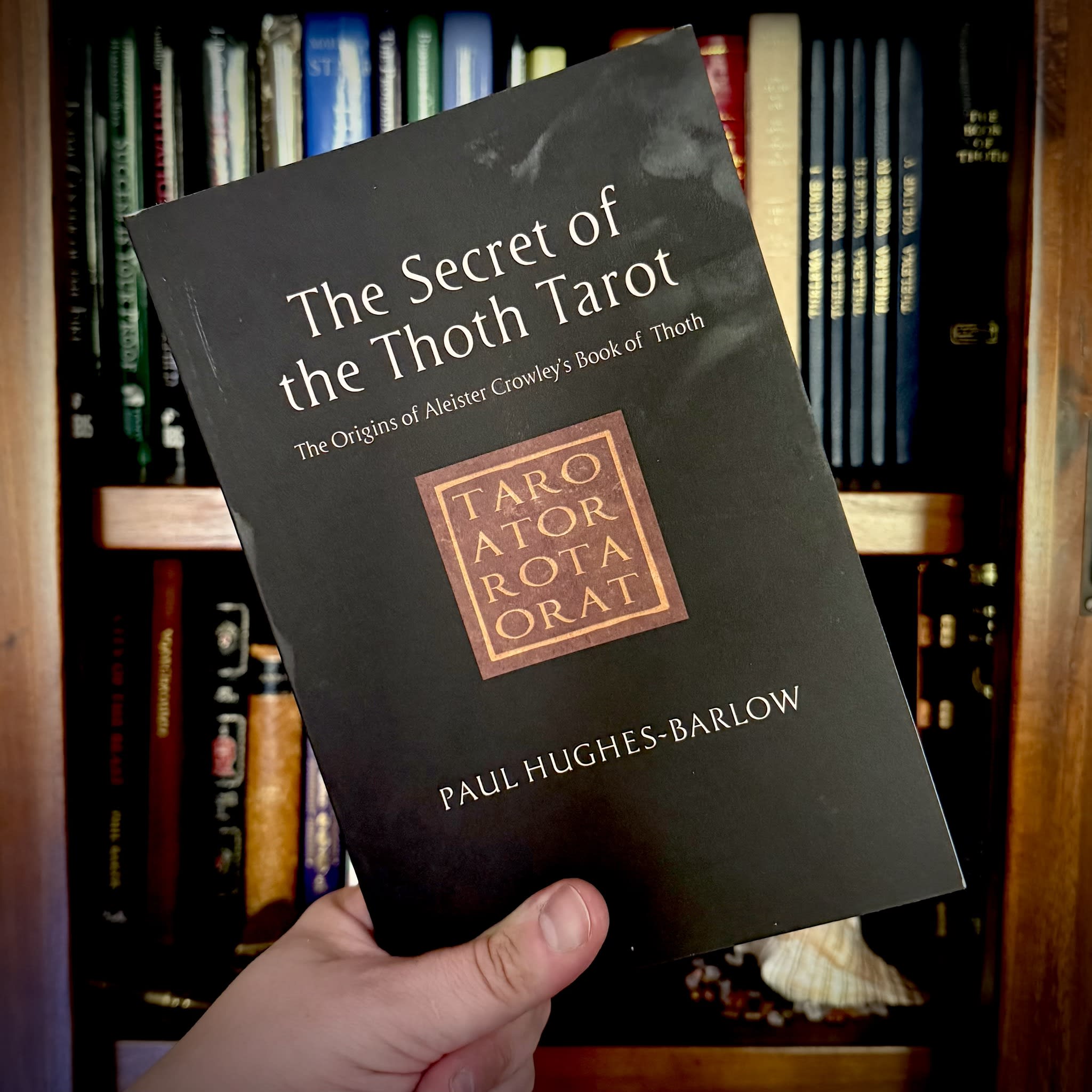
This emphasis lands. Crowley’s original Book of Thoth was already more a theurgic atlas than a fortune-telling guide, mapping the trumps into Qabalah, the Naples Arrangement, and the Great Work. Hughes-Barlow’s commentary stays in that current, helping readers actually work with those correspondences rather than admire them at arm’s length. If you want to understand why Crowley insists the Wheel of the TARO is the one wheel that “avails thee consciously,” and how that wheel becomes a ladder beyond the Abyss, this book gives you the scaffolding.
Where the book really shines is in its “Emergent Inspirations.” Essays on gematria, Kant in Crowley’s worldview, and “TARO as a Map of the Universe” push the discussion past rote correspondences into lived practice. A chapter on BABALON and ABRAHADABRA sits beside a study of Allan Bennett’s hidden influence, and the material on “the initiated view” reads like a seasoned practitioner helping you orient yourself in the storm.
Hughes-Barlow also treats the deck as a magical instrument, not just a text to decode. The foreword flags three new working patterns for invocation — ABRAHADABRA, Vision of 231, and 6°=5° — and the appendices include invocations and “Magick via the Princesses,” inviting readers to use the cards as keys, not just symbols. That practical, initiatory bent is the heartbeat of the book.
Verdict: readers hunting card meanings will be disappointed. Readers who recognise the Thoth as a ritual machine and a curriculum of consciousness will find real gems here, the kind you only uncover after years of turning the Wheel with intent. If Crowley’s Book of Thoth is the mountain, The Secret of the Thoth Tarot is a set of lines and holds that make the ascent possible without ever pretending it is easy.
Thanks for reading Magick Without Tears with Marco Visconti! This post is public so feel free to share it.