WALKING THE CITY OF THE BEAST with JOHN ROGERS
I have to begin with an admission. I am a massive fan of John Rogers. Not a casual fan who dips in once in a while, but the sort of dedicated viewer who lets his walks play in the background while answering emails, who pauses the video to look up an OS map, who buys the books, and who then spends an afternoon retracing the route in real life.
Magick Without Tears with Marco Visconti thrives on reader support. By choosing a paid subscription, you help keep new posts coming and fund ongoing research and writing. Thank you for considering a paid subscription to support this publication.
I discovered his work in 2018, which, looking back, feels like very good timing. London was already shifting again after the Olympic euphoria and the Brexit hangover, and I was in the middle of writing the material that would become The Aleister Crowley Manual, thinking very hard about how place shapes magic and not only the other way around. Then here comes this filmmaker, writer, and walker whose YouTube channel is basically a love letter to London in motion, and whose books This Other London and Welcome to New London insist that the city is never finished and that the overlooked corner is very often the key to the whole plan.
I liked him so much that I thanked him in the acknowledgements of both my books, the one already out and the one arriving later this year, because his way of moving through the city informed how I wanted to move through occult material. I wanted to show that the Western Esoteric Tradition is not all rarefied temples and remote abbeys. It is also pavements, bus routes, pubs where people argued about ritual grades, tenements where a poet and a Beast once lived above a shop. Watching John made me remember this.
So when he wrote to ask whether I would join him for an esoteric London walk devoted to Aleister Crowley, the answer was immediate. Of course. It was a no-brainer.
The video that went up on his channel is exactly what it says on the tin. John does what he always does. He takes a part of the city that most people hurry through, and he drifts into it, letting the camera serve as a second pair of eyes. Only this time, he invites me to be the magical tour guide, so the walk becomes a conversation rather than a monologue. We are not only walking through central London. We are walking through the wake of a person whose presence still clings to certain buildings and street corners. Crowley called London “dear, vile London.” He always came back. We get to show why.
Our route picked up a thread that I had already explored in my own Crowley Crawl events, but filtered through John’s psychogeographic lens.
You look up at the windows and you imagine Allan Bennett giving Crowley meditation instructions above the roar of traffic. You imagine how close the Golden Dawn temple at Mark Masons’ Hall was, and how perfectly that fits the narrative of a city teaching a magician how to be a magician.
We began at Cleopatra’s Needle, which felt perfect. Here you have a 3,500 year old obelisk carved for Thutmose III, hauled from Heliopolis to Alexandria, gifted to Britain in 1819, nearly lost at sea on the way over, and finally raised on the Victoria Embankment in 1878 with full Victorian pomp and a certain Masonic flavour to the ceremony. It already vibrates with that curious London feeling where imperial pride, Egyptomania and river magic are stacked on top of one another. So John and I met there, under the two bronze sphinxes, looking out over the river, and I remember thinking that if you want to tell the story of magick in London, you could do a lot worse than to start at an imported sun pillar that should by rights be in the desert but is instead watching the buses go by.
No occult walk through London can ignore the Atlantis Bookshop, so of course, we stopped to talk about it. Atlantis is one of those living reliquaries. Since the 1920s, it has seen everyone from Gerald Gardner to Dion Fortune to Crowley himself pass through, and it has managed to survive wave after wave of London redevelopment. I always tell students that if they want to understand occult London, they need to go into Atlantis, buy a book, and listen to the stories the shelves are telling. John understands this instinctively. His camera lingers on storefronts and doorways as if they were faces. We spoke about how Atlantis later published the illuminated edition of The Book of the Law and how it remains a crossroads for magicians, pagans and the simply curious.
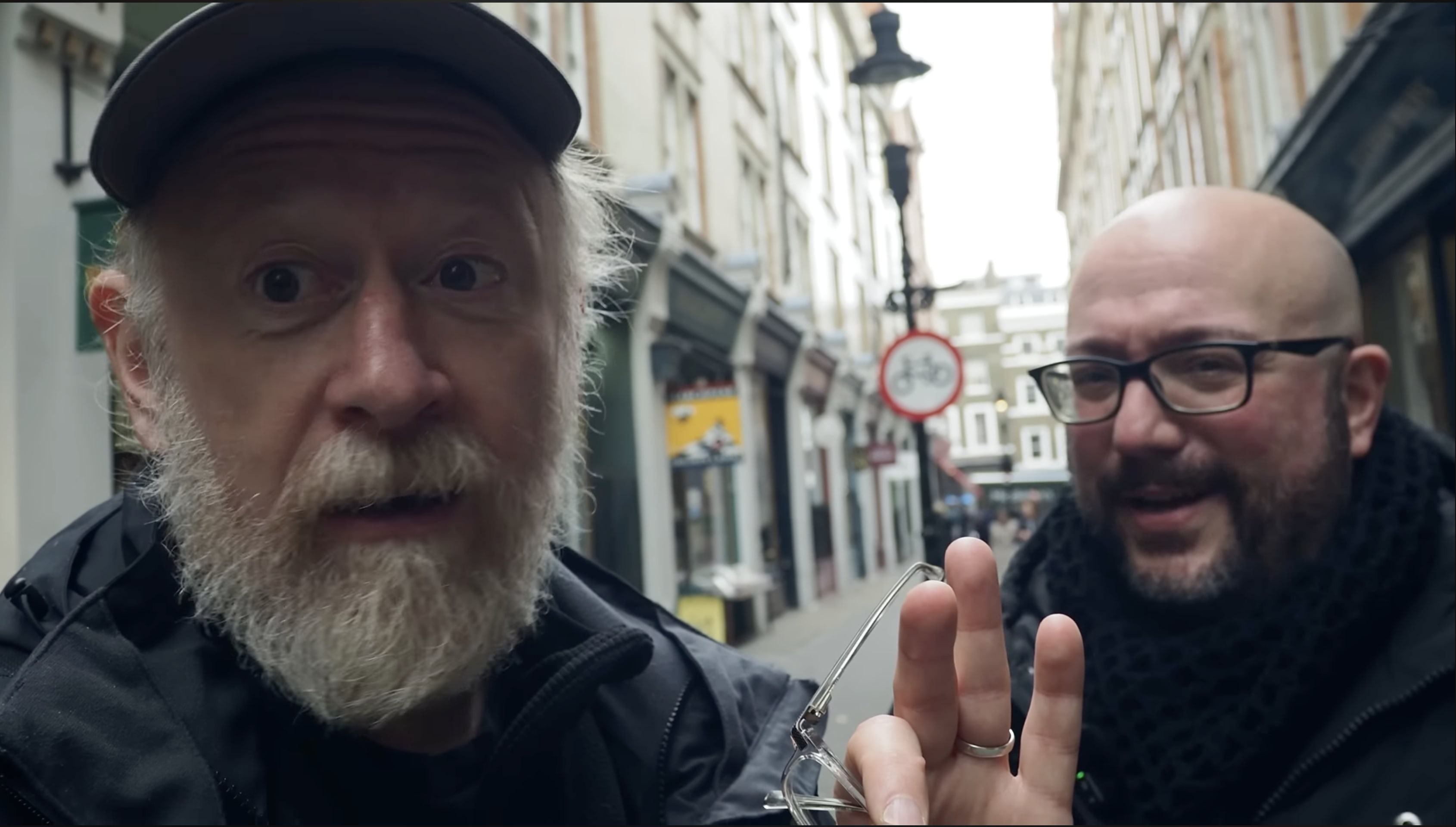
At some point, I remember saying to John that what he does with London is very close to what I try to do with Crowley. He does not tell you only the official, authorised, respectable narrative. He notices the desire lines people have worn into the city. He notices the ghosts. He likes what the Situationists used to call the dérive, the purposeful drift, and he has made a whole body of work about how a drift through the modern city can become a form of secular pilgrimage. That is exactly how I think about following Crowley through London, or Dion Fortune, or Austin Osman Spare. It is a pilgrimage without piety. It is a hunt for the places where spirit and brick once touched. John’s love for London is so generous and so stubborn that you cannot help catching it.
What struck me, watching him work that day, was how careful and patient he is. He does not just point the camera and walk. He frames. He listens to the street. He lets the buses pass so that their red bodies become part of the shot. He lets the voiceover breathe. When we talked about 93 Jermyn Street, where Crowley lived toward the end of his life and where he could look across to the garden of St James’s Church, John immediately started looking for the angle that would allow the viewer to see both the residence and the square. That is what a good psychogeographer does. They choreograph your attention. They make sure you see what the place wants you to see.
I have written before that John is an urban shaman of sorts. He would probably laugh it off, but I stand by it. He has this rare ability to stitch together folklore, municipal history, topography, film, and the odd bit of Forteana into a single narrative of place, and he does it without losing his sense of humour. He can spend five minutes telling you about the lost rivers of the Fleet or the Tyburn and then pivot into talking about psychogeography, hauntology and the way certain corners of London feel thicker in time than others. If you watch his channel, you know what I mean. He can start in a park and finish in the 1970s without ever leaving the footpath.
That is also why his work has had an impact on my own. When I was working on The Aleister Crowley Manual, I wanted the book to do something similar, to show students that magick lives in the present tense and in the streets they walk every day, not only in remote mountain ashramas or retreats. When I finished the manuscript for Aleister Crowley’s Mysticism: A Practical Guide, I thanked him again, because his videos had kept me company through the long nights of drafting and redrafting. If you watched London disappear and reappear on his channel during the lockdowns, you know the kind of company I mean. It is the reassurance that the city is still there, that the river is still flowing, that the stories are still worth telling, even if you cannot step outside yet.
Filming the walk with him was also a lesson in how form influences perception. On my own Crowley Crawls, I speak to a group. I look at faces. I modulate the energy in the moment. With John, I had to speak to a lens, trust that the viewers would hear every nuance, trust that some editor magic would later weave together the map, the voiceover and the walk into a single spell.
It reminded me of how Thelema itself was born. Crowley walked through Cairo; he visited the museum; he listened to a voice, and then he wrote a book. The book became a current. A century later, I am walking through London with a friend, listening to the murmur of buses and the rush of the West End, and the current is still alive.
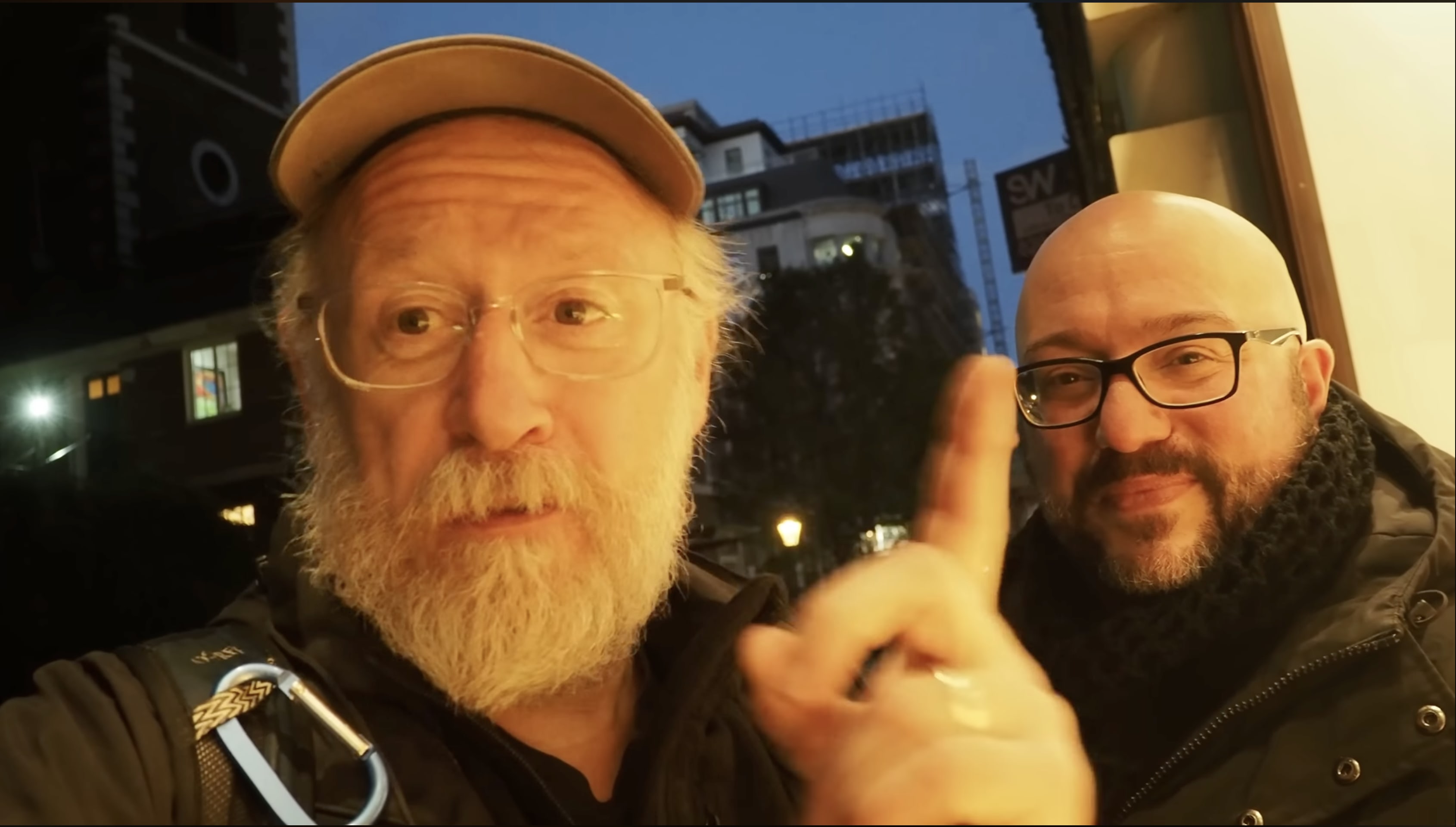
What I liked most about the finished video is that it shows what I have been repeating for years. Occult London is not an abstract idea. It is a lived, walkable archive. You can begin at an ancient obelisk by the bank of the Thames, trace a line to an old bookseller near the British Museum, then down toward Regent Street to stand before the building where the Great Beast chanted in the language of the Angels, and you will have in your body the memory of a magician’s career. You will have performed a sort of rite yourself. And if you do it with a guide who loves the city as much as John does, you will also have proof that psychogeography and practical magic are not separate disciplines. There are two names for the same longing to see through the surface of things.
So yes. This was a fantastic experience. It felt like two long-standing obsessions of mine finally shaking hands.
On one side, my insistence that Aleister Crowley is a London writer and magician as much as he is a world traveller. On the other side, John’s long project of revealing that every street in this city contains stories if you are willing to slow down. There are few things better, on a clear London afternoon, than walking with someone who pays attention to the same things you do.
If you enjoyed the video, watch it again with a map open. Mark the sites. Then come walk them with me on the next Crowley Crawl, or walk them on your own on a quiet weekday evening. Bring along John’s books, because they are the perfect companions, and because it feels right to keep this conversation between walkers, magicians and city lovers going.
The city is generous. It likes to be walked. And every time you walk it with intent, it will give you another secret.
Thanks for reading Magick Without Tears with Marco Visconti! This post is public so feel free to share it.