On Allyship + Book Recommendations for Empathy: Personal Curriculum series
For those who don’t know, I identify as a cisgender woman, third generation immigrant background (my grandparents came over from Jamaica and Ireland), bisexual, biracial (white and black Caribbean), atypical brain (I feel I am neurodiverse but I am not diagnosed with a difference; I take medication to stabilise my mental health though), and I am married to a cisgender man so I am straight-passing.
Therefore, when I speak about LGBTQ+ rights and immigration and refugees and gender norms etc., I am talking as an ally more than someone with direct, firsthand, personal experience.
Excerpt from my journal entry this morning:
I will always remember what a family member said to me when I was young, that I am “too defensive and that I always defend people who don’t need it, which causes conflict”. In this stage of my life, I take this as a compliment. He was describing allyship.
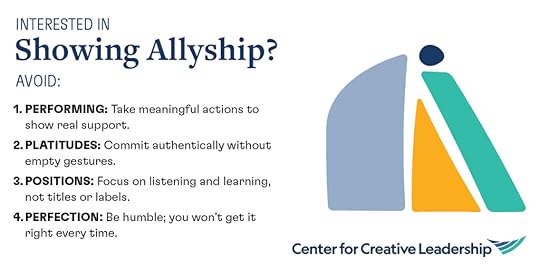 Image taken from Centre for Creative Leadership
 He also said that I am not the morality police. As in, I am not that one true voice of what’s good and ethically/morally right. He is right. I am not. Except, honestly, sometimes I do think I am. And this is a flaw, yes, but also something I like about myself (when done fairly!). That I search for the right and just and fair thing, always.
I had the Peacekeeper role in my family for so long. Perhaps this is part of the reason why I feel the need to combat injustice, stand up for the little guy, and find moral equity now. What is the root of all this? I think simply that it is a need for peace for fear of the opposite. Calamity, inequality, and division are a breeding ground for violence, pain and chaos. It makes complete sense that I would fear that.
I want fairness for all. I want everyone to feel safe because I know firsthand that not feeling safe and secure in who you are hurts deeply. It’s depressing and makes you want to end it all, just to escape that feeling. I can only imagine the anguish of feeling hate overtly from the society and community you live in. How that would chip away at you until there’s nothing left.
And that is cruel. Fact.
We can have our different beliefs culturally and socially (on gender norms and sexuality etc.) but it is never, EVER, okay to make someone (or a group) feel they can’t live their lives. To be that person chipping away at them until there’s nothing left.
Instead, drop the chisel, reach out a hand, lend an ear and a shoulder, and borrow their shoes for a moment.
Is that too much to ask?
Why am I writing this? Why say anything? Because I want to be the reason someone stays: in this country, or in this life. Not the reason someone goes…
 Part Two: Book Recommendations for Empathy and Understanding
Here are some book recommendations based on marginalised groups and communities to better educate and disrupt our biases. To bring us together with empathy and compassion. This is a means of “walking in their shoes“, as I urge us all to do.
A few disclaimers / explanations:
I hate categorising their books by race or gender or religion or sexuality etc. I just felt I needed to, to help you diversify your reading. Authors are more than just their labels. Their books can be (and are!) incredible all on their own, without being worthy only because they are different from the mainstream. But diverse books are a statement. Representation and own voices matter.
Secondly, I, of course, don’t know the races, religions or sexuality of most of the authors I read! Unless I’ve heard about them from someone recommending their work based on their identity / group. I’ve not researched these things for this post. I am only sharing ones that I already knew, and if I’m wrong on any, I do, of course, apologise.
Thirdly, authors don’t need to write about their struggles in society as part of their identity / group. Black authors don’t need to write about slavery and racism. LGBTQ+ authors don’t need to write about coming out and homophobia or transphobia etc. Instead, reading their books is a message, a symbol of support, and puts money in the pockets of people outside the dominant social group of the West. Simple as that.
Lastly, to ensure the integrity and authenticity of this post, I will only recommend books that I have personally read, but I will link to a booktuber who talk about books from these communities at the end. And please don’t be overwhelmed by the list! Just go slow. Make a point of reading one or two books outside your comfort zone before the end of the year. And then add some to your list for next year. You don’t need to become a diverse reader overnight!
(I don’t endorse buying from Amazon, but sadly, it’s the easiest place to link to. Buy secondhand and support independent bookstores if you can! Or source from your library, please!)
Books by black authorsHere’s a post I’ve done previously on black authors and another on books recs for black authors as there’s no point in recommending the same books over and over again!
Some new additions to the lists above:
Glory and by NoViolet Bulawayo (satire, history, Zimbabwean culture)
Real Life, by Brandon Taylor (dark academia, LGBTQ+, racism)
Blonde Roots by Bernardine Evaristo (alternative world/history)
Queenie by Candice Carty-Williams (realism, London)
A Blade So Black by L L McKinney (fantasy)
Books by Asian authors (big continent, big difference in ethnicity, let’s try cover all bases)Fiction:
(A lot of my recs here are Japanese books/authors because I love Japan and always wanted to go so I’ve read a lot of their literature)
Any R F Kuang book won’t lead you wrong! But for an education as well as entertainment, try Babel (I’ve seen some criticism online that Kuang is taking over as “THE diverse author” to read, but I love her work and I strongly recommend you read them as well as lesser-known Asian authors!)
Convenience Store Woman, by Sayaka Murata
The Book Eaters, by Sunyi Dean
Before the Coffee Gets Cold, by Toshizaku Kawaguchi
The Last Children of Tokyo, by Yoko Tawada
How Do You Live, by Genzaburo Yoshino
Lonely Castle in the Mirror, by Mizuki Tsujimura
The Travelling Cat Chronicles by Hiro Arikawa
She Is A Haunting, Trang Thang Tran
Black Water Sister, by Zen Cho
The Reading List, by Sara Nisha Adams
The Downstairs Girl, by Stacey Lee
The Life of Pi, by Yann Martel
The Very Secret Society of Irregular Witches by Sangu Mandanna
An Ember in the Ashes by Sabaa Tahir
Five non-fiction :
Crying in H Mart, by Michelle Zauner
This Is What I Talk About When I Talk About Running, by Haurki Murakami
Books by Latinx authorsThe Brief Wondrous Life of Oscar Wao by Junot Diaz
The Dangers of Smoking in Bed, by Mariana Enriquez
Books by Native American or Australasian authorsFiction:
Greta and Valdin, by Rebecca K Reilly
Boy Swallows Universe, by Trent Dalton
Non-fiction:
Braiding Sweetgrass, by Robin Wall Kimmerer
Books by Jewish authorsNotes on an Execution, by Danya Kukafka
Tomorrow and Tomorrow and Tomorrow, by Gabrielle Zevin (all time favourite book)
Non-Fiction:
Books by LGBTQ+ authors or about LGBTQ+ charactersFiction:
The Seven Husbands of Evelyn Hugo and Atmosphere by Taylor Jenkins-Reid
Bury Our Bones in the Midnight Soil, by V E Schwab
Our Wives Under the Sea, by Julia Armfield
They Both Die At The End series and History is All You Left Me, by Adam Silvera
Legends and Lattes, by Travis Baldree
Aristotle and Dante Discover the Secrets of the Universe, by Benjamin Alire Saenz (also Latinx author and characters)
The House by the Cerulean Sea, by TJ Klune
Five non-fiction:
This Book Is Gay, by Juno Dawson (also on trans experiences / explanation)
Can Everyone Please Calm Down: A Guide to 21st Century Sexuality by Mae Martin
Books by trans authors or about trans charactersFiction:
Detransition Baby by Torrey Peters
Books by disabled and neurodivergent authors or about disabled charactersFiction:
The Curious Incident of the Dog in the Nighttime, by Mark Haddon
A Mango Shaped Space, by Wendy Moss
Non-Fiction:
It’s Not What It Looks Like, by Molly Burke
Different Not Less by Chloe Hayden (own it, haven’t yet read)
Strong Female Character by Fern Brady (own it, haven’t yet read)
Books about disadvantaged people and povertyFiction:
Non-Fiction:
Poverty Safari by Darren McGarvey (husband has read not me)
Chavs: The Demonisation of the Working Class by Owen Jones (I’m partway through)
I’m so glad I wrote out this list as it shows where my own reading needs to diversify for next year! Let’s do it! Let’s read and elevate all voices. Representation and own voice authors / narratives matter in publishing and the entertainment industry. We the public need to show these industries that we want more diversity, inclusion and representation.
Reading is activism. Reading is allyship. Reading can change the world.
Go follow Starry Steph on YouTube as she has a brilliant eye for diverse books!
Lastly, an interesting looking Netflix documentary that should definitely help with empathy, education and inclusion! You Can’t Ask That! on Netflix
Sincerely,
S. xx