Essay on Gender Part One: My Femininity
I am going to write quite a vulnerable post here. Opening up about my own thoughts and feelings about being a woman and why I struggle with gender binaries in society. This post is not for anyone who may be triggered by difficult conversations around gender identity.
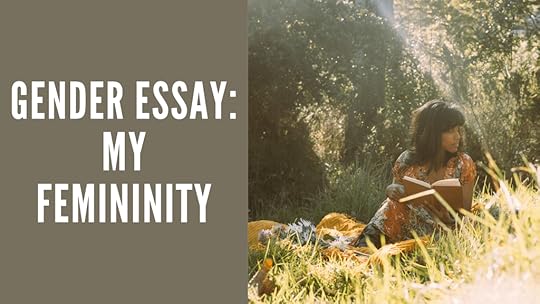 Part One: My Femininity
I am a cisgender female. As I’m writing this, I ask myself, what makes me feel feminine?
Pretty dress or skirtA nice blouseMy hair pinned back in a pretty clip, showing my nice earrings A great pair of boots Cute, cozy hobbies and aesthetic like reading, writing, candles, yoga, blankets, fluffy socksWhen my curves are accentuated When my body is admired by my husbandBut this seems a list of things that make me feel beautiful, no? Is that what femininity is? Beauty? Aesthetics? Sex appeal? Male gaze? Being cute and dainty?
Am I brainwashed by the patriarchy or is it actually my own idea?
I sometimes dress in a way that I know will make me look attractive to men. Tighter clothing, accentuating my curves, or something low cut, or that shows off my legs. Is it anti-feminist to do this? Is it immoral? Is it a double-standard because we can’t ask to be seen as sexually appealing while also berating men for objectifying and sexually leering at our bodies? Can we not feel sexy, in a patriarchal way perhaps, as well as fight for the rights of women’s safety?
And really, this isn’t femininity. It’s an expression of femininity. Yes, there is a difference. But we’ll get into that in parts two and three.
VaginaIt’s hard to have a vagina sometimes. The issues that come with having one. The brutality of the phallus and penetration as a concept…it does get to me sometimes. The literal and figurative power of the penis versus the vagina. Something that penetrates (the penis) and something that is penetrated (the vagina). It’s a power struggle. It’s a powerful image. One that may have caused our world’s views of men and women.
No wonder we are seen as the weaker sex.
And yet, the penis is much, much weaker than the vagina is! By a long shot!
Many times have I wished that I wasn’t a woman. Things just feel simpler for men. I know they have their own struggles, of course, but I have wished it, I admit.
To walk into a room and have a presence right awayTo not fear walking the streets aloneTo be considered a more natural leader To not fear rape as much as we doTo not have to bleed every month To not have crazy hormone cycles and constantly be blamed for it like it’s your fault To not have to bear the burden of childbearing and giving birth and being the default dominant parentMotherhoodI have something I call “the motherhood problem”. Where I feel damned if I do and damned if I don’t. Where I don’t feel myself pulled one way or the other. I just know I doubt my own strength for motherhood. The way it breaks a woman, when I am already rather chipped and stained to say the least. People talk about motherhood and child-rearing like it’s so natural. But it can’t be for everyone, right? And I envy the fact that it’s more socially acceptable for men to not want kids than it is for women.
I feel like I won’t be a fully realised woman unless I have a child. And many woman think that you’re better if you give birth naturally, too. Or if you get help with child care, you’re not a good enough mother. There seems to be this hierarchy and it’s very rude and confronting to be honest. Why should I feel less for not having children, or choosing to have and raise them my own way?
I really don’t know that I could cope with the trials of motherhood, and does that make me weak? Less of a woman? Never be called a strong woman?
WeaknessAny sign of weakness, emotion, vulnerability, opening up and shedding a tear is seen as feminine. It’s a word weaponised by some men against other men. “Don’t act like a girl” they say when a man shares his feelings or cries. Why? Why is showing emotion synonymous with being female and why is this a negative for men? For decades, the worst thing you could call a man was a “girl” (and variations of this such as bitch, chick, pussy) or “gay”. And gayness is seen as feminine too. To be a gay man is to be more feminine. To be weak. Again, more on this in part two.
But I’ve learned over the years that my weakness has led to my strength. Struggling with my mental health and being the “sensitive” one in my family – even though they all are, they just are quick to anger and cursing and rage whereas I’m quick to tears – made me strong. It made me able to hold the pain of other others = empathy. It made me able to speak openly and honestly about difficult things, thus making others feel comfortable to do the same. It’s made every new battle that little bit easier to deal with.
As my grandad told me, god only gives this hardest battles to his toughest soldiers.
I must be quite tough.
Women have been branded the “gentler sex” but our softness is our strength. It takes immense strength to stay calm, to express our feelings (vulnerability is strength), to nurture, care when caring is hard, and hold space for others. We have to be strong when bearing children, our bodies going through a metamorphosis to make space for another being inside of us. Tearing our bodies apart to bear that child unto the world. And then supporting that child throughout their lifetime.
And our strength isn’t just in motherhood, for I am not a mother and may never be. I see our strength in enduring menstruation every month and rigorous hormonal cycles we are barely taught to understand, but must bear alone. Taking contraceptives that will alter our brain chemistry and hormones to the point of poor mental health, yet no one bats an eyelid and they continue to push this on young women. We bear the poor knowledge and advancement of medicine to deal with our natural, everyday struggles. A society mostly run by men who have no idea how we live.
WomenIt upsets me that there is so much discourse between women. We have fought for our rights over decades only to tear each other apart now. A lack of intersectionality and plea for the rights of ALL women, means we are letting each other down.
I am a feminine woman. I like some traditional ideas of women, like cooking and cleaning. I’m a very kind and naturally nurturing person. I don’t know if I want children though, which some people believe is my natural instinct. I like to do yoga but I also like sprinting, punching things and weight lifting. I’ve always been naturally strong and fast. I have a muscular built without much effort. I sometimes hate my vagina, but I like my breasts. I like jewellery. I like dresses and skirts but mostly wear jeans and leggings with jumpers. I like my hair pinned up. I like dancing and singing. I also like video games. I did GCSE PE and got an A*, being a very sporty girl and one of a low number of girls in my PE class. I like education. I like deep conversations. I think myself a philosopher sometimes!
I like being right and I’m overly competitive. My uncle used to say that I was too aggressive and violent to ever attract a man. I am attracted to men and women, but find the female form more naturally beautiful. I like every genre of film except romances and musicals. I’m a huge nerd. I cry all the time, and would sooner cry at an animal dying than a human.
I am a woman. And I have never thought that my expression of my womanhood or femininity was ever what another woman should be.
I’ve hated the way I walk, that my body isn’t very curvy, my hair doesn’t swish. I have broad shoulders and a stocky build. But I’m not less of a woman because of those small things.
I do not feel my femininity is in jeopardy if a woman exists differently to me. If they were born with the sex of a man and then realises they are truly a woman. If they have a vagina but don’t call themselves a woman. If they enjoy and adore motherhood, or don’t. Desire to be a “lady boss” or to stay at home with the kids. Whether they are a muscle mommy or a yogi. It matters not.
There is no brand of femininity that I fear, other than women hating other women, and a lack of intersectionality in fighting for women’s rights.
I believe that masculine energy and feminine energy are therefore not mutually exclusive. They’re not opposing forces. Not polarised forces. We each have both.
Read Part Two on Exploring Gender Identity here.
Sincerely,
S. xx