Review: Althea by Madeleine Robins (1977)
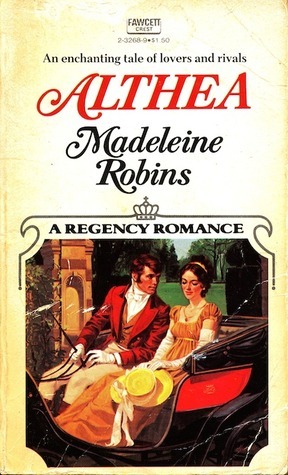 This one was a joy to read. The exchanges between hero and heroine are genuinely witty, both are interesting characters, the side plots are realistic and it’s beautifully written.
Here’s the premise: Althea Ervine is treated more like a housekeeper than a daughter of the household. Her father and brother seem incapable of managing without her, but when she tires of being taken for granted and escapes to her married sister in London, Mary takes up her cause with enthusiasm and determines to rig Ally out in fashionable style and give her a wonderful time.
And a wonderful time she does indeed have, being pursued by handsome, charming Edward Pendarly, and then there’s Sir Tracy Calendar, with whom she exchanges scintillating and witty banter (which is genuinely funny, by the way, unlike much so-called witty banter to be found in modern Regencies). Sir Tracy — actually, hold it right there for a moment. I hate, hate, hate this as a male name, but I’m told it is an authentic Regency name, so… {shrug}. But authors, please don’t be tempted.
Where was I? Sir Tracy {rolls eyes} makes some cryptic remark about Pendarly, which is actually intended to warn Ally that he is already betrothed (as the reader already knows), but Ally takes it as a curmudgeonly insult against the handsome, charming etc Edward, and decides to dislike Tracy. When she finds out the truth, and Tracy takes the opportunity to rush to a proposal, she accepts in a fit of pique.
So far, so very conventional Regency. It’s a pity that heroines don’t establish, with every offer from the hero, his precise reasons for making it, so that they don’t agonise for endless chapters over it, and would find out at once, instead of waiting for 200 pages, that he loves her, but then I suppose most novels would collapse to the length of a short story. Anyway, Ally doesn’t, but her agonisings aren’t as tedious as such things usually are, partly because Tracy understands her state of mind perfectly and makes allowances, and partly because he displays just that degree of unruffled calm in the face of her turbulence that is so appealing in a hero. I can cope with a heroine who gets in a tizz, but there are very few heroes who are improved by such behaviour.
Tracy lapses into a bit of a tizz himself late in the book, which I thoroughly disapproved of. Heroes who want to win their lady in the end need to stick close to her, and for heaven’s sake, how hard can it be to tell her you love her? But no, Tracy goes wandering off, and then has to do some chasing to catch up with her, and convince her that he really does love her. But of course he does the right thing in the end, and all ends just as expected.
There are a few anachronisms but nothing to stop me enjoying this totally. Five stars.