BOOK REVIEWS and NEWS
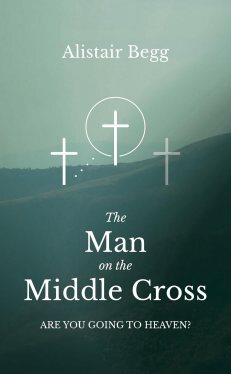 The Man on the Middle Cross: Are You Going to Heaven? by Alistair Begg. 10Publishing. 32 pages. 2025
****
In this short book, Alistair Begg shares three powerful stories. Each one records a conversation that alters the course of a life. These encounters are all found in the Bible.
The first story comes from John 4: 3-30; 39–42. This is the story of the Samaritan woman’s encounter with Jesus at the well. Carefully, Jesus points to the woman’s need for personal forgiveness and for salvation. A true encounter with God and real transformation always begin here.
Begg writes that the standard picture in our culture is that God is playing hide-and-seek and doesn’t want to be found. But the account we have in the Bible is the reverse of that. We are the ones who have gone into hiding. Jesus comes looking for each one of us – not to condemn us but to offer us living water, the fulfillment that each of us longs for.
Note: Please be sure to watch this 4 minute video.
Click on ‘Continue reading’ for:
BOOK REVIEWS ~ More of this review and a review of Truths We Confess: A Systematic Exposition of the Westminster Confession of Faith (Revised Edition) by R.C. Sproul
BOOK NEWS ~ Links to Interesting Articles
BOOK CLUB ~ Truths We Confess by R.C. Sproul
I’M CURRENTLY READING….
The second story comes from Mark 2:1-12. This is the story of the man who was lowered down to Jesus through a roof. He went with his friends hoping that his legs would be healed. That is what he longed for more than anything – to be able to walk for the rest of his days, to get a job, and to look after his family. But Jesus gave him something much greater. He forgave his sins and opened the door to a relationship with God.
The third story comes from Luke 23: 39-43. This is the story of the thief on the cross.
Begg writes that he often thinks about that thief on the cross, and is looking forward to the day when he comes across him in heaven, when he will ask him about what happened to him that day.
Begg writes that salvation is a gift. It’s pure grace from start to finish—unfiltered, unearned, freely given. He tells us that at the heart of the Christian faith is this incredible exchange: Jesus, the sinless Son of God, took the punishment that we deserve so that we could receive the forgiveness we can never earn.
Begg asks us to consider when we stand before God at the end of our life, what will our answer be when he asks us why he should let us into his heaven? Will we list our own achievements, hoping they will be enough? Or will you simply say, “The man on the middle cross said I could come”?
Begg writes that the Samaritan woman discovered that Jesus is the one who offers real fulfillment. The paralyzed man found that Jesus can forgive sins. The thief on the cross realized that Jesus could promise him a place in God’s perfect heaven forever. He tells us that Jesus makes those offers to you and to me. Your thirst can be quenched. You can be healed. You can come.
He states that we can respond to Jesus’ invitation by saying a prayer like the one that is listed in the book.
This is a helpful book that can be read in less than an hour, and is priced so that you can give copies away to friends and family.
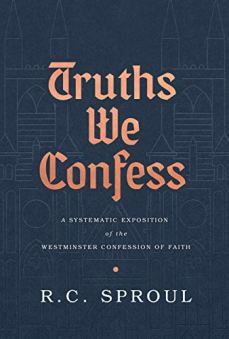
 Truths We Confess: A Systematic Exposition of the Westminster Confession of Faith (Revised Edition) by R.C. Sproul. Ligonier Ministries. 756 pages. 2019
****
In the “Foreword” to this book, Sinclair Ferguson writes that few things will do you more good or set you on a safer path than to sit at R.C. Sproul’s feet and read through his exposition of the great doctrines of the Christian faith. He tells us that this is a book for every Christian home and family and one that will be especially valuable for younger Christians setting out on the way.
Sproul writes that The Westminster Confession is the most precise and accurate summary of the content of biblical Christianity ever set forth in a creedal form. It was designed in the seventeenth century by Puritan divines to set forth the system of doctrine that is found in sacred Scripture. It is one of the most important Protestant confessions, for it gave substantial definition to Reformed theology in the seventeenth century.
This exposition of the Westminster Confession of Faith is not written in a technical, academic way but instead is designed to be accessible to the lay reader.
This volume, of more than 750 pages, takes you through the thirty-three chapters of the Westminster Confession of Faith. The Westminster Larger Catechism and The Westminster Shorter Catechism are included as appendices.
I highly recommend this volume as an introduction to the Westminster Confession of Faith.
As I read through this book, I highlighted a number of passages. Here are fifty helpful quotes from the book:
The Spirit works with and through the Word, never apart from or against it.Always interpret the implicit in light of the explicit, the obscure in light of the clear. These underlying principles in the Reformed doctrine of hermeneutics presuppose that the Bible is the Word of God.What the Holy Spirit inspired in one passage helps us understand what He inspired in another. We must interpret Scripture by Scripture.When we say that God is all-powerful, almighty, omnipotent, we mean that His power surpasses everything in the universe. Nothing can resist His power or overpower Him.The term holy is used biblically in two distinct ways: to refer to God’s otherness, the way in which He is different from us and transcends all created things, and to refer to His moral perfection.The Reformed faith teaches that human freedom is real but limited by God’s sovereignty. We cannot overrule the sovereign decisions of God with our freedom, because God’s freedom is greater than ours.The purpose of prayer is not to change God’s mind but to change ours, to bring us into communion with Him, to come to our heavenly Father and tell Him what is on our hearts.We have worth because God says so, because He assigns value and importance to human beings, and because He has made us in His image.The Reformed doctrine of predestination is called unconditional election. It teaches that election is based not on people’s meeting conditions but on the eternal decree of God Himself.God is glorified by the judgment of the wicked in hell just as much as He is glorified by the rescue of the saints in heaven. On the one hand, God’s mercy is made manifest. On the other, His justice is made manifest.In our fallen nature, we have a desire for sin. At the moment of sinning, we want to sin more than we want to please Christ and obey God. Otherwise, we would not do it.The concept of covenant, which provides the structure or framework of redemptive history and of the whole scope of theology, is vitally important. It provides the context within which God reveals Himself to us, ministers to us, and acts to redeem us.The classic formula for the Trinity is that God is one in essence, being, or substance and three in person.Christ has both a human nature and a divine nature, and those two natures are perfectly united in one person. The divine nature of Christ during the incarnation was fully divine. Christ did not give up any divinity when He took upon Himself a human nature.The Reformation view is that the physical nature of Jesus ascended into heaven and is there now—not anywhere else. But His divine nature is never absent from us.From all eternity, God has planned to save certain people, the elect. They will all certainly be saved because His decree of election cannot fail.What we affirm is that Christ’s death was intended to cover only the sins of the elect. He did not intend to die for the nonelect. Though His sacrifice was enough for the nonelect as well, our triune God did not have the nonelect in view when He planned and executed the atonement.The elect receive the mercy of God; the nonelect receive the justice of God. No one is treated unfairly or unjustly.We will never love Christ perfectly or love Him as much as we ought to. But if we have love for Him at all, we can be assured of our salvation.Regeneration precedes faith. You don’t have to have faith in order to be born again. Rather, you have to be born again before you can ever have faith.In justification, there is a double transfer. Our sin was transferred to Christ on the cross; His righteousness is transferred to us.When we say that justification is by faith alone, we are saying that justification is by and through our faith in Christ alone.We do not rest on anything else in our lives except Christ and His righteousness for our salvation.The Bible teaches that justification is by the possession of faith and not by the mere profession of faith.Effectual calling is the Holy Spirit’s work of bringing about a change in someone. The change that is brought about in and through the effectual call is regeneration.The gift of faith is given to all of God’s elect and to no one else, because from all eternity God has had a plan of salvation that includes a certain number of people whose names He knows. He has moved heaven and earth to secure the salvation of the elect.The Holy Spirit changes the disposition of the heart, to be sure, but the ordinary way by which the Spirit does that is the ministry of the Word. He gives the gift of faith through the power of the Word.Our growth in sanctification is directly related to our growth in faith, because our growth in faith is closely related to our faithfulness. The more faithful we are, the more sanctified we become. We must work hard to strengthen our faith.A Christian can fall radically and seriously but not fully and finally.If repentance is not preached, the message is a false gospel.Christians do not need to worry about committing blasphemy against the Holy Spirit because the Holy Spirit Himself restrains us from doing so if we are ever tempted to do so. It is by God’s grace that we do not do it.Our good works do not contribute anything to our justification, but if we are truly people of faith, the goal of our lives should be to please God and to seek first His kingdom and His righteousness.If we have any true faith at all, it will manifest itself in works of obedience and in a spirit of repentance.All who are elect come to faith and are preserved in that state of faith until the end of their lives. The goal and purpose of election is completely realized in them.Our perseverance does not rest on our ability to persevere, but rather on the preserving activity of God. The Holy Spirit abides with us to this end.Probably the most prevalent doctrine of justification in modern culture is the doctrine of justification by works. Most Americans, including those who call themselves evangelicals, believe that people will get into heaven if they live a good life.We will not be judged in the last judgment by what our culture approves or disapproves, or by what our government allows or does not allow. We will be judged by the law of God. That is why it is important to understand the law of God.A God without wrath is not God. The biblical God promises to pour out His wrath with a vengeance against an impenitent, rebellious world. That day has been fixed, and we will all be there.People were saved the same way in the Old Testament as they are saved in the New Testament. They were justified by faith.Any church that is a true church has the responsibility to exercise discipline over its members. That comes as a shock to many people in the United States.The confession calls on people not only to keep the Sabbath day holy but to prepare for the Sabbath day—an idea that has been all but completely eclipsed in our culture today.The primary focus of the Sabbath day originally was to provide rest for people. So, it is not best to say that our whole time has to be taken up with worship and doing works of necessity and mercy. There is also time to enjoy fellowship and to rest.Those churches that seek to be confessional and biblical in the matter of divorce generally reduce the legitimate grounds for divorce to two: adultery and desertion.Sacraments are given in the context of covenant. The sign of the old covenant was circumcision, and the sign of the new covenant is baptism.Both baptism and the Lord’s Supper are outward signs and outward seals of the truth of God’s promises.The Lord’s Supper ought never to be celebrated without preaching, because the signs are never to be given without the Word. The Word and the sacrament may be distinguished but not separated.The efficacy of a sacrament depends not on the piety or intention of the minister but on the actual working of the Spirit and on the One who instituted the sacraments.The goal of church discipline is to bring sinful people to repentance, so that they may be restored to full, active participation in the church.All people will have their bodies raised in the last judgment. The redeemed will have their bodies raised so that they may enjoy the glorious, honorable resurrection for all eternity. The bodies of the unjust will also be raised by Christ, but to dishonor.Both heaven and hell have the same ultimate purpose: to glorify God.


Won’t you read along with us?
We are reading through Truths We Confess: A Systematic Exposition of the Westminster Confession of Faith by R.C. Sproul. From the Ligonier description:
“The Westminster Confession of Faith is one of the most precise and comprehensive statements of biblical Christianity, and it is treasured by believers around the world. R.C. Sproul has called it one of the most important confessions of faith ever penned, and it has helped generations of Christians understand and defend what they believe.
In Truths We Confess, Dr. Sproul introduces readers to this remarkable confession, explaining its insights and applying them to modern life. In his signature easy-to-understand style and with his conviction that everyone’s a theologian, he provides valuable commentary that will serve churches and individual Christians as they strive to better understand the eternal truths of Scripture. As he walks through the confession line by line, Dr. Sproul shows how the doctrines of the Bible—from creation to covenant, sin to salvation—fit together to the glory of God. This accessible volume is designed to help you deepen your knowledge of God’s Word and answer the question, What do you believe?”
This week we look at WCF 33: Of the Last Judgment. Here are a few helpful quotes from the chapter:
In God’s calendar, there is already a fixed date for the day of judgment. Each one of us will be brought before God to be judged by Christ on that date.Those who are Christ’s will have Him not only as their judge but also as their defense attorney. We will be garbed in His righteousness, which alone can meet the requirements of God.Those who are not in Christ will also appear before Him, standing there on their own, as their every idle word is judged.Both heaven and hell have the same ultimate purpose: to glorify God.Scripture is clear that both in heaven and in hell there are degrees. There are degrees of blessedness in heaven, for each person will be rewarded according to his works.It is not just unbelievers who will face the judgment of God, but also believers.It is true that we will not face condemnation, but we will still undergo an evaluation. Christ will examine our lives and determine our degree of obedience and sanctification.