Echoes of Eden
During her time at Wheaton College, Elisabeth Elliot once heard a chapel speaker say, “If my life is broken when given to Jesus, it may be because pieces will feed a multitude when a loaf would satisfy only a little boy.” Those words resonated with Elisabeth; they do for me as well.
I have witnessed this firsthand, both in my life and in the lives of countless others. Jesus does remarkable work with our broken pieces. He draws near with grace, mercy, and compassion. He forgives. He mends and restores. And he is utterly unabashed in his association with us—ready and willing to put our mended pieces on display as marks of his power to bring new life and new hope.
And yet, even knowing this truth, we often struggle to release our grip. Rather than holding our sin, suffering, and shame with open hands, we clutch them in closed fists, hiding them away. It feels too tender, too shameful, too much. We are afraid of rejection and being misunderstood. We fear being silenced, our pain minimized—or being shamed, our sins magnified. So we lock it away in hidden chambers of our hearts, rarely allowing it into the light. But God is fully committed to healing every part of us and setting us free from the shame we carry—whether that shame is the result of our own sin, the sins committed against us, or the result of living in a world tainted by sin.
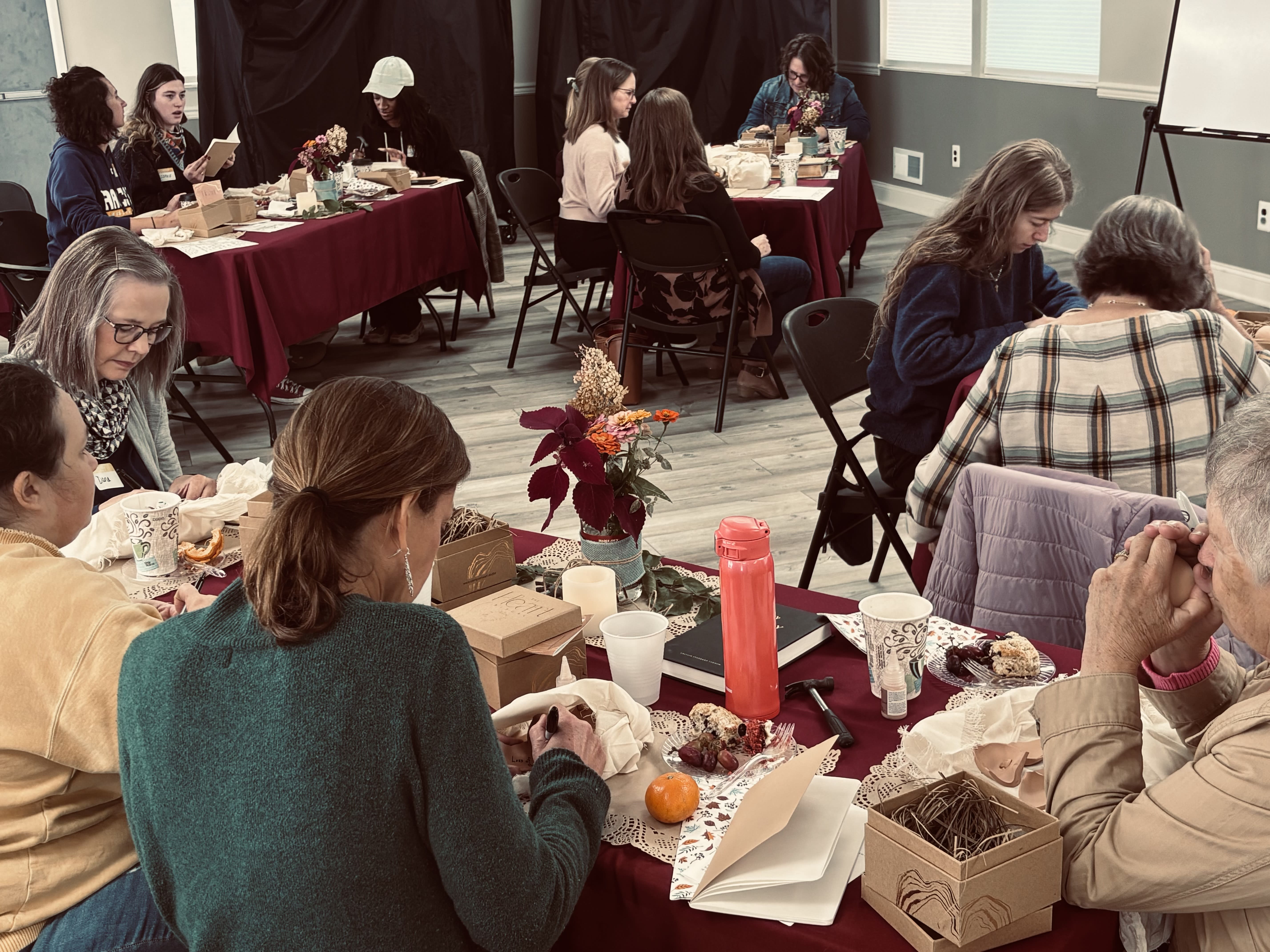
Recently, I had the honor of leading a retreat for a group of women at Redeemer Anglican church in Annapolis, Maryland. We spent the weekend engaging with the metanarrative of Scripture (creation, fall, redemption, restoration) and exploring how that grand story intersects with our own stories of sin, suffering, and shame.
During our time together, we engaged in the Japanese practice of kintsugi—breaking and mending clay hearts with gold lacquer. The art of kintsugi is a beautiful expression of God’s mending work in our lives. It is a hard, but healing and hope-filled experience. I have led several groups of women through this process over the years, and every single time it feels like holy ground.
I am convinced that when women experience the healing Jesus offers and feel freedom from the sin, shame, and suffering that have weighed them down, there is no limit to the multitudes God can feed through them.
Advent Is Upon UsIt’s been a busy month! I was preparing for and leading the aforementioned women’s retreat. My Bible study group resumed meeting for the fall semester, and I am teaching through the book of Colossians. And I came down with a persistent upper respiratory infection, which has knocked me flat for over two weeks now. Needless to say, I haven’t had energy for much else lately.
However, the Advent season is upon us, and I want to remind you about a study I created to help us celebrate God’s provision in Christ while we also long for and anticipate his return.
Aching for Eden: Excerpt from the WholeHearted Advent StudyIn his song, “The Year of the Locusts,” songwriter Andrew Osenga wrote that we are “aching for Eden.” These words struck me and inspired me to write this poem shortly after:
Deep calls to deep—
Beckoning me.
Echoes of Eden,
Imprints of eternity
Planted within me.
A holy longing, an aching for Eden—
To remind me of all that was lost
And is still to be returned.
The truest story I know to tell is that of the holy ache—the one that reminds me that things in this life are not how they are supposed to be. But how can we long so deeply for something we’ve never known? How can we miss something we’ve never had? How can we crave something we’ve never tasted? The answer is that somewhere deep within, we hear the echoes of Eden.
I am much more of a word nerd than a science buff, but it is exciting when the two collide to provide beautiful imagery. I am sure this analogy breaks down somewhere, but bear with me. An echo occurs when sound travels and bounces off a hard surface, reflecting the original sound. The echo is not the source, but the reflection. In order for there to be an echo, there must be a lot of space—a cavern—between the source of the sound and the surface it bounces off of.
We live in the vast expanse between two gardens—the Garden of Eden in Genesis 1 and 2 (God’s original creation) and the garden in the heavenly city in Revelation 22 (God’s creation of the new heavens and new earth).¹ Caught between the two, the sounds of Eden bounce off the gates of the heavenly city and reverberate deep within our souls. This holy echo exposes the gulf between the world we currently inhabit and the one to come when Christ returns and makes all things new (the second Advent). It echoes the original goodness and glory of Creation before sin fractured us and the world God created. And it stirs in us a longing, a hunger for the new creation.
Religious philosopher Blaise Pascal once wrote,
“What else does this craving, and this helplessness, proclaim but that there was once in man a true happiness, of which all that now remains is the empty print and trace? This he tries in vain to fill with everything around him, seeking in things that are not there the help he cannot find in those that are, though none can help, since this infinite abyss can be filled only with an infinite and immutable object; in other words by God himself.”²
What Pascal describes is the echo of Eden—a time when we were whole and wholly satisfied. Ever since Genesis 3, we’ve been haunted by a spiritual hunger that we’ve tried to satisfy with other things—food, sex, approval of others, shopping, hobbies, relationships, social media. Whatever promises us life, but in the end, cannot deliver. Everything here is just a shadow, not the substance; the echo, not the source.
But Christ bridged the gap between creation and new creation with his outstretched body—allowing us safe passage out of this no man’s land, haunted by the echoes of life and delivering us to the source and substance of life—Christ himself.
Just as the Israelites trusted God to daily provide for their nourishment through manna until he delivered them into the Promised Land, we trust Christ to be our daily provision until he delivers us into the new heavens and new earth. In Christ, God provides what is necessary to fill and satisfy the needs of his people.
Encountering Jesus in JohnIf you’d like to explore these themes more deeply this Advent season, my study examines four ways Christ is God’s provision for us: as the Lamb of God, the Bread of Life, the Good Shepherd, and the Great High Priest.
My hope is that this study will ground you in the life-giving person of Christ and help you rediscover the hope, power, and provision of the gospel.
This self-paced study is good for individuals and groups. It includes 12 videos and a 60-page workbook, available as a PDF download or in paperback on Amazon. You can find it here.
There are many great Advent resources available (and I am glad to recommend some if you’d like)! Whether you choose to use the “Encountering Jesus in John” study or any other resources, I hope you encounter and experience the rich hope of Christ this Advent!
Until next time,
CC
P.S. If you went through the Advent study last year, I’d be grateful if you’d consider leaving a review on Amazon!
The Wholehearted Project is reader-supported.If you enjoy or have benefited from the content, would you consider supporting future content in a few ways:Like or comment below. I love hearing from you!
Become a financial supporter through a one-time gift at Buy Me A Coffee or a recurring supporter at Liberapay.
Share this newsletter with others:
Subscribe to receive regular updates:
Thanks for reading The Wholehearted Project! Subscribe for free to receive new posts and support my work.
Want to Connect?You can find Chrystie Cole on Facebook and Instagram.
You can find more resources on the Wholehearted Project website.
Or send me a direct message: