Gaza: the Egregore of Exterminations

When I was writing my book, Exterminations (2024), the war in Gaza had just started, and it was too early to examine it in detail. But today, we can at least see a glimmer of hope for an end to the violence, so we may try to assess what happened and why. I’ll describe the situation here on the basis of an idea that I developed in the book, that of the “egregore,” a virtual entity that takes control of people’s minds, leading to the events we call exterminations and genocides. You can see it as the same thing as a “meme,” although it sounds much more ominous. Image from Cribes.
Unfortunately, the tragedy of Gaza is not exceptional in history. As I describe in my Exterminations book (2024), the statistical analyses of wars show a consistent pattern. Wars and the related exterminations are an “emergent” phenomenon of the complex system we call “society.” They are similar to earthquakes, landslides, hurricanes, and other disastrous events: the result of thermodynamic factors.
An earthquake is the result of an imbalance of geological potentials, a landslide of gravitational potentials, a hurricane of thermal potentials. An extermination, then, is caused by a socioeconomic imbalance. Put simply, when someone can gain something in terms of money or power by exterminating someone else, then it is probable that an extermination will take place.

But the fact that an extermination is possible doesn’t mean it has to occur. What triggers one? You know that guns don’t kill people; people kill people. You could go one step deeper with this statement and say that people don’t kill people; ideas kill people. Violence is a result of mental states; the virtual world has no material consistency, but it can kill real people. No one would kill anyone unless they were convinced that they had to. In my book, I used the term “egregore” to describe the collective mental states that lead groups of people to violence.
Egregores are not necessarily evil, but the egregore of extermination is a typical feature of human groups. You may read James Frazer’s book, The Golden Bough (1890), to find a catalog of cases in which societies or groups of people become possessed by the idea that they should kill someone, a single person or a minority group, in rituals that we sometimes call “human sacrifices.” René Girard described the process of “scapegoating” in his book Of Things Hidden from the Foundation of the World (1983). A feature of these events is that the victims are demonized; they are supposed to incarnate the evil the group needs to be washed out of. Once they are killed or eliminated, one way or another, the violence subsides, and the egregore disappears.
In modern times, we see that egregores are generated in the mediasphere, the result of mass media communication. The pattern is always the same: first, accusations appear in the media, targeting a minority within society. Initially, it is a matter of small crimes and misbehaviors, then gradually the accusations pile up and grow to involve monstrous crimes; eating children is a typical one. The accusations are initially resisted, but they gradually snowball, becoming accepted by almost everyone.
It is a pattern seen over and over in history. Jewish people in Europe were commonly accused of eating the children of non-Jews since medieval times; a legend still widely believed until relatively recent times, and probably still believed in some quarters. Think of the “weapons of mass destruction” that Iraq was supposed to have before the 2003 invasion. And many other absurdities. But the egregore of group violence has nothing to do with facts, data, or rationality. Do you remember the concept of “Manifest Destiny”? Can you define it? It is impossible. Yet, it was an egregore that served as a justification for the extermination of millions of people, the North American Natives. There wasn’t even the need to accuse them of eating children.
Egregores of demonization can take as targets entire populations or individuals. During the 20th century, the sacrificial victim was often a single person. Adolf Hitler, Saddam Hussein, Muammar Gaddafi, Osama Bin Laden, and many others. Even now, individual leaders are branded as the origin of all evil, as in the case of Vladimir Putin. Focusing on a single person is, in a certain sense, a good thing. It can limit the extent of an extermination since the elimination of the leader removes the evil stain on the population that supported him. For instance, the death of Adolf Hitler created a scapegoat that may have been an important factor that saved the Germans from the extermination that was planned for them under the “Morgenthau Plan,” approved by President Roosevelt.
But we see a different pattern with Gaza. The Hamas government has leaders, but their names are not mentioned in the Western Media and remain largely unknown to the public. The egregore behind this conflict takes as its scapegoat target an entity called “Hamas.” Still, the Prime Minister of Israel, Benjamin Netanyahu, likened the struggle to the ancient one against the Amalekites, mentioned in the Bible. The Amalekites are reported to have attacked the Israelites in the Sinai desert, on their way to the Promised Land, but they were defeated and routed by the Israeli warriors. God then ordered the Jews to exterminate the Amalekites to the last one as a form of revenge, including women, children, and livestock. Applied to the current situation, this ancient command by God could be understood to apply to all Gazans, not just their leaders. Statements on the Web indicate that some people in Israel see the situation exactly in this way. That makes the war more dangerous and difficult to stop.
The egregore is a hungry beast: it is satiated only when the designated evil is destroyed. And that, in this case, could be an entire population. It would turn a war that already has the aspect of an extermination into a full-fledged genocide if the conflict is not stopped soon. And it could be worse: egregores tend to spawn more egregores, and you never know who will be the next scapegoat. (For whom the bell tolls? Don’t ask, because you know that)
Right now, there are some elements of hope in the situation in Gaza. There is a chance, maybe a small one, but still a chance, that the egregore of extermination has run its course and it is fading out, just like hurricanes and earthquakes eventually do. But what could be the factor that stops violence?
Perhaps, the best hope we have comes from the current demographic trends, which show an evident decline in global fertility (as I describe in my forthcoming book The End of Population Growth). In a previous post, I examined the Palestine region, showing that the fertility decline is affecting Israelis and Palestinians in the same way. The two populations are still growing, but at rapidly decreasing rates. That prefigures the imminent start of population decline, possibly hastened by pollution and warming, both factors being known to decrease human fertility. The concept of "Lebensraum” (vital space) of Nazi times has always been absurd, but it is rapidly becoming more and more absurd, even in the crowded Middle East. And without perspectives of expansion, it will soon make little sense to go to war against one’s neighbors. But that will take time, and right now there are good chances that the extermination in Gaza will continue.
In the end, though, the problem is that human beings are what they are: always looking for an excuse to massacre each other, and building weird constructions of ideas to justify that. We may call them ideologies, memes, dogmas, creeds, tenets, egregores, or whatever you like. It matters little: the problem is inside our minds.
Appendix: the war zoneIn the so-called debate in the media, people tend to take sides in the conflict in Gaza. The choice is justified depending on where they set the starting point of history. If it is in October 2023, then Israel is engaged in a just war of defense. If it is in the 1940s, then the Palestinians are defending themselves and their land. If it is in the 1930s, the Jews are reacting to the crime of the Shoah. Keep going backward along the ups and downs of history, and you can find good reasons for revenge against this or that event, all the way to the destruction of the Temple in Jerusalem by the Romans in 70 CE. And you can go backward more. It is a tit-for-tat game that many people seem to enjoy playing, but that only leads to intensifying the hatred between the two sides.
But it is a game with no winners. The Middle East has been a cradle of wars since ancient times. The very first battle recorded in history was fought in the Palestine region, near the city of Megiddo, in 1457 BCE — we still remember it with the name of “Armageddon.” Even earlier, the siege of Tell Hamoukar, in the nearby northeastern Syria (modern-day Hasakah Governorate), around 3500 BCE, represents the earliest archaeologically documented siege of a city. You can have some feeling of the distribution of wars in the past 2500 years or so from this map, from nodegoat.net.
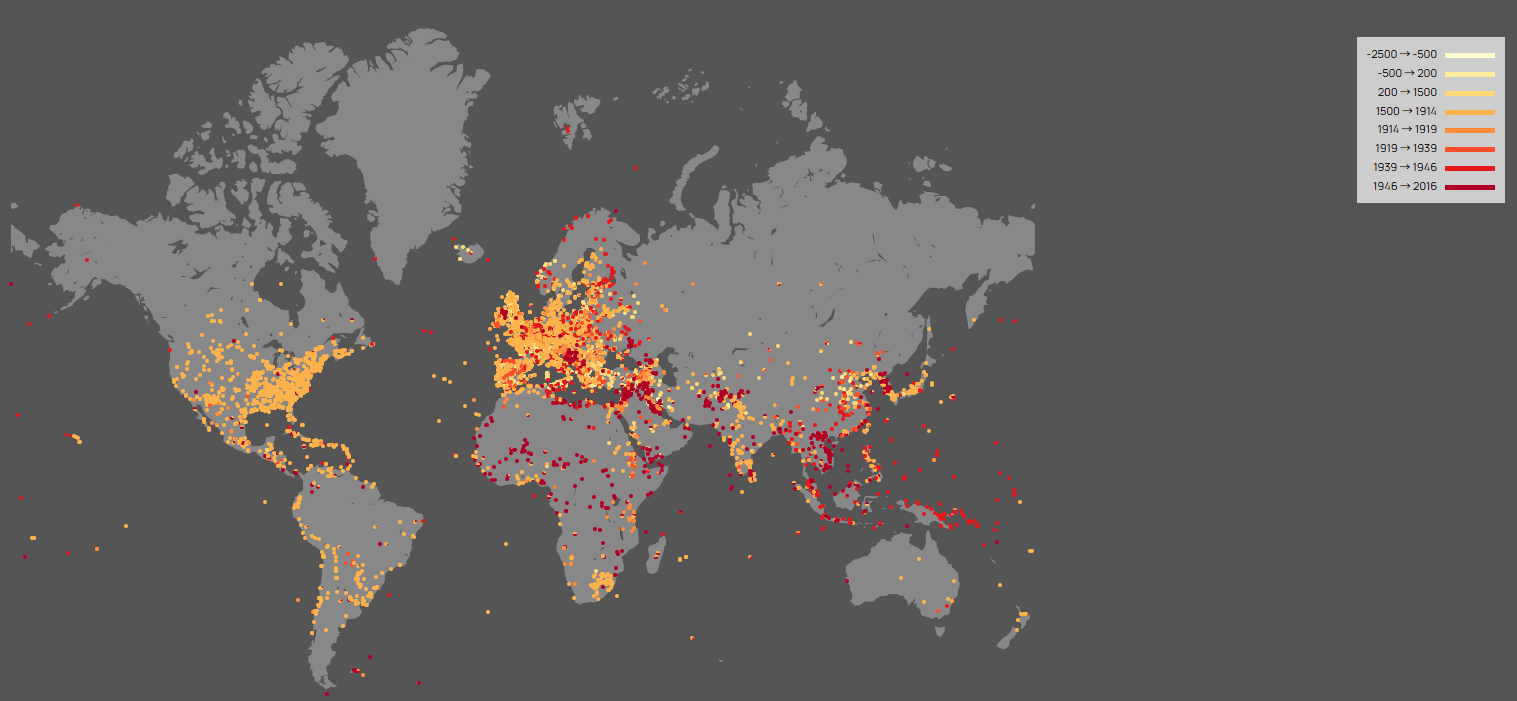
The image is surely biased because of the different availability of data for different regions. However, it qualitatively supports the idea that some areas of the world are especially subjected to human violence. At the bottom of this post, you can find a table reporting the historical sieges or captures of the city of Jerusalem (made by Grok-4). It is a total of 28 cases; not bad for a city whose name originates from the term “shalim,” meaning “peace.” For comparison, the city of Rome, another crossroads of peoples, had only 12 sieges during the same period. Palestine is a land of hungry egregores.
!function(){"use strict";window.addEventListener("message",(function(e){if(void 0!==e.data["datawrapper-height"]){var t=document.querySelectorAll("iframe");for(var a in e.data["datawrapper-height"])for(var r=0;r<t.length;r++){if(t[r].contentWindow===e.source)t[r].style.height=e.data["datawrapper-height"][a]+"px"}}}))}();