REDEEMING 666: THE ANTICHRIST THROUGH THELEMIC EYES
In Christian mythology, the term Antichrist refers to the ultimate adversary of Christ in the last days, a figure of deception and desecration who opposes God’s plan. The concept evolved from New Testament sources: the First Epistle of John speaks of “many antichrists” referring to any deceivers denying Christ, but later Christian imagination crystallised this into a single apocalyptic villain.
In the Book of Revelation, authored by “John” on Patmos in the 1st century, this evil takes the form of the Beast, a monstrous tyrant empowered by Satan. John describes a Beast rising from the sea, demanding worship and warring against the saints. Crucially, he cryptically notes in Revelation 13:18:
Let him that hath understanding count the number of the Beast… it is the number of a man; and his number is Six hundred threescore and six.
Thus, 666 entered lore as “the number of the Beast”, forever marking the Antichrist’s name.
Magick Without Tears with Marco Visconti thrives on reader support. By choosing a paid subscription, you help keep new posts coming and fund ongoing research and writing. Thank you for considering a paid subscription to support this publication.
Early Christians often interpreted this coded 666 as a reference to Nero Caesar, the infamous Roman emperor who savagely persecuted Christians. Indeed, in Hebrew gematria, “Nero Caesar” can total 666, and numerous scholars agree that John’s Beast symbolised Nero or the spectre of Nero’s return.
In later theology, the Beast of Revelation became synonymous with the Antichrist, a “man of lawlessness” or “son of perdition” prophesied in Scripture. Church fathers from the 3rd–4th centuries, like John Chrysostom, explicitly taught that Nero was a “type of Antichrist”, pointing to his cruel hubris and self-deification as foreshadowing the ultimate enemy of Christ. Over the centuries, this archetype of the Antichrist as a tyrannical false messiah – branded by the number 666 – became deeply ingrained in Christian eschatology and popular imagination.
Scholar of the Bible (and all-around hero) Dan McClellan produced many videos to deconstruct the Antichrist myth, but I want to share one here:
Symbolically, Christian tradition cast 666 as a polluted or imperfect number, falling short of the sacred 7. Where 777 might symbolise holy perfection or the Trinity, 666 was seen as a dark parody, “an imperfect knockoff brand of God”, a triad of sixes evoking unholiness or incomplete power.
In medieval and modern Christianity, the Antichrist/Beast is often depicted as a single future dictator or demonic entity who will briefly rule the world, demand worship (bearing the “mark of the Beast” 666), and be defeated by Christ at the Second Coming. He is the “dark twin” of Christ, a counterfeit saviour bringing a reign of terror and thus, in Christian eschatology, the Beast with the number 666 is a malignant figure, embodying all that is anti-divine: tyranny, blasphemy, and deception.
Aleister Crowley and “The Beast 666” : Reclaiming a BlasphemyAgainst this backdrop of dread, the English occultist Aleister Crowley shocked his contemporaries by openly styling himself “The Beast 666.”
Crowley, always the irreverent mystic and magician, adopted the very epithet meant to terrify Christians. It was not a whimsical choice. Raised in a strict fundamentalist household, young Crowley was well aware of Revelation’s Beast. In fact, his devout mother, dismayed by his rebellious behaviour, had nicknamed him “the Beast” in his youth, an insult he “revelled in.” Crowley later quipped that he was born to that role. As an adult occultist, he fully embraced the persona of To Mega Therion (Greek: “The Great Beast”), even making it one of his official mystical titles.
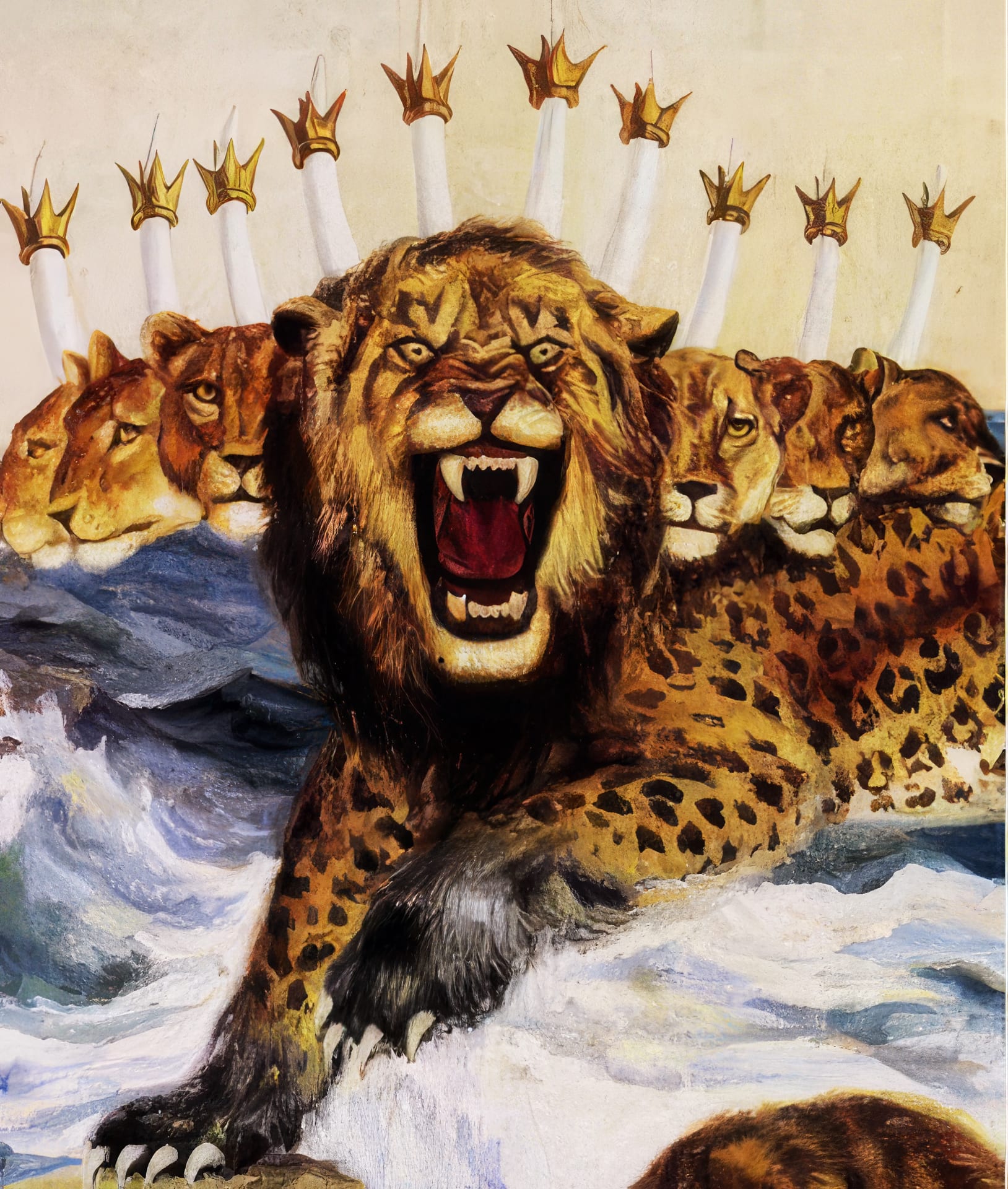
Crowley’s identification with “the Beast” was not an empty provocation but a deliberate redefinition of the symbol. In Thelema, Crowley recast the Beast from Revelation into a positive, initiatory archetype. In The Book of the Law, the Being who dictated the text, Aiwass, proclaims Crowley the prophet: “the prince-priest the Beast” to whom “all power is given” along with his consort “the Scarlet Woman”. Far from denouncing this Beast, the holy book exalts him as the chosen emissary of the new age. Crowley believed he was the Beast prophesied, but not as Antichrist in the Christian sense of an evil impostor. Rather, he saw himself as the inaugurator of a new Aeon, heralding a spiritual revolution that the old Christian world had demonised.
In Crowley’s eyes, nearly every term of Christian blasphemy was ripe for redemption. He delighted in pointing out that 666, far from being a satanic omen, is in fact the number of the Sun in Qabalistic symbolism – the life-giving star. In one of his essays, Crowley notes that the Sun’s magic square (6×6) produces the number 111 in each row and 666 in total: “The Sun being 6… each line adds to 111; the total of all is 666.” He then wryly reminds us that 666 is “the number of a man”, echoing Revelation but with a twist of meaning.
To Crowley, 666 symbolised not a fall from God but the ascent of human divinity. It stood for the solar force of life and the creative will within humankind.
Thus, Crowley boldly reversed the valence of the Beast symbol. What Christianity had vilified as demonic, he hailed as holy. Thelema taught that the so-called Devil was misunderstood: “The Devil does not exist,” Crowley writes provocatively; “‘The Devil’ is, historically, the God of any people that one personally dislikes.” In Liber ABA: Magick in Theory and Practice, he explains that the figure Christians call Satan – the serpent, the tempter – is actually a divine force.
This serpent, SATAN, is not the enemy of Man, but He who made Gods of our race, knowing Good and Evil; He bade ‘Know Thyself!’ and taught Initiation.
In other words, the serpent that brought knowledge to Eden (and by extension the Beast/Antichrist) represents the inner spark that spurs humanity toward enlightenment.
By calling himself the Beast 666, Crowley was aligning with this liberating current of knowledge and revolt. He intended to personify what the old Aeon (the Christian era) most feared: the overthrow of obsolete dogmas.
In The Book of Thoth, Crowley directly links the Beast symbol to the new epoch. The seers of the past (in the “Aeon of Osiris,” the age of the Dying God) foresaw a coming age of freedom and illumination – and “regarded it with intense horror.” He writes that this is “the real interpretation of the diatribes against the Beast and the Scarlet Woman in the Apocalypse”. John’s furious vision of the Beast 666 and the “Whore of Babylon” was, in Crowley’s view, a frightened prophecy: a distorted warning about the incoming Aeon of Horus, which would unseat Christian values. Crowley took it as a badge of honour to be cast in that Revelatory role.
Scandal and Misunderstanding: Crowley as the “Antichrist”Unsurprisingly, Crowley’s embrace of the Beast archetype created enormous confusion and scandal, both in his own time and long after.
To a public raised on Christian symbolism, proclaiming oneself The Beast 666 sounded like literally claiming to be the Antichrist – Satan incarnate. Many could not discern the nuance of Crowley’s reclamation. The British press in the early 20th century seized upon his self-designation and lurid occult activities to paint him as a monster.
Crowley was dubbed “the wickedest man in the world,” accused of devil-worship and every depravity under the sun. Tabloids described him as a black magician, a diabolist sacrificing humans in dark rituals. Even some occultists who didn’t understand his symbolism thought he might be truly in league with evil forces. The nickname “The Great Beast” stuck to Crowley in tabloids and popular culture, shorn of its Thelemic context. He became, in the public imagination, virtually interchangeable with the Biblical Beast, a living Antichrist figure to be feared or derided.
Magick Without Tears with Marco Visconti is a reader-supported publication. You have read only 1/3 of the entire article so far. To read it in its entirety, become a paid subscriber now.