
France at Its Best: Three Consecutive Years of the Game Menu at Le Gabriel
Since I started dining out in the mid-80s until now, I witnessed the gradual disappearance of the classical French cuisine. Meat and fish cooked on the bone for two and finished at tableside by a skilled server and carefully prepared and long cooked sauces almost disappeared from high end dining. A la carte menus mostly disappeared from gastronomic restaurants. Tasting menus consisting of several dishes replaced them, and the content and style of presentation of multiple course menus gradually became all alike and the search for originality and creativity turned into its opposite, that of sameness and conformity over time. It is now the “plant based” cuisine that is a la mode, and it seems to me that there is a correlation between size, quantity, and impracticality on the one hand, and recognition together with the number of stars on the other. That is, if a restaurant composes a menu with multiple courses and very small portions and presents them in non-traditional vessels (ranging from flower pots, various forms of shellfish, specifically designed strange shaped plates, etc.; which make eating impractical and messy) at least one Michelin star is in their pocket.
This is basically why I frequent Michelin three star restaurants less and less. The experience gets tiring and repetitive after visiting one or two. In this regard I fully agree with David Katz who also published excellent articles here and expressed similar views.
This said, I have been visiting Le Gabriel restaurant located in the hotel La Reserve in Paris for three years in a row in the Fall to taste chef Jerome Banctel’s “Gibier” game meat menu. So after three visits, I can make some generalizations (November 21 2023, November 18 2024, and this time on October 27 2025 along with my friend Julien Mallol). Most importantly, it is an excellent restaurant, combining care and precision in the kitchen with great service and wine selection — the coefficients are a little high but not exorbitant — led by Director Alexandre Augé and the sommelier Gaëtan Lacoste. Secondly, the consistency in both regards is noteworthy as I have not seen any “faux pas” in service or a serious flaw in cuisine in all of the three meals over the years. Finally the chef likes to make some fine adjustments to dishes and substitutes one instead of another. For example, in October we had chevreuil (venison) instead of palombe (wood pigeon). But overall I can see that his style and vision remains unchanged over time. This is truly a chef’s cuisine that I associate with with the greats of the past, including his mentor Bernard Pacaud of L’Ambroisie.
The meal always starts with a trio of amuses: a tartlet with boudin and caviar, a gougere or pommes souffle, and a warm shellfish, such as a clam, oyster, or crab. Julien whose passion for wine needs no introduction, recently tasted the Champagnes of Frédéric Savart. Among them, the Ecueil Trépail cuvée (N.M.) stood out with particular brillance. I found myself enjoying this cuvée even more than the 1er cru “Le mont des Chrétiens 2019”, which I had previously tasted.
Still, I can’t help but I found myself longing for the warm ormeaux (abalone) salad with lentilles, caviar, algue and salicornia. Attesting to the chef’s Breton origins and revealing tremendous complexity and harmony around the marine-sea plants theme, this was a masterpiece.
It is replaced by “game terrine and fine gelee”, with colvert duck, veal, pork, and foie gras with pickled vegetables. The chef also added some pickled wild berries this year which worked extremely well. This is a very good terrine and certainly appropriate as the first course, but honestly it fails to titillate my taste buds (a like terrines with more “gras”, so maybe wild duck is not the best vehicle).


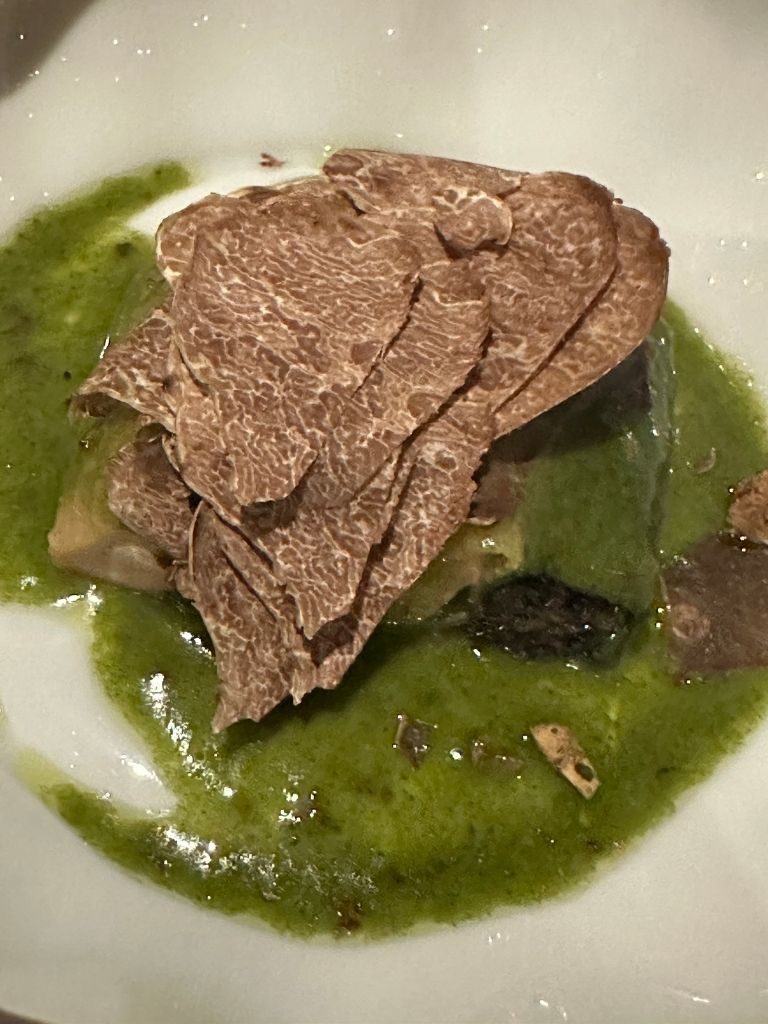
Steamed pheasant hen (poule faisane) with truffled chard, and foie gras is a light dish which is nuanced and aromatic, thanks to Alba truffles, and also texturally complex. Texture-wise it reminds me of something in between a savory parfait and a souffle. It is light, airy and delicious. The quality of the very young and crunchy chard almost steals from the truffle! Unfortunately in this year’s visit the Alba truffles had not become mature and croquant-crisp, and they did not bring the truffle box.
Instead they served the dish with shaved truffles on top. The amount of truffle was certainly less than they served in 2023 and 2024, but, on the other hand, the spongy pheasant hen was even lighter than the earlier versions which used a ravioli from hard durum wheat and added a clear bouillon with the dish. I have a slight preference for the earlier version, but this remains an excellent dish.
 2023 version
 2025 version
Next comes the colvert or mallard duck. The wild duck is wrapped in green cabbage with foie gras and is served with two sauces: foie gras cream and duck jus. I normally prefer duck cooked whole and carved tableside, but this duck is outstanding. The chef uses all the parts — leg and breast — judiciously, he seasons well, and he achieves an optimum ratio between duck jus and foie cream. I can attest that that this modern version of a classic dish was nearly perfect in earlier versions, and it is now perfect without any caveats. To accompagny that dish, we chose a German Pinot Noir – Friedrich Becker’s Spätburgunder Kammerberg GG 2010, a wine that still shows remarkable complexity, yet delivers an effortless elegance.
 2023 Version
 2025 Version
For those who like game meat, the great partridge is not as prized as “becasse” (woodcock) or “grouse” (Scottish partridge), but it is highly valued. It is not easy to cook game, as the meat tends to be low in fat. So many chefs send to the dining room overly dry meats. I don’t also like too gamey or too chewy versions as I often see in Italy. I believe chef Banctel is a master in faisandage-aging the carcass to optimum marination and seasoning. His “perdreau gris, lait ribot and King Ha Farz” with sauce salmis is a consistently a masterpiece. The lait ribot translation is buttermilk, but the one found in the US has nothing in common with fresh lait ribo. Sauce salmis and buttermilk balance each other, while “king ha farz”– an earthy and crisp powdery dumpling of buckwheat flour enriched by eggs, long simmered meat, raisin and spices — adds a wonderful dimension both in terms of textural contrast and depth in taste. In 2025, they made the partridge dish even more exciting by serving its heart and liver in a brioche on a separate plate.


This year they served chevreuil (venison) loin with exemplary sauce grand veneur and salsify in two forms and textures: fermented and braised like a stick and crisp like angel hair potato fries. The sauce was very good and thick, but my number one slot for the “grand veneur”, which is a sauce poivrade with the addition of cream and sweet jelly, still goes to the Relais de la Poste in Magescq.

On the other hand, one hits the jackpot if they serve “Palombe barbajuan des cuisses, betterave facon “Bortsch”. It is a portion composed of three components. The main part is the rich and optimally gamey breast of wild pigeon which has been roasted under a salt crust and served with an incredibly flavorful sweet (blueberries) and sour (two kinds of beets) sauce with tarragon. The pulled thigh of the pigeon is used to stuff a crisp and fried somoza-like pastry called barbajuan. Finally, in a bowl, they serve the jus of sweetened beetroot and a little cream under which one discovers a “ravioli” of the meat. One eats them all together, and each bite invites one to stop and think and admire its complexity and harmony before continuing to eat.
 21 November 2023, all three together
The feast ends with “lievre de Beauce a la royale, spatzle au sarrasin”. Simply put, if one loves the long cooked hare in a very rich and thick sauce with foie gras, Banctel’s version is one of the very best I have tried. I love this dish and tried many versions. It can be dry or too gamey. But when it is good, it is a very deep dish which to me represents the zenith of gourmandise that I associate with the heyday of French cuisine. Served alongside with buckwheat spatzle, hare jus, and puffed rice, this last savory course makes an imprint in gustatory memory. The Amontillado, a sherry variety, from Bodegas Poniente was a perfect pairing with that dish. I was delighted to see that sherry on the wine list. A small nod to head sommelier Gaëtan Lacoste, who shares the same affection for sherry and has even gone on to create his own label.


The dessert course is always “limestone kiwi, green Chartreuse, shiso and sabayon”. This is a nice and modern dessert which is very appealing and appropriate after the journey into game territory.


Vedat Milor's Blog

- Vedat Milor's profile
- 23 followers

