Global Dumbing: The Consequences
Don’t you have a feeling that certain fictional things are becoming true?
You may have heard of “global dumbing.” It is the idea that Intelligence Quotient (IQ) scores are declining everywhere in the world. Is it a real phenomenon? Probably yes, although the trend is weak. You can find some data in this 2018 article. Here are data for US adults
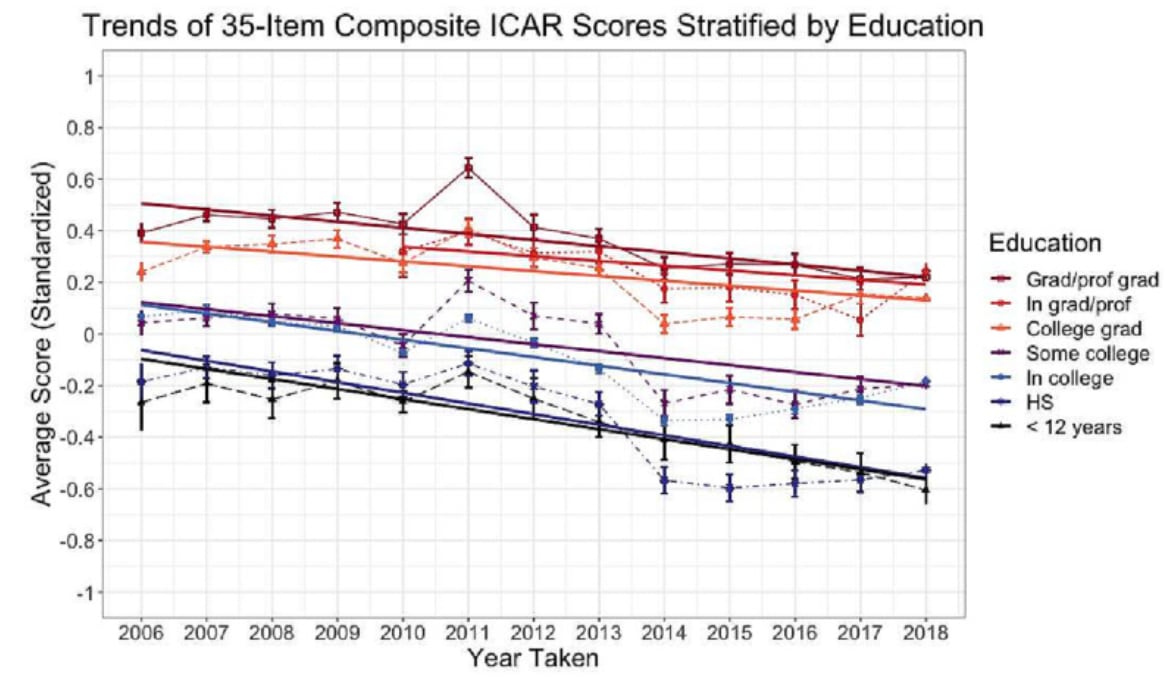
As you see, we are dealing with fractions of an IQ point compared with an average score of about 100. But the trend is there: intelligence in the US seems to have peaked in 2011 and then started a slow decline. It fits with the qualitative feeling you can have by watching TV or reading the debate (to call it in this way) on social media.
Recently, I proposed that global dumbing may be correlated to the increasing concentration of CO2 in the atmosphere, which acts as a metabolic poison on the human brain. It does not need to be the sole explanation. The decline may be due to other pollutants (heavy metals or microplastics), to electromagnetic fields, or non-chemical factors, such as exposure to dumbing media in TV and the Web.
The story is complex it involves understanding the effect of pollutants on the human brain. Let me just assume that global dumbing and it is gradually getting worse. Let me also assume that IQ tests do measure something (*see note at the end of this post) even though that may not be what intelligence truly is. Then, what do we expect to happen?
To frame the question, let me show you this graph (h/t Chuck Pezeshsky).
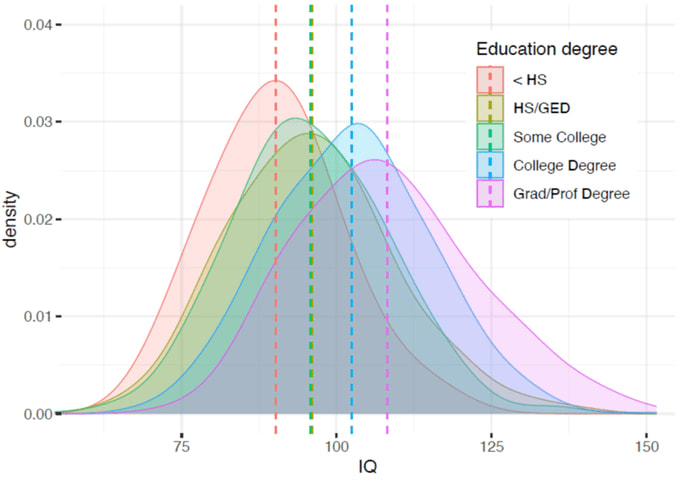
This figure gives you some idea of how IQs are distributed among various fractions of the US population — likely, the situation is not very different in other Western countries. Note how the IQ of people with PhD/graduate degrees is shifted by about 10 points toward higher intelligence, as you would expect. Conversely, people without a schooling degree lean on the other side of the distribution, with an average around 90, although quite a few of them have IQs higher than the average.
That fits with the way our society is structured. Most tasks that people normally perform in their jobs involve nothing more than moving things from one place to another. These things may be physical entities (say, you are a mailman or a truck driver), or numbers/strings of letters (say, you are a clerk, or a government bureaucrat). Or, maybe, your job is to try to move a chunk of lead from the inside of a gun barrel into someone’s body, but it is basically the same idea. Human brains have a certain capability to evaluate the position of things in space and to act on them. And that’s what they are used for.
Now, assume that global dumbing affects everyone in the same way, and that we are discussing a loss of a few IQ points, say, 5 points. Then, the whole set of curves would shift to the left. Would that change something in our society? Probably not. Surely, there would be fewer geniuses around, but geniuses are neither appreciated nor encouraged in our society, and, in most cases, they are not needed. Consider theoretical physicists: they are an elite of super-smart scientists. Most of them are engaged in arcane tasks such as making models of dark matter or cosmic strings. Their work is totally irrelevant to the world as it is now, even assuming that the things they are studying actually exist. And even if they were to be useful for something, probably a sufficient number of high-IQ people could be found to work on them even in a moderately dumbed-down world. Let’s say that global dumbing would solve for academia the problem that Peter Turchin calls “Elite overproduction.”
For the rest of the IQ distribution, a shift to the left of 5 points is unlikely to change much in ordinary people’s jobs. If you are a clerk or an employee in a fast food joint, you don’t need intelligence beyond the ability to recognize icons on a screen. The same is true for all those jobs termed “clerical” — you have to follow protocols, but little more. So, in principle, the world could remain the same. Bureaucrats would still harass ordinary people, trucks would still carry food and merchandise, supermarkets would sell groceries, and people would go to work every morning and take a vacation once in a while.
One political consequence of the general dumbing down would be that most people would lose their ability to critically evaluate what they are told. They would become even easier to fool for government propaganda and all the various private and public scams that pervade our world. Smart politicians would get to the top by feeding the dumbed-down population with lies and aggressive statements, convincing them to vote for people who promise to beggar them. Nothing surprising: we are already seeing that. It would just get worse (it is).
We could also imagine a really large IQ drop, say 20-30 points. If it does occur, that would make a big difference, and quite possibly wreak or society. One consequence would be that a large fraction of people, probably a majority, would lose the capability to read and write, which is already being gradually lost in Western countries. It is true that most people don’t really need to be able to read and write for their everyday jobs (**), but at least some do. If something breaks down, there has to be an instruction manual somewhere. But if there are not enough people able to read and understand an instruction manual, then it is a disaster. Everything collapses. Maybe bots will come to the rescue?
An alternative scenario is that the social structure collapses in the near future because of external factors, mineral depletion, pollution, global warming, or a nuclear war. Then, what would happen to dumb people? To survive societal collapse, you don’t need to be highly intelligent, but you have to be adaptable and socially collaborative. In terms of survival, I see a hard time for bloggers and social media stars, just as for string theorists, but some chances for people who can make things with their hands and who can maintain a social circle in the real world. If humankind survives, in time, it may recover the IQ points lost in our era, provided that the new generations of human beings are not exposed to daily doses of TikTok.
_______________________________________________________________________
_______________________________________________________________________
* Note. The question of the relevance of IQ tests is important. One thing that they do NOT measure is the capability of adaptation in difficult times. They have been developed in modern times by Western people and tested on Western people, so it is not surprising that when they are used on non-Western people, the result is low IQs, even if the tests are modified and supposedly “tailored” for non-Western cultures. This is a long story; let me just tell you that I have direct experience with the Romani culture (the “gypsies”), people who notoriously score low in IQ tests. In my experience, though, the Romani people are smart, reactive, and extremely adaptable, masters of managing social interactions. I gave lectures to the young ones in an educational program, and it was a pleasant experience to speak to people who reacted critically and intelligently to what I was telling them. Nothing like the sullen attitude of my regular Italian students. Whether the Roma could be good scientists, I don’t know. Surely they are not common nowadays. But maybe we need creative and adaptable people much more than we need scientists.
** Note 2. Most of the Romani people I know are illiterate or semi-literate. In my opinion, that doesn’t hamper their capability to communicate, socialize, know things, and build things. Their view of the world, though, is substantially different from that of literate people, as we are. We are always conscious of the records of the past, and we always try to extrapolate these records into the future. The illiterate Romani people, for what I can say, live in a perpetual present. As some people said, they have perfected the art of forgetting and of living happily in the present moment. They never heard of the Stoic Emperor Marcus Aurelius, but they would agree with him when he said, “It doesn’t matter whether your life is long or short. The only life you have is the moment in which you live.”