
The Science Kid
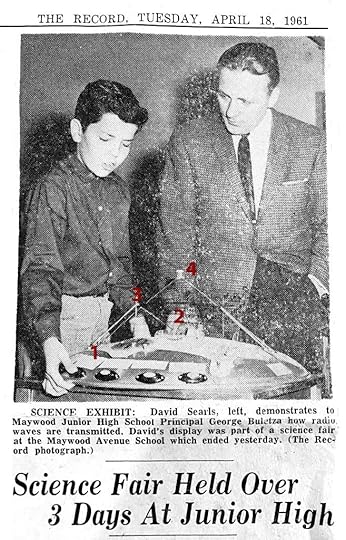
That’s me, with George F. R. Buletza, the principal of Maywood (NJ) Junior High. I was in the 8th grade, five-foot-three and eighty-three pounds, still with hair, no body fat, and obsessed by sciences in general and radio in particular.
From my bedroom window I could see the lights atop the towers of New York’s major AM radio stations. The closest was the biggest: WABC/770, a clear channel giant that transmitted from a 655-foot tower a mile south across Route 17 in Lodi. The signal from WABC was so thick in the air that you could hear it in the toaster and on the TV when it was off.
I wanted so much to learn how radio worked that I became a novice ham radio operator. My callsign was WV2VXH. Here I am at my rig:
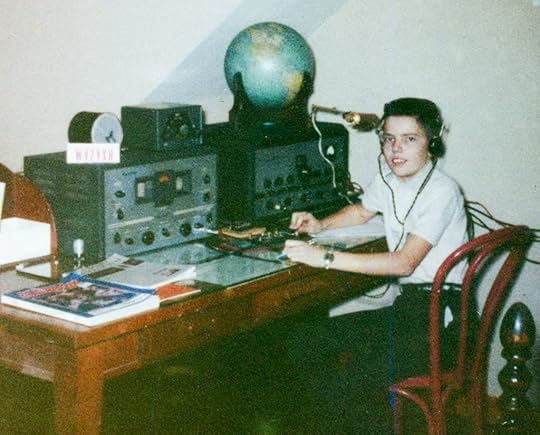
The gear:
Hammarlund HQ-129X receiverJohnson Viking 1 transmitterClockAntenna switcher (between my 80-meter and 40-meter dipole antennas)Morse code keyEarphonesSpeakerOn that stuff I talked in Morse to other hams as far away as Sweden. But I was far more interested in DXing radio stations, especially on the AM band. Between that Hammarlund and my Zenith Royal 400 seven-transistor portable radio, I logged more than a thousand different AM stations. That’s about ten per channel. (There were 107 of those between 540 and 1600 kHz on the AM band.)
Listening to faraway stations and locating them on maps gave me a profound sense of geography. I also learned a lot about local and regional concerns and speech characteristics. I would listen to faraway baseball: the Cubs and White Sox on WGN/720 and WMAQ/670, the Tigers on WJR/760, the Red Sox on WBZ/1030, the Cardinals on KMOX/1120.
I also fell in love with space science and astronomy. From what I learned about the ionosphere, I knew that when I listened to KFI/640 from Los Angeles and KNBR/680 from San Francisco, their signals bounced off the E layer twice, and off the ground at the midpoint, somewhere on the plains of Eastern Colorado.
And I took a lot of what I learned and put it into my exhibit at the school science fair.
First (with my father’s help), I took an aluminum “Flying Saucer” sled, drilled holes in it, and wired lights and button switches to a battery strapped to the bottom. On top I glued a map of the U.S. and mounted pieces of plexiglass sheets and rods to demonstrate The Propagation of Radio Waves (the glued-on title). The finished work was four exhibits in one:
1. The transmission pattern of a four-course or Adcock radio range for aircraft navigation. I showed how the Morse Code N (-.) in two opposite directions overlapped with the A (.-) in the perpendicular directions, producing a solid tone in the overlap. In those days, there was a five-tower radio range just south of Newark Airport, and another for LaGuardia, just west of the north end of the Bronx Whitestone Bridge. I was familiar with them because we drove by both often, and they looked like AM arrays, but were not. (See the LaGuardia one here.)
2. Layers of the ionosphere. There were curved lines for E, F1, and F2. The E layer reflects AM (aka MW or mediumwave) frequencies back to earth at night.
3. A skywave, demonstrated by a plexiglass rod bent in the middle.
4. A satellite communication path, illustrated by a plexiglass rod. Satellites were brand new then, and the one I had in mind was Echo 1, a shiny 100-foot-wide reflective balloon. Telstar was planned but not yet launched.
I used plexiglass because it would glow when you put light into its ends or edges, and you could also light up surface scratches with light fed into an edge. Plexiglass was also easy to heat and bend, with help from an ordinary lighter (plentiful in those days).
The buttons lit up red bulbs under the edges or ends of the plexiglass pieces. It was a fun project, and I was proud of it. (Though I don’t remember if it won a prize. Having that photo in the paper was a big enough win for me.)
A bonus item is that the school principal, George F.R. Buletza, on the right in the photo, later (his obituary tells me) settled with his family in Charlotte, Eaton County, Michigan. That was a town and region pioneered by my great-grandfather and his brothers in the early 1800s. (In 2018 my sister and I visited the Searls/Searles graves there.)
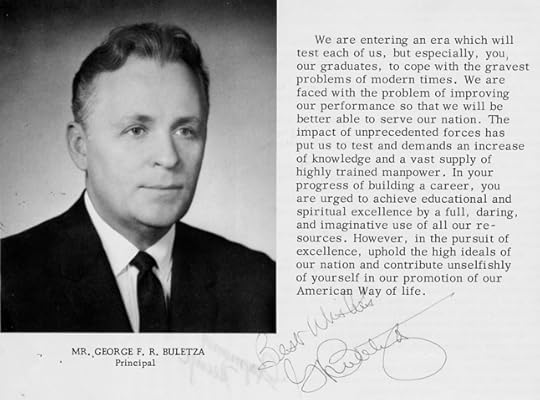
What I remember most about Mr. Buletza was his signature. On a Maywood Schools group chat, somebody shared a sample of it, here:
Anyway, that exhibit was the high point of my academic life in the Maywood Public School system. I was a good learner but a poor student: what today they would call an ADHD case, though I’d call it ASO. I’m pretty sure I never got better than a B in any course through the 9th grade.
But I did have fun, and never lost my curiosity about everything.


Doc Searls's Blog

- Doc Searls's profile
- 11 followers

