The January Nutshell
Dear Reader,
By now you’ve seen hundreds of other people’s New Year’s Resolutions, including their revolutionary resolution not to have any resolutions — you’ve seen it, you’re sick of it, and I’m here for your resolution fatigue, which is why I’ve decided to express my New Year’s Resolutions in the form of tawny frogmouths.
You haven’t seen anyone else do that, have you? All right, here goes (there are only 3).
Photos taken by me, Naarm/Melbourne, November 2025, with a Nikon Coolpix P1000.
1. Fiercely protect productive time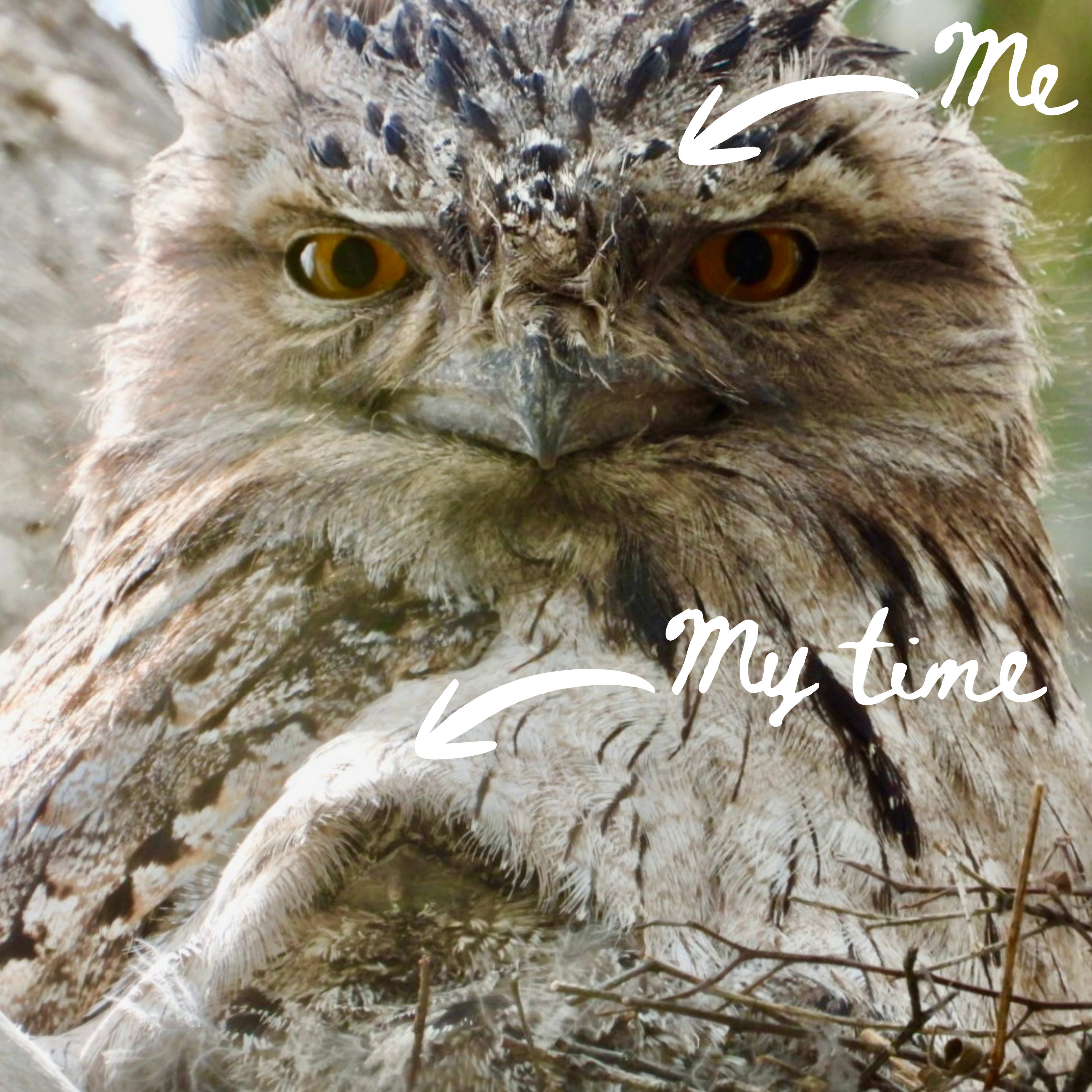 Tawny frogmouth with young chick poking out of brooding patch.
I learnt about the surprising capacity of a nesting tawny frogmouth’s ‘brood patch’ last spring. It’s a hidey-hole for chicks, an area of bare skin underneath the outer feathers that allows the parent bird to provide warmth and shelter. I was especially taken with the parent pictured here who made its nest higher up and harder to discover than most, and made a point of hiding the chick whenever it spotted me. For my part, though I visited regularly I never lingered.
I had a reckoning with myself in 2025. I’d worn myself out in the children’s book industry with a blend of oldest child and impostor syndromes, the one always warring with the other. So in the most basic terms I started to say no to things that I knew from experience were a drain on my creative reserves. I wish I had the energy for the industry that I had ten years ago, and I hope that by continuing this resolution it is eventually restored. But it’s not there yet. In 2026, 90% of my creative energy is going into my own work.
The other 10% is for things like this:
2. Make meaningful connections with readership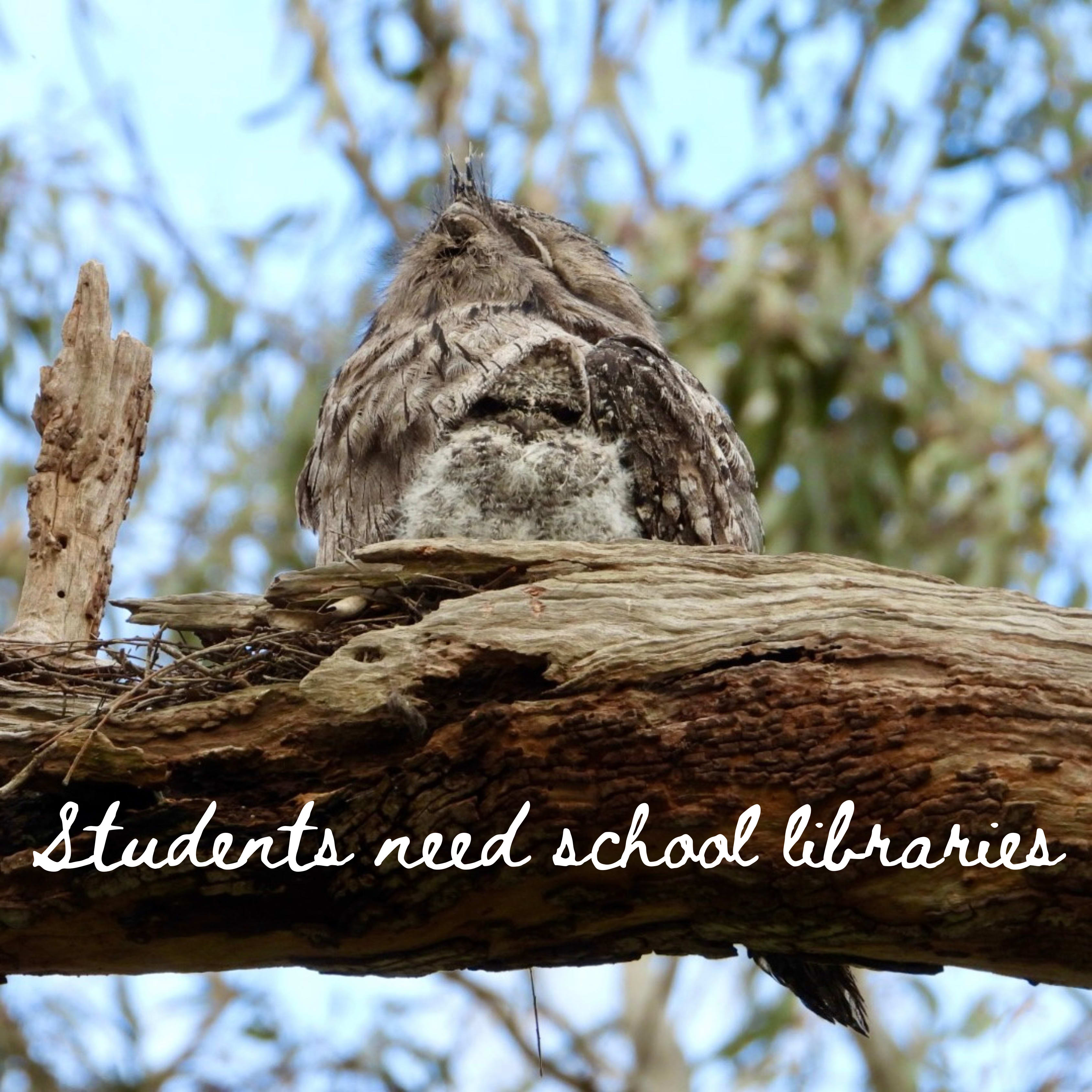 This very exposed nest has nevertheless had hundreds of people walking underneath it without noticing.
 Some children’s authors shine on the schools circuit and their passion and stamina is wonderful. I can work a roomful of students as well as most but what I prefer is a longer-term relationship with students, something that carries on beyond the hour-long school visit. I learnt this by working in two school libraries, and this year I was able to experience something like that via the excellent Australian programme Author Pen Pals, which connects authors and illustrators with schools. It was started by two authors, Dee White (Beyond Belief, The Girl in the Painting, Eddy Popcorn’s Guide to Parent Training) and Kate Foster (Paws, The Bravest Word, Harriet Hound), inspired by Book Pen Pals UK.
It’s up to the author and the school they’re matched up with how the communication works, the frequency and the mode, but I will say it was as eye-opening and rewarding for me as my time working as a children’s bookseller. Notably my 2025 school was in regional New South Wales, whereas I’m mostly confined to my inner-city Melbourne bubble. So I’m excited to be pen pals with another school this year, anywhere on the map.
3. Stop slaving for social media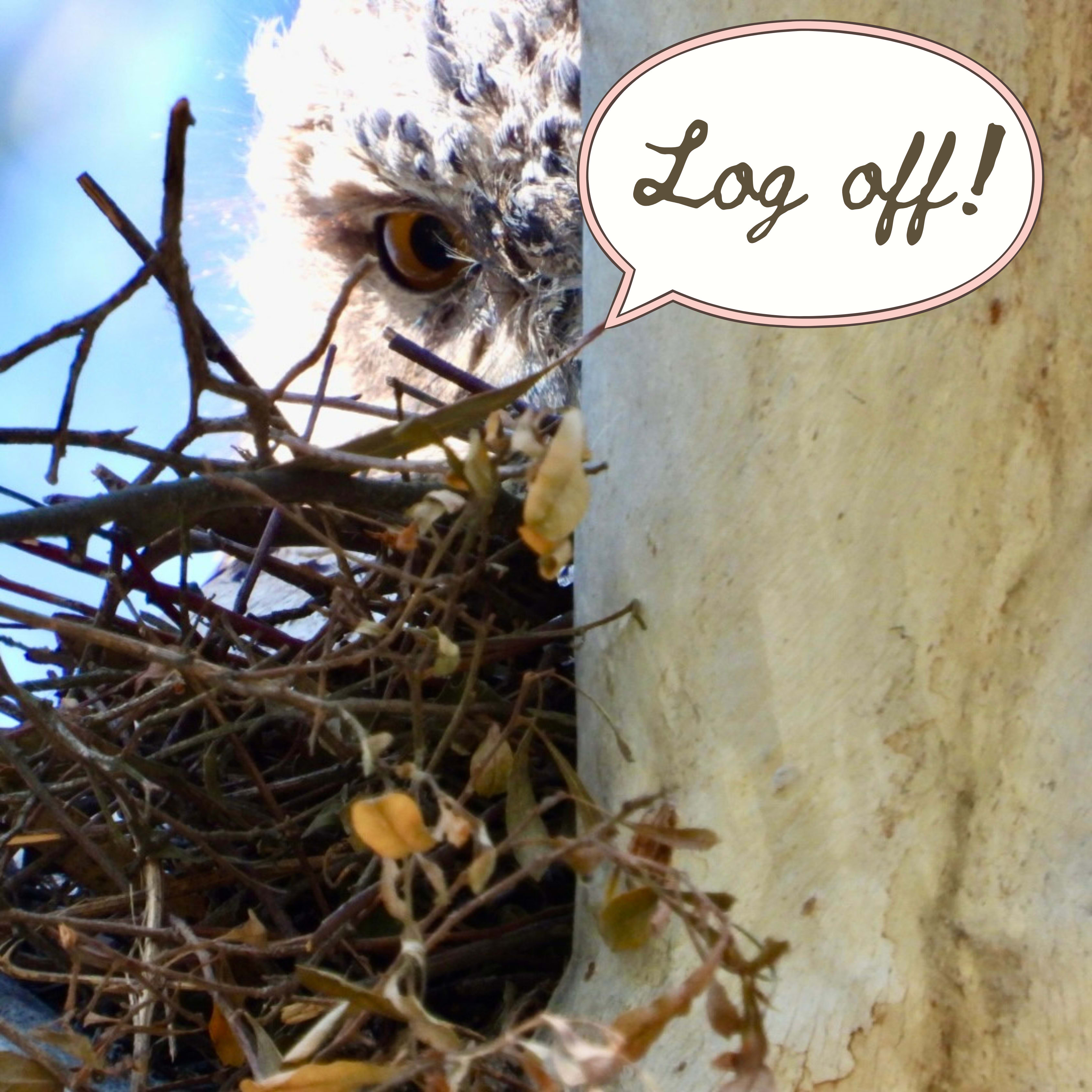
Social media worked for me for a long time, until all of a sudden it didn’t. I hit my final wall last September when I caught myself, mid-difficult-sentence in my novel, drifting onto desktop Instagram for a mindless scroll. I don’t know how many times I’ve done that but this particular time shook me. I was choosing mindless over mindful too often. All of my passing thoughts about how social media has changed, how I’d been clinging onto it without any evidence of its benefits, how it had started to feel that the more I put into it the less I got out of it, and that I was intoxicated by it in the worst way, suddenly stopped being passing thoughts and became overwhelming. So I did one of those ‘goodbye for now’ posts, logged myself out, changed my password to something I’d never remember, gave that to my partner with strict instructions, and deleted the app from my phone.
I thought it would be so difficult to give it up. It was a piece of cake. I popped back recently to post a quick hello and to catch up with what my peers were posting, but the effect on my nervous system was almost immediate — I got out again the following day. So I think that’s me for the moment: Instagram once every twelve weeks or so. Sanity-making or career-ending: we shall see.
Quick thoughts on David WalliamsIn case you missed it, David Walliams has been dropped by Harper Collins, as well as the Waterstones Children’s Book Festival, following allegations of inappropriate behaviour towards young women, which he denies.
I am not sorry to see his reign come to an end, and I hated seeing the marketing dollars lavished on him here in Australia as well as in the UK while talented writers went unnoticed, but I feel terrible for kids. The industry created a myth out of this one man, this natural ‘performer’, and rammed the myth down everyone’s throat. Kids fell for it, of course they did, the marketing was aggressive and constant, the works were pumped out, there were shows and adaptations and so much infectious noise. And now it’s suddenly over — sorry kids, turns out this guy is no good after all! This absolute shambles is on the industry as a whole. What confusing messages we are sending children on the quest to turn them into committed readers. Could we just stop lying to them all the time?
Basic rules for children’s publishing: this book was written by the person whose name you see on the cover, the author is to the very best of our knowledge not a creep, and no AI was used in the making of it.
Children and chatbotsIn the lead-up to the publication of my middle-grade novel, The Wild Unknown, and since one of my storylines is about chatbots, I’ve been checking on what’s happening with children’s use of AI. In setting this book in 2045 I was determined not to present a bleak portrait of the near future to my readers — the future I’ve made for them is as good and as bad, as exciting and as perilous, as ordinary and as extraordinary, as they probably perceive their world to be right now. And the storyline about chatbots is not a crusade to end all chatbot use, it’s about critical thinking.
My dominating thought now, as I observe what’s happening in educational and home settings, is whether we’re just going to continue to watch, helplessly? passively? — on a societal or government level — as AI does damage to children, and then attempt to deal with it a decade down the line when we’ve compiled mountains of evidence that it was a bad idea to introduce children to a system they’re not psychologically equipped to cope with.
Are we doomed to repeat what we’ve just done with social media?
Some further reading for you on children and chatbots (with trigger warnings for distressing content, which will be obvious from one of the headlines):
The ‘one chatbot per child’ model for AI in classrooms conflicts with what research shows: Learning is a social process (The Conversation, December 2025)
‘A predator in your home’: Mothers say chatbots encouraged their sons to kill themselves (BBC news, November 2025)
AI companions are arriving faster than platforms can build guardrails around them. Parents need to pay attention. (Casey Newton, July 2025)
Reading / Watching RecommendationsI usually like to plug a recently published children’s book but I’ve been fully occupied on a project that involves older ones — and I don’t know if this project will ever turn into one I’m inclined to talk about but I can say that it’s one I’m relishing.
My writing group’s commitment to read The Jane Austen Six has reached the final book, Persuasion, via hilarious and brutal battles over Emma and Mansfield Park, and much more harmony over Sense & Sensibility and Pride & Prejudice. I’ve loved this reading project so much that I’m looking for my next.
I may find it in Anne Enright’s essay collection, Attention: Writing on Life, Art and the World, which I got for Christmas (thank you, Nova Weetman). And it may be that my next reading project is Anne Enright’s backlist, since I’ve only read (and loved) The Green Road. Or it may be inspired by Enright’s grippingly insightful writing about other authors in Attention. The front runners at the moment are the work of Toni Morrison (I haven’t read The Bluest Eye since someone I’d just met gave it to me at university — that someone is to this day one of my closest friends), or the Irish short story writer Maeve Brennan. Readers who’ve stuck with Voracious since the beginning may recall my Maeve Brennan phase — I became hooked on her after listening to this New Yorker Fiction episode, Claire Louise Bennett reads Family Walls by Maeve Brennan. And despite this only happening in 2023, I could easily get obsessed with Brennan again.
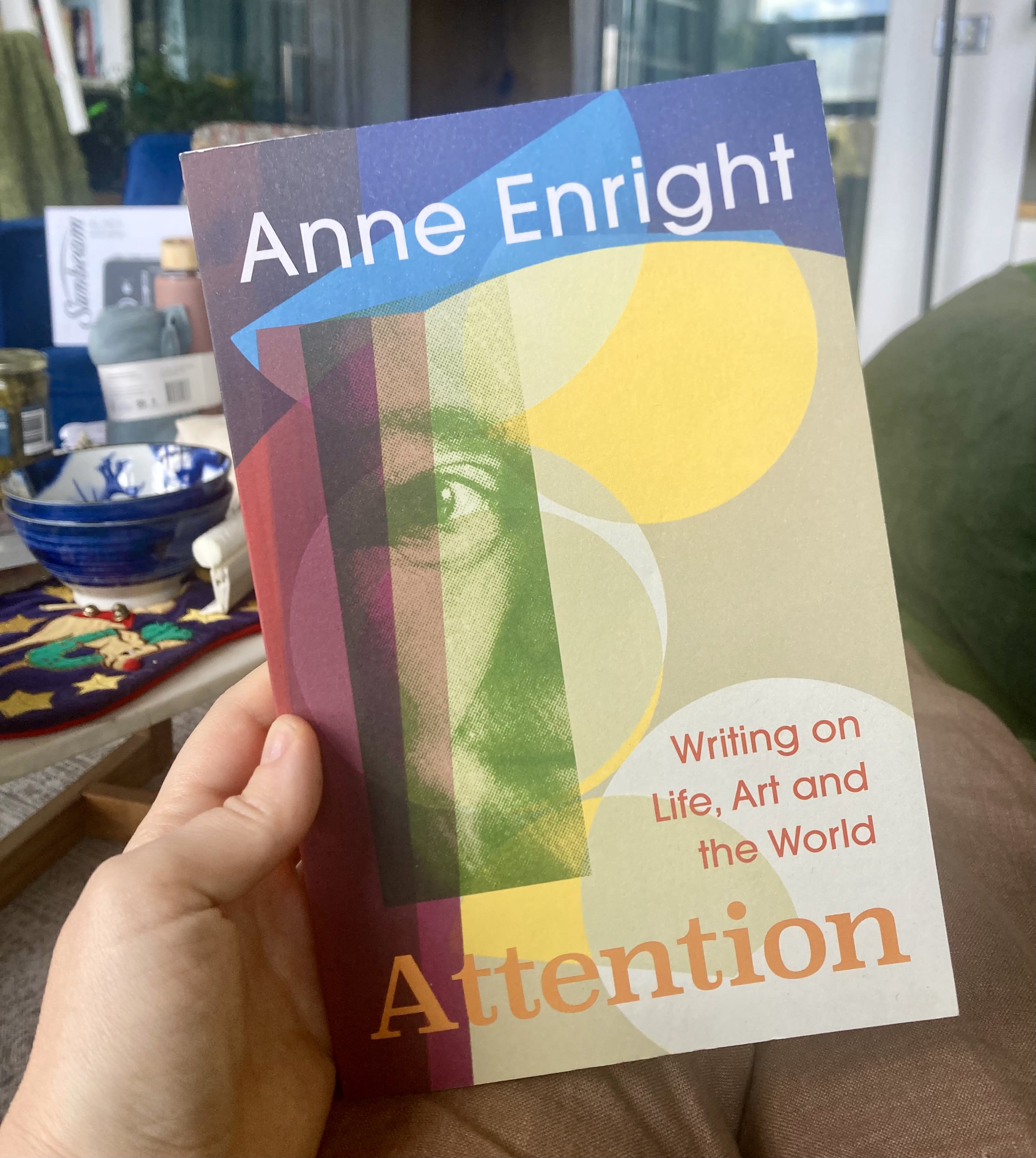 Opening Attention on Christmas Day. You can see other Christmas presents in the background, including a jar of pickles and a squeegee.
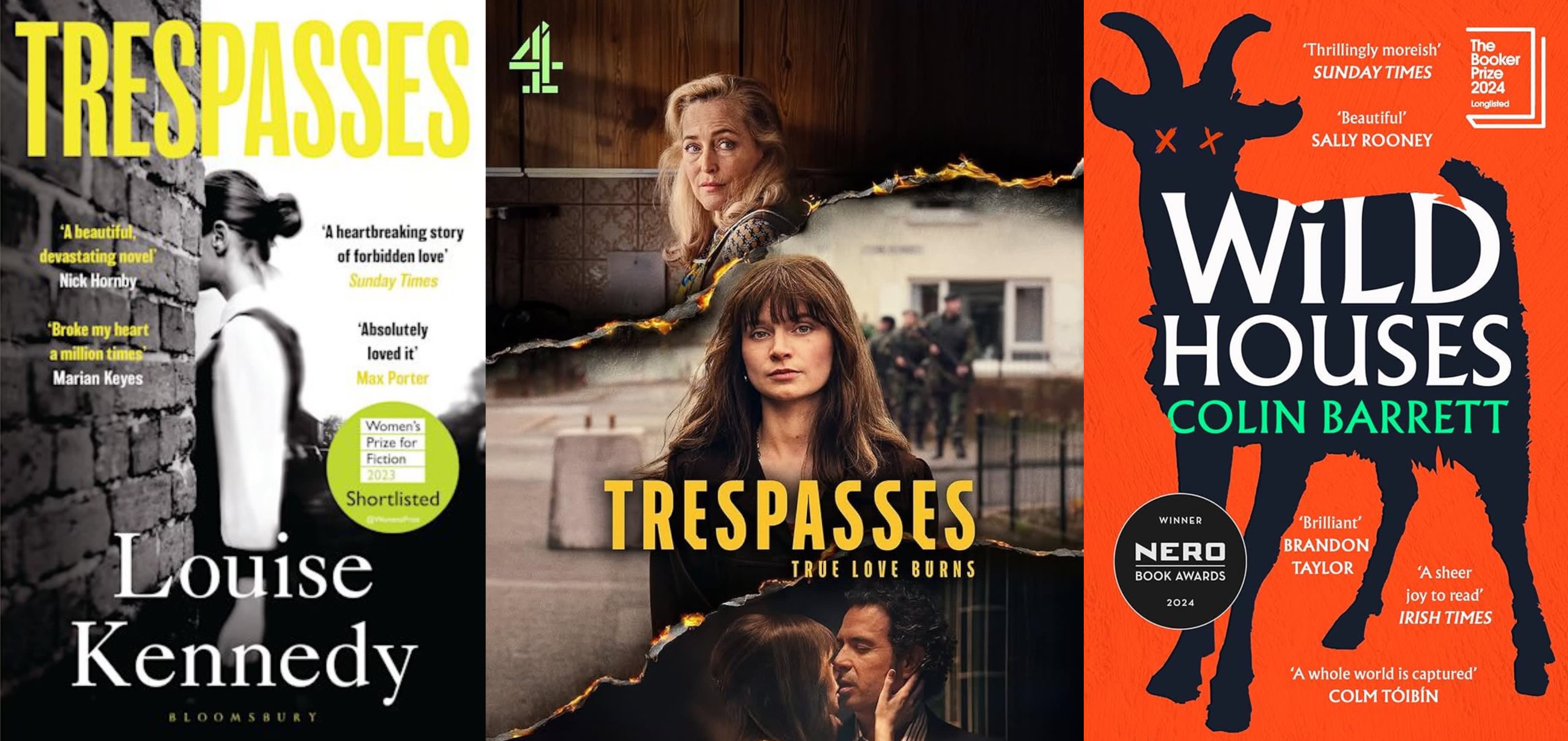
In book-related watching, I’m two episodes into Trespasses, a four-part drama set in Belfast in 1975, based on the novel of the same name by Louise Kennedy. This was a favourite novel of 2024 and my memory of it is vivid so I was hesitant about the series, but have found it to be a close capture. I believe the accents of certain actors were a problem for some viewers and in the early scenes I felt the same, but I got past that. Perhaps my only hesitation is the portrayal of the married, Protestant barrister that the young, single, Catholic teacher falls in love with — Tom Cullen is a beautiful-looking man but I’m missing some of the substance of the novel in his portrayal. I’m of course heartily recommending that you read the novel first. To quote myself from a previous newsletter: It’s a novel I’d hold in my hands for as long the instructions told me to if they promised that some of Kennedy’s skill would rub off.
And if you loved Trespasses, I recommend the 2024 Irish novel Wild Houses by Colin Barrett, which was longlisted for the Booker.
 To finish
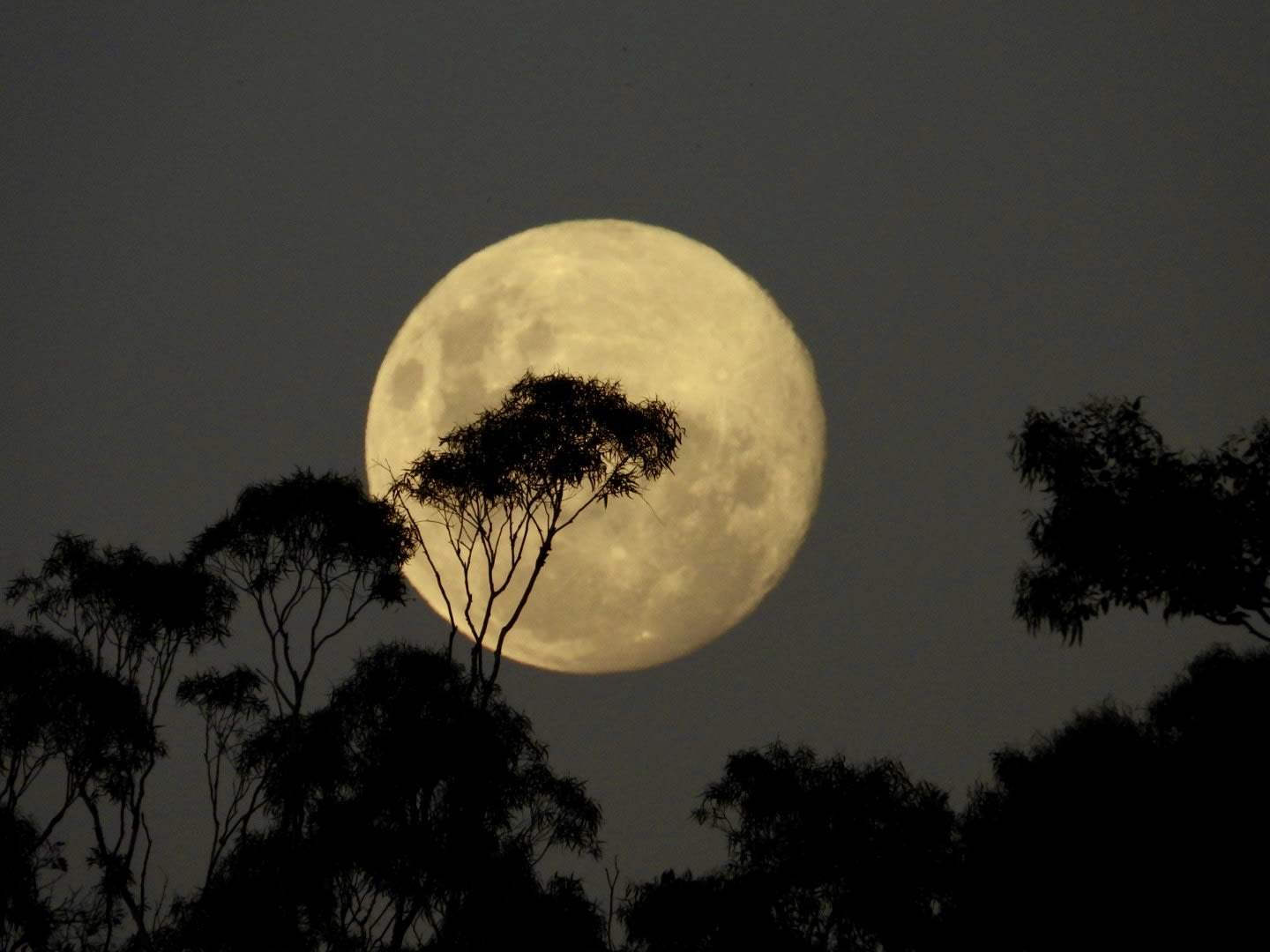
My camera doesn’t just do birds, it also does moons. I happened to be on my balcony rescuing wilting sunflowers when this moonrise happened, and it was a humbling experience to see it through my camera’s optical zoom.
 Thank you for reading
Voracious
.
Thank you for reading
Voracious
.If you enjoy this newsletter and you’d like to support me in some way, I’d love it if you’d consider leaving a review of one of my books or sharing this with a friend.
 I’ve worked in the children’s book industry for 25 years in various roles: in-house editor, consultant to a literary agent, children’s book buyer, reviewer, freelance manuscript assessor, and as a writer-in-residence in a high school library. My writing includes the Young Adult novels Girl, Aloud (2009), Steal My Sunshine (2013) and I Am Out With Lanterns (2018). For late primary/early high school readers: The Other Side of Summer (2016; a companion novel to I Am Out With Lanterns) and Aussie Stem Stars: Gisela Kaplan (2021). Eliza Boom’s Diary books 1 & 2 (2014) are for emerging readers aged 5-9. My latest novels are
Elsewhere Girls
(2021) and
Outlaw Girls
(2024), with Nova Weetman, and
The Goodbye Year
(2022), for readers aged 10+. My next middle-grade novel will be published in May 2026.
I’ve worked in the children’s book industry for 25 years in various roles: in-house editor, consultant to a literary agent, children’s book buyer, reviewer, freelance manuscript assessor, and as a writer-in-residence in a high school library. My writing includes the Young Adult novels Girl, Aloud (2009), Steal My Sunshine (2013) and I Am Out With Lanterns (2018). For late primary/early high school readers: The Other Side of Summer (2016; a companion novel to I Am Out With Lanterns) and Aussie Stem Stars: Gisela Kaplan (2021). Eliza Boom’s Diary books 1 & 2 (2014) are for emerging readers aged 5-9. My latest novels are
Elsewhere Girls
(2021) and
Outlaw Girls
(2024), with Nova Weetman, and
The Goodbye Year
(2022), for readers aged 10+. My next middle-grade novel will be published in May 2026.Thanks for reading Voracious! This post is public so feel free to share it.