The February Nutshell
Dear Reader,
Shouting from the rooftops: I’m home!Behold the British commitment to installing bath tubs in spaces that were intended to be occupied by mice or bats — for here I am for my annual stay in London where I’ve succeeded in the triple challenge of (1) contorting myself into a bath under a 1-metre ceiling, (2) turning the pages of Wolf Hall without dropping it, (3) reading it through fogged-up glasses.
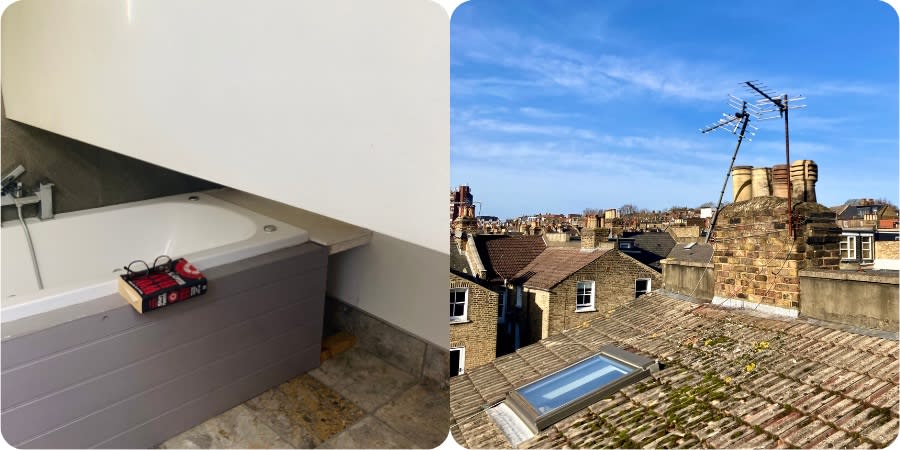
I cherish this kind of eccentricity, especially when I’m in the grip of a childlike thrill to be back in London. Even my Australian partner’s grievances — he’s very cold, he’s very wet, and he doesn’t understand why half of this Air BnB bathroom is carpeted — cannot put a dent in my wide-eyed wonder.
“Are you actually Mary Poppins?” said a friend in Australia when I sent her these chim-chim-chimneys.
A Spoonful of StructureIn my January Nutshell I mentioned being on the look-out for a structured reading challenge to soothe my Jane Austen hangover. I found it: Simon Haisall’s slow-reading, 40k-strong book club, Footnotes and Tangents. I signed up for the Wolf Crawl, aka the slow read of the Wolf Hall trilogy by Hilary Mantel.
Footnotes and Tangents is my ideal book club: structure but no pressure, a community you can either enjoy in quiet anonymity or contribute to, and high quality footnotes, including beautifully narrated audio, to suit those of us who exist down the rabbit-holes of life.
So that’s the slow lane; meanwhile some memorable reads are filling up the fast lane, but before I get to those let me tell you what I’ve been up to between leaving Melbourne at the beginning of February and arriving in the rooftop.
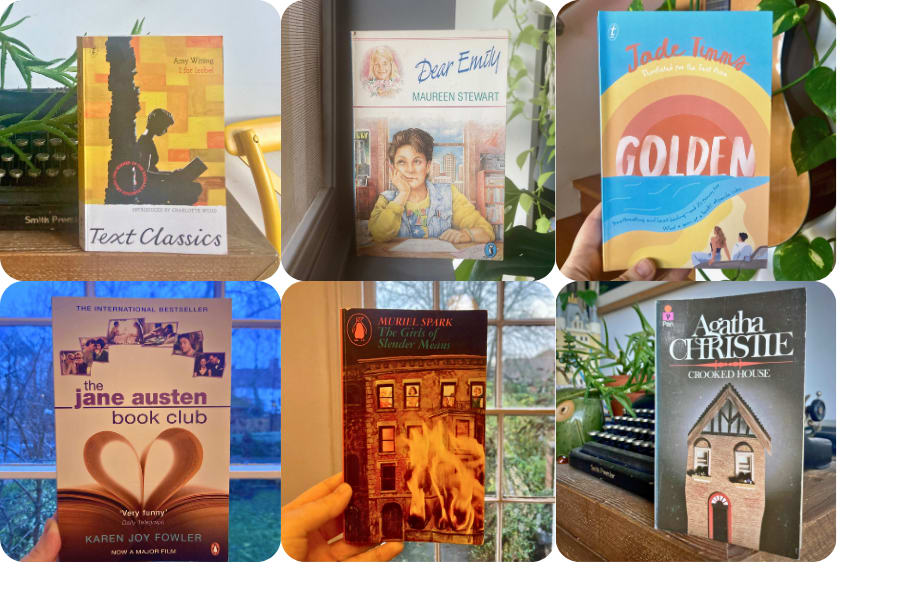 I for Isobel by Amy Witting, Dear Emily by Maureen Stewart, Golden by Jade Timms, The Jane Austen Book Club by Karen Joy Fowler, The Girls of Slender Means by Muriel Spark, and Crooked House by Agatha Christie.Editing out of a suitcase
This is a big trip for us. We’ve never travelled abroad together without our kids, now capable, independent young adults who nevertheless still ask basic survival questions that make the blood run cold. We crossed the world via Muscat a few days after Trump sent an armada towards Iran, ensuring my anxiety was at its pinnacle.
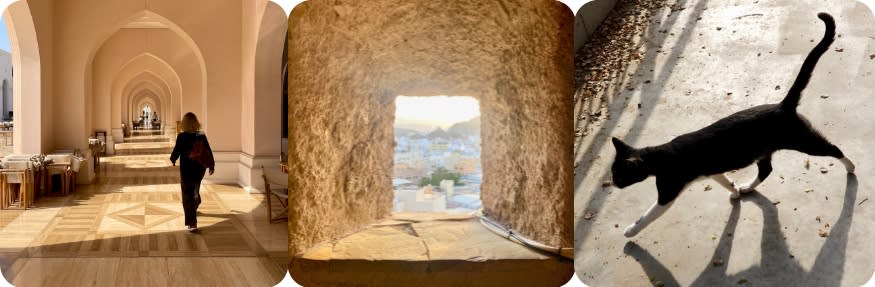 The Royal Opera House, a view from the Al Mirani fort, and a friendly member of Muscat’s large street cat population.
While we befriended Muscat’s feral cats, huffed at influencers posing for the perfect shot on a 16th century fort, and assured eager market stallholders that I didn’t need a knock-off Gucci handbag, the first typeset* pages of my children’s book, The Wild Unknown, arrived in my inbox.
(*typeset: when the manuscript graduates from a Word doc to beautifully designed pages)There are many tweaks at the typesetting stage, and this being a mystery set in the near future there are still details that my editor and I are finessing for the young readership. But though the schedule is tight, my jetlagged brain was uncooperative. I decided to leave it for a few days.
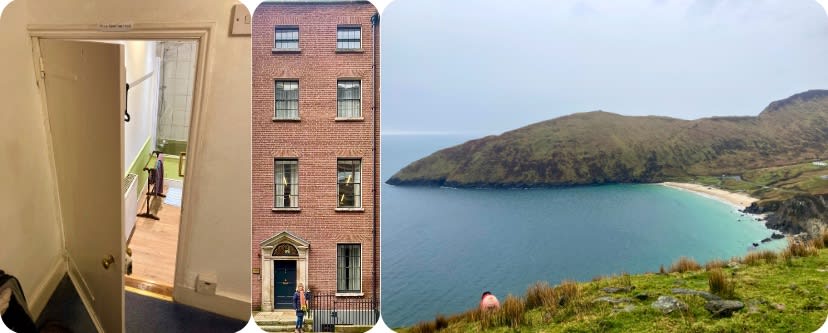 The half-height bathroom door; me outside the final home of my great-great-grandfather in Dublin; Keem Bay, Achill Island.
We spent our first week at the top of a Georgian cottage on the outskirts of London, which had among its charms a half-height door leading to the avocado bathroom of my dreams. In the middle of the night my six-foot partner provided free entertainment trying to navigate to the toilet through said door, which opened directly onto a staircase.
Then we were off to Ireland to trace my ancestral roots. We explored County Mayo through near-relentless rain that occasionally stopped to show us breathtaking views. We wound down the windows to say hello in high voices to the beautiful black-faced mountain sheep. They gave us the looks we deserved.
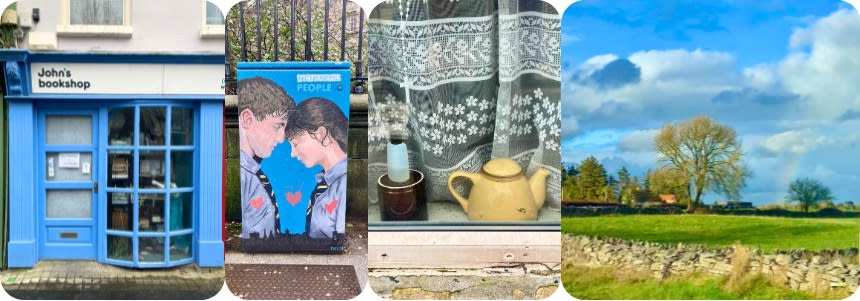 John’s Bookshop (closed on Sundays); a Normal People street cabinet near Trinity College, Dublin; holy water and a teapot in somebody’s front window; the green, green grass of County Mayo.
I traced the house my great-grandmother was born in, and looked longingly through the dark windows of bookshops (Ireland: closed on Sundays). The weather flipped between rain and rainbows. We were told by a larger-than-life restauranteur that he won’t sell Guinness because of their aggressive tactics. Fine by us: we were drinking whisky. I visited a street I’d chosen for scenes in a long-running work-in-progress. A door opened and an old man in a dressing-gown said hello to me; I said hello back and walked shyly away because he was already a character in my book and I didn’t want to break the spell. That book is unlikely to make it out of Word Doc status but I continue to work on it because nothing beats the thrill of chasing down a story.
It was in Dublin after an Irish Coffee and a pub sing-a-long that I realised I no longer had the excuse of jet-lag and had to knuckle down to the edit of The Wild Unknown.
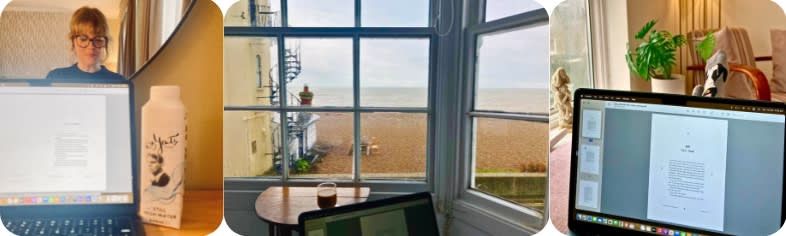 Editing in front of a hotel mirror; editing in front of a steel-coloured sea; editing with my feet up in North London.
In the hotel, the only desk was in front of a mirror. I felt like I was about to get a haircut, which would normally be disconcerting but on this occasion felt like book-magic because the first chapter of The Wild Unknown is called The Haircut. It features two brothers and a pair of craft scissors. I edited 100 pages before we flew back to England. I edited another 100 with a view of the steel-coloured sea in Suffolk. I finished the edit in the North London rooftops of my youth.
Now it’s off to the proofreader and my opportunities to tweak and polish are rapidly diminishing. I don’t really want to read it again but at the same time I can’t let it go.
Other people’s books now.Proof of my former life as a children’s bookseller: I was minding my own business when the thought popped into my head that there were 2 Australian children’s books by well-loved authors published last year that heavily feature an octopus (Song of a Thousand Seas and The Keeper of the Octopus). And from there I wondered: wouldn’t it be fun* if I could make a list totalling 8 books — you know, the 2 octopus ‘arms’ and the 6 octopus ‘legs’.
(*actually, there’s no need for me to explain why this counts as “fun” — you’ve subscribed to a bookish newsletter called Voracious, this is probably your kind of fun, too.)Approximately one hour later . . . this will be useful to someone, somewhere.
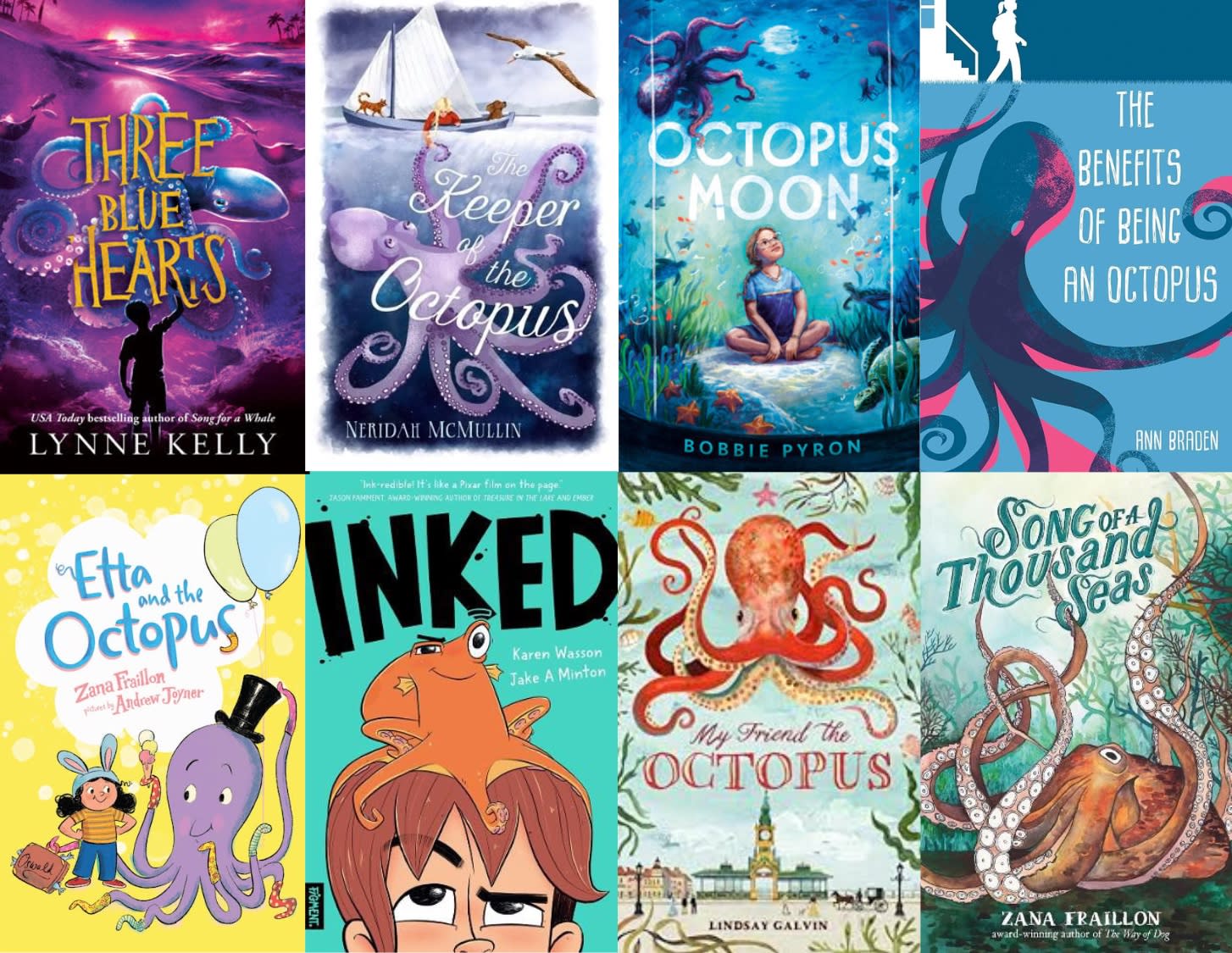 Three Blue Hearts; The Keeper of the Octopus; Octopus Moon; The Benefits of Being an Octopus; Etta and the Octopus; Inked; My Friend the Octopus; Song of a Thousand Seas.
 The Jane Austen Book Club, Karen Joy Fowler (2004)
This passed me by in 2004 — I only knew the author from We Are All Completely Beside Ourselves in 2013. The Jane Austen Book Club was a good palate cleanser straight after reading the Jane Austen Six back to back. The characters take turns to host a night to discuss each novel, and as they do so they become the central character. I think the novel suffers from some of the weaknesses but has all of the strengths of other shifting perspective novels, and I cherished the discussions about Austen’s work.
Crooked House, Agatha Christie (1949)
London, 1947, a wealthy patriarch is poisoned with his own medicine. Red herrings galore. The breakneck speed made my head spin with suspicions, none of them correct.
I For Isobel, Amy Witting (1989)
I loved this but have since learned that several friends had to read it in high school and have no fond memories. I found it a psychologically faithful and sophisticated child’s eye view of growing up with a hateful mother, without being mawkish. Even though Isobel escapes her family in the physical sense, she later grapples with what it means to be followed by yourself wherever you go. I recognised masking, social anxiety, difficulties with social navigation, and intense special interest, and found it very quotable. Here’s Isobel reluctantly learning to touch type:
‘. . . she sat at the hated machine with a wooden hood covering hands and keys (why grope when one had eyes?), forcing her fingers into an unnatural poise to lend strength to little fingers she would well manage without (why not make typewriters to suit hands, instead of forcing hands to suit typewriters?), timing her efforts by the second hand of the large clock on the wall, pestered by the incoherent rattling of keys, while other damned souls round her competed in solitude against themselves . . .’
The Girls of Slender Means, Muriel Spark (1963)
I leapt on this after listening to this podcast episode: The Many Lives of Muriel Spark. The novel is witty and savage, centred on the lives of a group of young women living in a London boarding house just after the Second World War. If you haven’t read Muriel Spark before I would start with the slightly jollier A Far Cry From Kensington.
Dear Emily, Maureen Stewart (1986)
Letters from a troubled teen to a sweet one. This is an ultra-slim Australian novel with shades of the earlier Adrian Mole. I found it a hoot, being a child of the 80s, but aspects of it would make it unpublishable today — the questions the reader is left with, the insulting humour . . . it is not a kind book but I thought it a clever one, because while the narrator is unhappy and unfiltered, we never hear the side of the nice girl she is writing to except when Maria references things Emily has written, so the reader effectively becomes the moral ombudsman of the book — they have to take on that responsibility. A fascinating step back in time.
Golden, Jade Timms (2025)
Lovely. It has a laid-back, languid quality that I found enjoyable, but underneath there is a current of past trauma and it rises to the occasion when the story needs a different energy or a disruption. I found the climax most affecting and I know I would have loved it as a 14 year old. It reminded me of the gorgeous tone of Kate O’Donnell or early Cath Crowley.
Before I sign off:A fantastic children’s book that I recently blurbed is Fiona Wood’s The Boy and the Dog Tree, published by UQP in March. I have a long association with Fiona and was fortunate enough to be her editor on her first middle-grade novel, How To Spell Catastrophe, so is this a biased opinion? Absolutely, it is heavily influenced by what a perceptive writer and superb stylist I think she is. Take the word of highly awarded author Peter Carnavas: ‘A beautiful book, filled with courage, magic and a huge ancient dog to wrap your arms – and your heart – around.’
An Australian YA I’m keen to read is also due in March: Julianne Negri’s verse novel The Belly of a Wolf, published by UWA. Quoting Books & Publishing, this is: ‘an astonishing novel for readers aged 14 and over who have lost someone they love, who have ever felt alone in the world or who have found comfort in creative practice.’
Thank you for reading Voracious .If you enjoy this newsletter and you’d like to support me in some way, I’d love it if you’d consider leaving a review of one of my books or sharing this with a friend.
 I’ve worked in the children’s book industry for 25 years in various roles: in-house editor, consultant to a literary agent, children’s book buyer, reviewer, freelance manuscript assessor, and as a writer-in-residence in a high school library. My writing includes the Young Adult novels Girl, Aloud (2009), Steal My Sunshine (2013) and I Am Out With Lanterns (2018). For late primary/early high school readers: The Other Side of Summer (2016; a companion novel to I Am Out With Lanterns) and Aussie Stem Stars: Gisela Kaplan (2021). Eliza Boom’s Diary books 1 & 2 (2014) are for emerging readers aged 5-9. My latest novels are
Elsewhere Girls
(2021) and
Outlaw Girls
(2024), with Nova Weetman, and
The Goodbye Year
(2022), for readers aged 10+. My next middle-grade novel The Wild Unknown will be published in May 2026.
I’ve worked in the children’s book industry for 25 years in various roles: in-house editor, consultant to a literary agent, children’s book buyer, reviewer, freelance manuscript assessor, and as a writer-in-residence in a high school library. My writing includes the Young Adult novels Girl, Aloud (2009), Steal My Sunshine (2013) and I Am Out With Lanterns (2018). For late primary/early high school readers: The Other Side of Summer (2016; a companion novel to I Am Out With Lanterns) and Aussie Stem Stars: Gisela Kaplan (2021). Eliza Boom’s Diary books 1 & 2 (2014) are for emerging readers aged 5-9. My latest novels are
Elsewhere Girls
(2021) and
Outlaw Girls
(2024), with Nova Weetman, and
The Goodbye Year
(2022), for readers aged 10+. My next middle-grade novel The Wild Unknown will be published in May 2026.Thanks for reading Voracious! Subscribe for free to receive new posts and support my work.