Playground
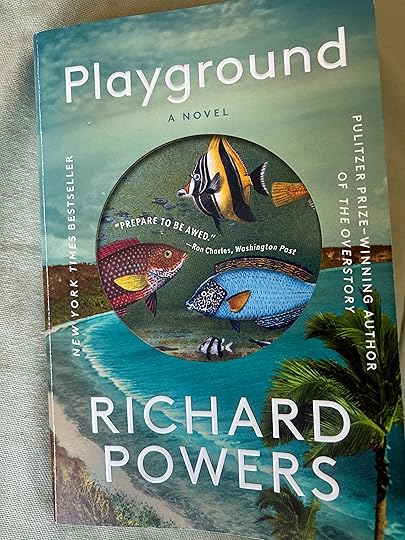
I picked up Playground, by Richard Powers, because I thought it would be about the ocean. And it kind of is, but it’s more about his fictional people and how what they do for a living ends up affecting the ocean.
I was unwilling to be drawn in by his story about the early life of one of his main characters because the character’s main talent is what a good reader he is (and later, a writer), and the breadth and depth of the character’s reading brings rewards like scholarships and jobs. This is not true to life!
The novel focuses on four main characters. The reader is Rafi, who grows up in Chicago. He marries Ina, an artist and Pacific Islander who comes to Chicago for graduate school. Rafi’s best friend is Todd, a computer programmer who invents a game called “Playground.” (Todd’s sections are written entirely in italics, which makes them wearying to read.) A fourth character, unrelated until they meet on the Pacific island of Makatea, is Evelyne Beaulieu, a diver.
Most of Evelyne’s sections take place in the ocean, so they gave me more of what I was looking for in this book. I particularly liked what she says about Pacific Manta Rays: “years of study had convinced Evelyne that mantas were far smarter than the world suspected. She had spent too many decades of close observation to be cowed any longer by the prohibition against anthropomorphism. What began, centuries ago, as a healthy safeguard against projection had become an insidious contributor to human exceptionalism, the belief that nothing else on Earth was like us in any way. At her age, Evelyne Beaulieu had no more time for demure self-censorship. A good empiricist, she felt no qualms about giving the behavior in front of her a name. The way the Loner toyed with her air bubbles was clear enough. Call it what the evidence suggested. Call it what it looked like: the giant bird-like fish was playing.”
Early on, I liked some of the things Todd says about playing chess with Rafi: “why is this silly little game with its poofy little moves so damn addictive? Why is it all I want to do, all day long? Why is it…the most beautiful thing in the world?” Later, though, they abandon chess, dismissing it as something already solved by computers and rhapsodizing instead about a game called Go. Todd also describes Rafi’s fascination with a book entitled The Philosophy of the Common Task, by Nikolai Fyodorovich Fyodorov, which they take to be about a kind of metaphorical necromancy. I particularly disliked this part of the novel, as it makes the two seem facile and overly impressionable.
Powers makes the mistake that novelists sometimes make when writing about characters they want us to believe are great poets—he includes a sample poem. In this novel, we get this poem on p. 230, further increasing my skepticism about Rafi’s vaunted genius. And to keep my skepticism going about Todd’s intelligence, I learn on p. 233 that Todd has never seen or even heard of Shakespeare’s play The Tempest. And to increase what by that point has become my disgust with Todd, on p. 311 he says “I still felt mostly apolitical. I didn’t care which party was in charge, so long as they kept their hands off the vital new human spaces we were creating.” This is the attitude that’s brought us to our current pass, where the people of my country can’t even rid themselves of a would-be dictator who has already fomented insurrection, is probably under the thumb of blackmailers related to his pedophilia, and appears more senile and insane every day.
Reading about what Evelyne sees is fun, but not worth having to plow through the rest of this novel, especially since some of what she sees is recounted second-hand, as a description of a book about the sea she writes for middle-grade readers:
“Her one little chapter on eyes alone was a bestiary beyond the power of the most imaginative dungeon master to invent. There were the two hundred eyes of a scallop. Starfish that see with the tips of their arms. Fish whose eyes are split in two so they can see both above and below the surface at once. The cock-eyed squid, which points its large eye upward toward greatmoving shadows and its small eye downward to the twinkling creatures of the deep. But down where the light was powerless, even the world’s largest eyes could not make out the stunning, jagged mountain ranges, vast waterfalls with a thousand times the flow of Niagara, trenches and crenellations and pits and crevasses like nothing known on land, panoramas never to be seen by any living thing.”
The four characters do come together at the end in what should be an exciting culmination, but by the time they meet I had gotten too tired of their attitudes to be excited by how and why they affect each other and the planet.