Shibboleth
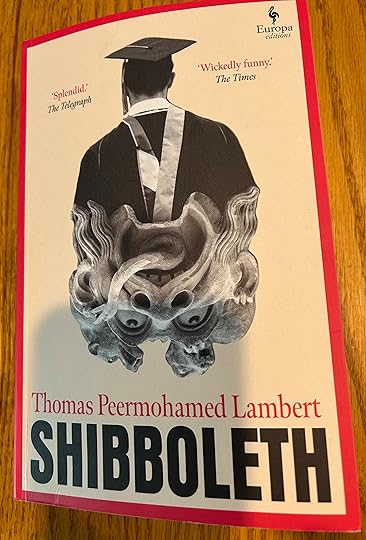
I heard of Shibboleth, by Thomas Peermohamed Lambert, because of a review at ElleThinks, a blog I recently came across because the author, upon hearing about After Kenyon, said she had considered Kenyon before picking Oxford. Shibboleth is a satiric novel set in Oxford, exaggerating the tendency of undergraduates to pick an identity and say uninformed and sometimes ridiculous things about the world based on that chosen identity.
The main character is Edward, a nondescript and “pasty white” British undergraduate who is welcomed into some of the many groups of students with ethnic identities because he can claim a grandfather from Zanzibar. There’s a funny bit of dialogue when he reveals this to an African-American student and it becomes clear that neither of them know anything about Zanzibar, including exactly where it is: “so that’s like—North Africa right?”
When Edward first meets another undergrad named Youssef Chamakh they exchange names, and Youssef parodies the way people in England and America often talk about names they haven’t heard before: “What was his? Edward? Well, he couldn’t be expected to remember that.” Later he tries to spell it: “Edward. E-D-W. What comes next? O?”
Edward is an English major, and Youssef makes the same dismissive joke that the boyfriend of a friend of mine, who was in a technical field, made when he met me: “what did he study anyway? English? . . . . I’d have assumed you spoke that already.”
Youssef tells Edward what every student is afraid of: “they’re all terrified…of saying something wrong—accidentally summoning a djinn or contradicting someone’s lived experience.”
The main topic of the satire comes into focus when Edward learns that Youssef, like almost everyone else at Oxford, is an antisemite:
“Edward was pretty sure that a vague, instinctive suspicion of Jews was something you simply had to forgive in Muslims—that anything else would be some kind of failure of cosmopolitanism, a rejection of the hand of friendship that had been so graciously offered. He decided not to take it too seriously. A lot of the more pointed references seemed to be going over his head, anyway: in truth, Edward wasn’t even sure he knew any Jews, and they had certainly never been talked about when he was growing up; they seemed like one of those things that hadn’t quite made it to his part of the country, like quinoa or Ayurvedic medicine, reserved for people who worked in law and finance and the editorial sections of all those literary magazines to which his course-mates had been given subscriptions for Christmas.”
When asked why he dislikes Jewish people, Youssef says it’s because they “want special privileges all the time. Want everyone to know they’re different….They love the idea of their own suffering….The Jew can be both aggressive and innocent, because he has suffered.”
Edward is falling for a girl from Germany named Rachel who is Jewish, and she tells him that what he is reacting to as antisemitism from his African-American friend Liberty is because “she’s doing it to be provocative, and because she has a vague sense that Jews are trying to steal something from her, some kind of credit for past persecution, and that this is somehow undeserved….and we just happen to be surrounded by a load of people who don’t seem to know anything but feel all these powerful, vague, directionless feelings and like nothing better than to sit around calling Liberty brave and me a coward on the grounds that, since I am a Jew, a private citizen is something I simply do not get to be.”
Late in the novel, Youssef says to Edward that “the IsraelPalestine controversy…is the great issue, isn’t it? The great shibboleth. The one question on which neutrality is not an option.”
Recently I complained that an American edition of a British book translated a measure of temperature, making it less immediately understandable in context. I’m now going to reverse myself by saying that I never understand what it means when I read in a British novel that someone’s weight is measured in “stones” and so I had to look it up to get the joke of a quick caricature of a woman “(bangles, lime vitamin water, twenty-eight stone).” The woman is on an undergraduate panel: “The… first topic of discussion—‘discussion’ was the favoured term, although Edward noticed very little room for audience contribution, and indeed Oscar had been equipped with a little bell, which he was to jingle any time someone from the floor made a point that threatened the carefully crafted rubric—was something called ‘culture.’ ‘Culture,’ Angelica informed them, glancing occasionally down at the programme, was just about the most precious commodity anyone could have; it was found mainly among international students and people who had at least one grandparent born overseas.”
The students are “tended to by the usual flock of waiters—a quiet, shy, uncomfortably-waistcoated bunch, most of whom would return to the council estate at the back end of College where they lived once they had put away all the silverware” and by porters and various other staff members who seem to be mostly invisible to these students. One student sleeps with “the timid cleaner of her staircase who was called in by management one day and never seen again.”
There are delightful little bits of occasional satire, contributing to the atmosphere of the whole, like when we’re told that “every term, a little flyer would appear in Edward’s pigeonhole, opening with a few paragraphs on the Chamber’s powerful social role, in these dark and uncertain and unprecendentedly censorious times: Once again, the last one had read, the Chamber remains committed to free, fair and open debate, and this is why it will no longer tolerate…”
I found the satire on target all the way through, and the ending isn’t even deflating, as the ending of many novelistic satires tend to be. Anyone who has worked in academia since 2020 will see students and situations they recognize in Shibboleth.